Roth IRA vs Brokerage Account: 5 High-Yielding Dividend Stocks You Should Never Own Outside a Roth
Certain high-yield dividend stocks quietly hand a massive cut of your income to the IRS every single year, and the account you hold them in makes all the difference. Five popular names sit at the center of a tax mistake…

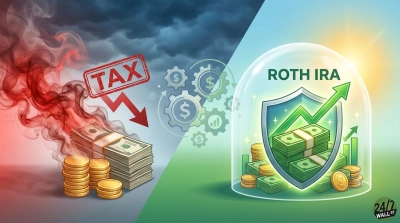
At the 24% federal bracket, a $500,000 portfolio split across five high-yield dividend stocks generates $48,400 in annual distributions. It sends $11,616 to the IRS each year when it sits in a taxable brokerage account. Inside a Roth IRA, the full $48,400 stays in the account.
The five names below pay distributions taxed mostly as ordinary income instead of at qualified-dividend rates, so they are the most expensive to keep outside a tax-advantaged account. For tax year 2026, the 24% rate applies to single filers with taxable income over $105,700 ($211,400 for joint filers).
Roth vs. Taxable: $11,616 a Year on a $500,000 Portfolio
The model puts $100,000 in each stock. Yields come from each company’s annualized dividend and its share price on October 7, 2026. All figures are rounded and cover federal tax only.
| Scenario | Gross Income | Federal Tax at 24% | Net Income |
|---|---|---|---|
| Taxable account | $48,400 | $11,616 | $36,784 |
| Roth IRA | $48,400 | $0 | $48,400 |
The Roth’s edge is $11,616 a year. Over 10 years, with no new contributions, no growth, and no reinvestment, that adds up to $116,160 in income lost to federal tax.
AGNC Investment: 17.0% Yield
AGNC Investment (NASDAQ:AGNC) pays $0.12 per share monthly, or $1.44 a year. At $8.47, that is a 17.0% yield. Mortgage REIT payouts are taxed at your marginal rate, so in a taxable account the $17,000 from this position loses $4,080 and clears $12,920. That is the largest single tax cost in the portfolio. Part of the high yield reflects a 17.23% share-price decline over the past month.
Ares Capital: 10.5% Yield
Ares Capital (NASDAQ:ARCC | ARCC Price Prediction) pays $0.48 quarterly, or $1.92 a year. At $18.35, that is a 10.5% yield. As a business development company, Ares Capital passes interest income through to shareholders as ordinary dividends. That costs $2,520 a year on $10,500 of income. Regular dividends have been stable or rising for 17 consecutive years.
Main Street Capital: 8.1% Trailing Yield
Main Street Capital (NYSE:MAIN) paid $4.32 per share over the trailing 12 months, including $0.30 quarterly supplemental dividends. At $53.54, that is 8.1%. The regular $0.265 monthly dividend alone yields 5.9%. Because the supplementals add taxable ordinary income on top of 12 monthly payments, the position’s annual tax bill comes to $1,944.
Realty Income: 6.1% Yield
Realty Income (NYSE:O) has an annualized forward dividend of $3.258, which works out to a 6.1% yield at $53.82. The company has raised its dividend for 115 consecutive quarters. REIT dividends are mostly non-qualified, so the estimated tax cost is $1,464 a year. The Section 199A deduction for REIT dividends can lower that figure for some filers. Because the payout keeps rising, the tax cost rises with it every year the shares stay in a taxable account.
Energy Transfer: 6.7% Yield
Energy Transfer (NYSE:ET) pays $0.34 per unit quarterly, or $1.36 a year, after its nineteenth consecutive quarterly increase. At $20.22, that is a 6.7% yield. Energy Transfer is the outlier on this list. Much of an MLP distribution is return of capital, which lowers your cost basis and pushes the tax into the future. That makes the $1,608 estimated tax an upper bound. In a Roth, you avoid K-1 paperwork, but unrelated business taxable income above $1,000 can trigger tax inside the IRA.
Bracket Multiplier: Top Earners Lose Up to $17,908 a Year
The same $48,400 in income costs more as your bracket rises. For 2026, single filers reach 22% above $50,400, 32% above $201,775, and 37% above $640,600 of taxable income.
| Bracket | Taxable Net Income | Roth Advantage Per Year |
|---|---|---|
| 22% | $37,752 | $10,648 |
| 24% | $36,784 | $11,616 |
| 32% | $32,912 | $15,488 |
| 37% | $30,492 | $17,908 |
Going from the 22% bracket to the 37% bracket raises the annual Roth advantage from $10,648 to $17,908 on identical holdings. State income tax would widen the gap further in most states. That is why placing these stocks in the right account matters more the higher your bracket.
Compounding Turns $11,616 a Year Into Roughly $346,000
The annual delta understates the real cost. Money that goes to taxes can never be reinvested. Say you reinvest the $11,616 annual Roth edge at a conservative 4% a year, with no share-price gains and no dividend growth:
- 10 years: about $139,000, against $116,160 without reinvestment
- 20 years: about $346,000, against $232,320 without reinvestment
The 20-year figure is about $317,000 in the 22% bracket and about $533,000 in the 37% bracket. These numbers show opportunity cost. They measure what you give up for good by keeping these five stocks outside a Roth.
Three Steps to Take Before Your Next Tax Filing
- Calculate your actual tax cost. Multiply the annual payout from each BDC and mortgage REIT held outside a tax-advantaged account by your marginal rate. Then compare the result with the Box 1a/Box 1b split on your most recent 1099-DIV.
- Start with the highest-yielding ordinary-income stocks when estimating a phased Roth conversion. AGNC and Ares Capital produce the largest tax cost per dollar invested. Weigh the one-time tax on converting them against the annual delta at your bracket.
- Treat Energy Transfer separately. Before moving the units into a Roth, check the UBTI history on your K-1 and your remaining cost basis. Its return-of-capital structure already shields much of the payout from taxes.
Watch fourth-quarter payout announcements and early-2027 tax-character reports from all five companies. They will show how much of each 2026 distribution was ordinary income, and that split determines the exact Roth advantage at your bracket.
Contact [email protected] for any questions or corrections.
Lee Jackson has covered Wall Street analysts' equity and debt research and equity strategy daily for 24/7 Wall St. since 2012. His broad, diverse career, including a stint as creative services director at an NBC affiliate in Austin, Texas, gives him unique insight into the financial industry.
Lee Jackson's journey in the financial industry spans more than 30 years, including nearly two decades as an institutional equity salesperson at Bear Stearns, Lehman Brothers, and Morgan Stanley. His career spanned pivotal sell-side Wall Street events, from the dot-com rise and bubble to the Long-Term Capital Management debacle, 9/11, and the Great Recession of 2008. This reflects his resilience and adaptability amid market volatility.
Lee Jackson’s practical financial industry experience, gained through a career at some of the biggest banks and brokerage firms, is complemented by a lifetime of writing across various platforms. This unique combination allows him to shed light on the intricacies of Wall Street in a way only someone with deep insider experience and knowledge can. Moreover, his extensive network across Wall Street continues to provide direct access for him and 24/7 Wall St., a privilege few firms enjoy.
Since 2012, Jackson’s work for 24/7 Wall St. has been featured in Barron’s, Yahoo Finance, MarketWatch, Business Insider, TradingView, Real Money, The Street, Seeking Alpha, Benzinga, and other media outlets. He attended the prestigious Cranbrook Schools in Bloomfield Hills, Michigan, and has a degree in broadcasting from the Specs Howard School of Media Arts.