Applied Optoelectronics Cratered 50% Over 6 Months: It’s Going to Triple According to 2 Wall Street Pros


Applied Optoelectronics (NASDAQ:AAOI) is priced at $76.74. Wall Street’s average price target is $160. That implies roughly 108.5% upside to where analysts think it belongs.
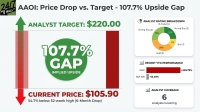
The Sugar Land, Texas company makes fiber-optic transceivers, lasers, and cable TV amplifiers. AI data center demand has made it one of the market’s most volatile hardware names. Last quarter, revenue rose 86.4% to $191.92 million. Two analysts, Michael Genovese at Rosenblatt Securities and Ryan Koontz at Needham, share a Street-high target of $220. The target points to 186.7% upside, close to a triple. The stock has fallen more than 50%, and the consensus target implies it should more than double, a gap that reflects deep disagreement over execution.
A 53% Collapse While Revenue Kept Setting Records
The biggest driver was a sector-wide unwind of high-beta AI optics trades. Over six months, AAOI lost 53.1%, and it now sits 67.2% below its 52-week high of $233.67. A beta of 3.843 amplifies every sector move. In one mid-July de-risking session, AAOI fell 12% alongside Lumentum (NASDAQ:LITE | LITE Price Prediction) and Coherent (NYSE:COHR), even though the company had no negative news of its own.
Company-specific problems added to the damage. First-quarter revenue of $151.14 million missed expectations. Third-quarter guidance included a $20 million to $25 million hit because a 100G customer can’t source switches. Over the past 90 days, the consensus Q3 EPS estimate fell from $0.2783 to $0.1433, and all six recent revisions were cuts. Dilution weighed on the stock too. Through its at-the-market offering, the company raised $538.8 million to fund $565.5 million in quarterly capital investment.
Why Two Analysts Still Back a $220 Target
Optimism here rests on demand that exceeds supply. The CEO, Thompson Lin, said customer demand runs “20% to 40% higher” than available capacity, and that capacity is pre-booked through Q2 2027. Management expects 2026 revenue of around $1.1 billion and output of more than 930,000 800G and 1.6T units per month by year-end.
The next catalyst is 1.6T. The company holds more than $200 million in 1.6T orders, and most of them should ship in the fourth quarter. Management sees Q4 gross margin of 32% to 33% and a long-term target of about 40%. Analysts expect EPS of $4.602 in 2027, up from $0.68 in 2026.
Coverage is thin and split:
- Strong Buy: 2
- Buy: 1
- Hold: 3
- Sell: 0
Recent moves lean conservative. Koontz cut his target from $260 to $220. Customer concentration is extreme: the top 10 customers made up 99% of revenue, and one CATV buyer alone accounted for 42%.
Optical Peers Sold Off Too, but AAOI Fell Hardest
The sector sold off, and AAOI took the deepest loss.
Lumentum slipped 8.1% over six months. With the stock at $822.51 and a $1,179.07 target, it offers 43.4% upside. Coverage is 5 Strong Buy, 18 Buy, and 4 Hold, which is far more confidence than AAOI gets.
Coherent fell 33.3%. It trades at $231.80 versus a $405.22 target, for 74.8% upside. Ratings are 4 Strong Buy, 15 Buy, and 5 Hold.
Fabrinet (NYSE:FN) dropped 49.2%, nearly matching AAOI. With shares at $355.48 and a $715.56 target, it implies 101.3% upside, with 7 of 9 analysts bullish.
AAOI shows the largest implied upside in the group. It also has the weakest coverage and the most volatile stock.
Down 53% While the S&P 500 Gained 9%
Over six months, AAOI lost 53.1%. Over the same stretch, the S&P 500, tracked by the SPDR S&P 500 ETF Trust (NYSEARCA:SPY), gained 9.1%. At $76.74, the company is valued at about $6.64 billion and trades at a forward P/E of 84.
The six covering analysts set an average target of $160. Take that figure with some doubt. These same analysts spent the last quarter cutting near-term estimates.
A Real Opportunity, If the 1.6T Ramp Shows Up on Schedule
The bull case for Applied Optoelectronics improves if the upcoming third-quarter report shows 800G volumes rising nearly five times sequentially, as management guided, and the 1.6T orders convert into Q4 revenue with margins expanding. In that case, $160 looks reachable.
It looks like a value trap if component shortages delay shipments, a top customer cuts orders, or further equity raises keep diluting the per-share gains. With 99% of revenue coming from 10 customers, one lost contract could undo the whole thesis.
The balance of evidence leans cautiously positive. The demand appears genuine, and the stock already prices in a lot of disappointment. Still, the $220 target needs perfect execution, so the more realistic bull case runs closer to the consensus.
Contact [email protected] for any questions or corrections.
Alex Sirois is a financial writer with experience spanning both retail and institutional investing. He has written for InvestorPlace and held roles at BNY Mellon and Bernstein, giving him a perspective that bridges Main Street portfolios and Wall Street analysis.
Alex holds an MBA from George Washington University and has built his career across multiple industries, including e-commerce, education, and translation — a breadth of experience that informs how he breaks down complex financial topics for everyday investors. His writing is conversational, actionable, and grounded in long-term, buy-and-hold investing principles.
At 247 Wall St., Alex focuses on delivering analysis that is both accessible and useful, with a clear emphasis on helping readers make more informed decisions with their money.