Defense Stocks Sank as Democrats Took Congress and the $1.5 Trillion Budget Looks Doomed
While the broader market rallied, defense contractors got hammered after the midterms flipped Congress. A massive spending request now hangs in limbo, and one number on Lockheed's chart may reveal whether Wall Street sees a ceiling or a floor.

This post may contain links from our sponsors and affiliates, and Flywheel Publishing may receive compensation for actions taken through them.
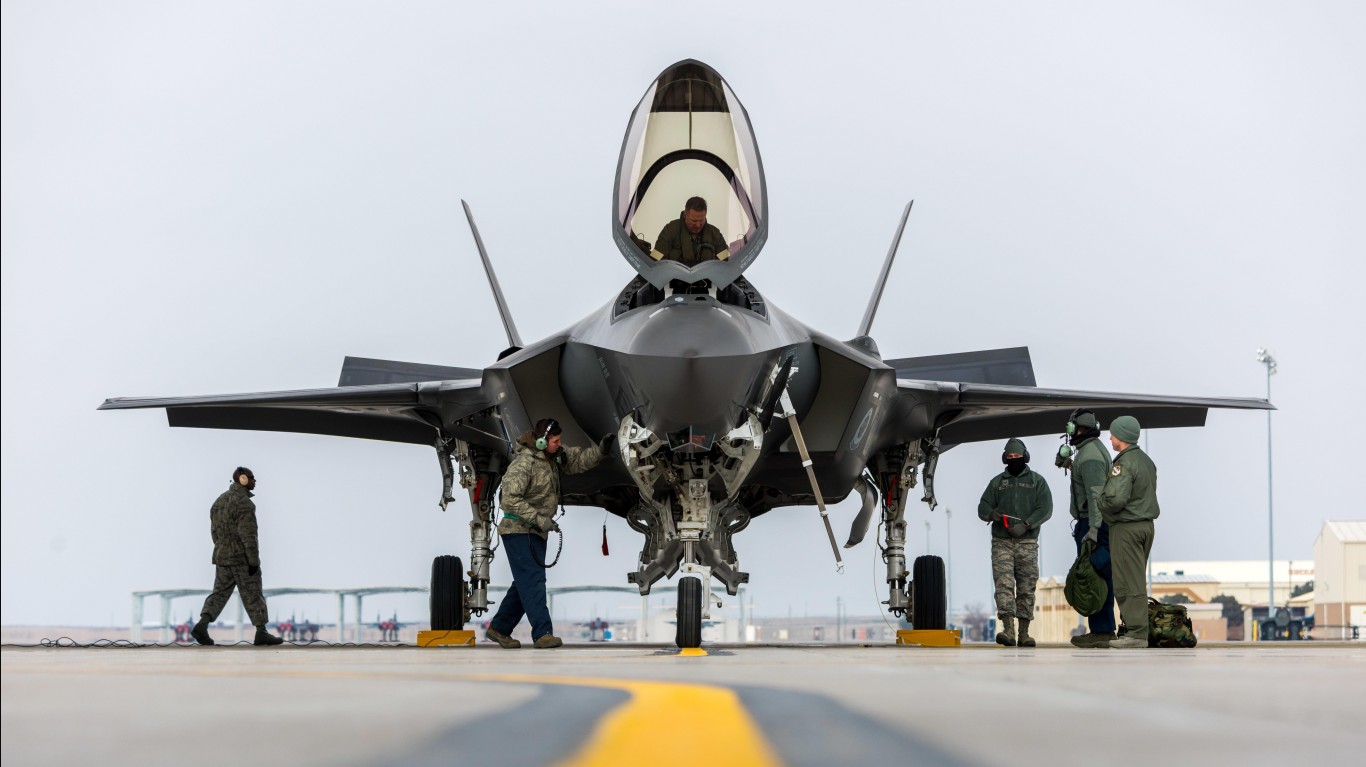
Lockheed Martin (NYSE:LMT | LMT Price Prediction) lost $43.96 per share on November 4, 2026. The 6.88% drop left it at $595.04, with a market value of $137.46 billion. It was the stock’s worst session since July 22, 2025, when it fell 10.81%.
The selloff followed Democrats’ wins in the House and Senate in the November 3 midterms. It ran counter to the rest of the market. The S&P 500 rose 1.6%, and the Dow gained 3%.
President Donald Trump asked for a $1.5 trillion military budget for fiscal 2027, far above the currently approved $901 billion. That request, along with the war with Iran, had driven the sector higher.
No budget has been decided. Analysts see the full request as out of reach, although even the lower figure they expect would still sit well above the approved level.
Pure Defense Names Took the Hardest Hit
L3Harris (NYSE:LHX) fell 6.46%, Northrop Grumman (NYSE:NOC) dropped 4.53% to $525.35, and RTX (NYSE:RTX) slid 2.64%.
The iShares U.S. Aerospace & Defense ETF (CBOE:ITA) lost just 1.54%. Its largest holding is a jet-engine maker with a 20.61% weight, and RTX is second at 17.02%. That commercial aviation exposure cushioned the fund’s decline, so it understates how far pure defense names fell.
RTX and Lockheed both reported upbeat October results and record backlogs. Still, the S&P 500 aerospace and defense sub-index is now down nearly 1% for 2026.
Three Budget Numbers That Matter
The request had two parts: a $1.15 trillion base budget and a $350 billion reconciliation piece. Reconciliation is a fast-track process. It can pass with one party’s votes, and Republican appropriators were already doubtful about a third such package in June.
The House proposed roughly $1.15 trillion, while the House GOP Pentagon spending bill came in at $1.072 trillion. Jefferies analysts expect the final budget to land closer to the House figure.
The Pentagon reportedly plans to trim its request to $1.1 trillion. That number likely overlaps with the base piece.
Analysts Name the Programs Most at Risk
TD Cowen analyst Roman Schweizer wrote that Trump-branded programs, including the Golden Dome missile shield and the Golden Fleet battleship effort, are dead. That is one firm’s view, and Golden Dome is still an active program.
Republican Senator Thom Tillis said on November 3 that Defense Secretary Pete Hegseth’s strained relations with lawmakers were undermining the push for the full package, with 60 days left in this Congress. Trump said he is not considering replacing Hegseth.
Lockheed’s backlog can still buy time.
Democrats take control when the new Congress is sworn in, and Trump keeps his veto. Lockheed also carries a record $292 billion backlog, and its seven-year PAC-3 deal includes a recovery mechanism if Congress cuts the agreed volumes.
What the Budget Fight Means for LMT Stock
A budget near $1.15 trillion would still lift Lockheed’s spending base well above the approved level. Missile defense sits near the top of any funding list.
The risk is multiple compression, which means investors pay less for each dollar of earnings as the peak-budget story fades. That risk is real because the stock still closed about 16.8% above its September 30 close of $509.25.
Guggenheim analyst Michael Ciarmoli started coverage with a Buy rating and a $735 target. The $3.45 quarterly dividend, with the next ex-date expected December 1, pays holders while Congress works out the budget.


Northrop’s nuclear work sits among the programs least exposed to cuts, so watch the short-term funding bill Congress is likely to pass in December. If Lockheed closes below $509.25 before the possible March fight over full-year funding, the market is viewing the base budget as a ceiling.
Contact [email protected] for any questions or corrections.
Omor Ibne Ehsan is a writer at 24/7 Wall St. He is a self-taught investor with a focus on growth, cyclical, and dividend equities that have strong fundamentals, value, and long-term potential. He also has an interest in high-risk, high-reward investments such as penny stocks.