How These Growth Stories Became Cautionary Debt Tales: CoreWeave Vs. Nebius
Both AI cloud darlings posted triple-digit growth and sold-out GPUs, yet their stocks have plunged about 40% in a month. The real divide is who pays for the buildout: lenders, customers, or shareholders.

This post may contain links from our sponsors and affiliates, and Flywheel Publishing may receive compensation for actions taken through them.
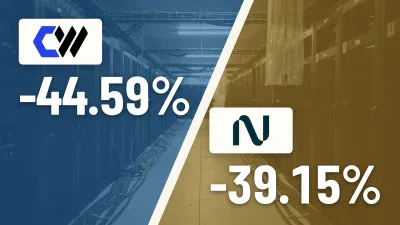
CoreWeave (NASDAQ:CRWV) and Nebius Group (NASDAQ:NBIS | NBIS Price Prediction) both reported Q2 2026 earnings in August. Each showed triple-digit revenue growth and sold-out GPU capacity. Three months on, investors are asking how each one pays for that growth. CoreWeave trades at $48.42, down 44.59% in a month. Nebius is at $141.52, off 39.15%.
Record Demand Arrived With Record Interest Bills
CoreWeave posted Q2 revenue of $2.575 billion, up 112.3% YoY, and its backlog reached $104.2 billion. Demand is real. Interest expense hit $640 million, though, against adjusted operating income of $128 million. That means lenders collected more than the business earned from operations.
CEO Michael Intrator called the quarter “an important inflection point.” I have questions. The net loss widened to $626 million from $290 million, and management forecast next-quarter interest to $860 million to $940 million.
Nebius grew faster from a smaller base. Revenue rose 454.04% to $582.3 million, and group adjusted EBITDA margin reached 41%, which points to real pricing power. Interest expense jumped to $119.1 million from $4.8 million after heavy convertible issue. Three customers also supplied 24%, 21% and 14% of revenue, so losing even one of them would hurt.
| Lens | CoreWeave | Nebius |
|---|---|---|
| Total debt | $51.608B | $10.056B |
| Cash | $6.397B | $8.042B |
| Main funding driver | Term loans, bonds, convertibles | Prepayments, convertibles, share sales |
CoreWeave Borrows While Nebius Taps Customers and Shareholders
CoreWeave raised about $18 billion in the quarter and cut its weighted cost of debt by almost 300 basis points. That cut helps, but the CFO admits the cost of each build is “front-loaded.” Its debt load only works if new clusters start generating revenue on schedule.
Nebius leans on prepayments. About 70% of Q2 deals included upfront cash, and management expects prepayments to top $9 billion this year. It also sold 12.7 million shares for roughly $2.8 billion, which diluted existing holders. CEO Arkady Volozh said Nebius “could sell today our entire 2027 capacity” but is holding some back for short-term deals at $40 million to $50 million per megawatt. Holding capacity back pays off only while GPUs stay scarce.
Washington and Q3 Results Will Test Both Models
Data-center stocks slid as a blue wave raised the prospect of more scrutiny. CoreWeave, which reports earnings soon, forecast Q3 adjusted operating income of $200 million to $260 million. One key question is whether operating profit starts to catch up with interest costs. For Nebius, keep an eye on whether the big Q2 deals start coming online from late Q4 as promised.
Why Nebius Has More Balance Sheet Breathing Room
Both companies have signed contracts behind their growth. For me, leverage is what separates them. CoreWeave’s debt-to-equity ratio is 8.94. Nebius holds $10.34 billion of equity against $17.62 billion of total liabilities. Nebius owners pay through dilution. CoreWeave owners stand behind a long line of lenders.
If CoreWeave reaches the low-teens adjusted operating margin it targets for Q4, the leverage comparison could shift. Until then, Nebius has the stronger balance sheet of the two, as long as GPU shortage continues into 2027.
Contact [email protected] for any questions or corrections.
Alex Sirois is a financial writer with experience spanning both retail and institutional investing. He has written for InvestorPlace and held roles at BNY Mellon and Bernstein, giving him a perspective that bridges Main Street portfolios and Wall Street analysis.
Alex holds an MBA from George Washington University and has built his career across multiple industries, including e-commerce, education, and translation — a breadth of experience that informs how he breaks down complex financial topics for everyday investors. His writing is conversational, actionable, and grounded in long-term, buy-and-hold investing principles.
At 247 Wall St., Alex focuses on delivering analysis that is both accessible and useful, with a clear emphasis on helping readers make more informed decisions with their money.