CoreWeave’s Demand is There, $41.6B of Corporate Debt Remains: What This Means for Nebius and CoreWeave

This post may contain links from our sponsors and affiliates, and Flywheel Publishing may receive compensation for actions taken through them.
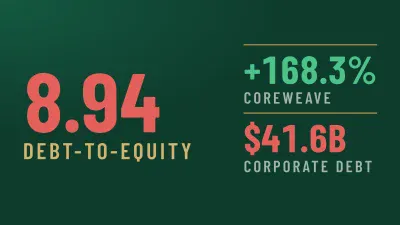
CoreWeave (NASDAQ:CRWV) and Nebius Group (NASDAQ:NBIS | NBIS Price Prediction) reported third-quarter results two days apart. Both say demand for AI compute is greater than the capacity they can bring online. CoreWeave posted revenue of $3.66B, up 168.3%. Nebius posted $980.8M, up 571.3%. The two diverge on the balance sheet. CoreWeave carries $41.6B of corporate debt.
CoreWeave Sells Out Its Capacity While Nebius Waits on Power
CoreWeave says qualified demand is 10 times available capacity through the end of 2027. It raised prices approximately 25% in July and another 10% later in the quarter. Adjusted operating margin reached 10% a quarter ahead of plan. Debt is the cost of that growth. $846M of net interest expense helped drive a $709M GAAP net loss.
Nebius had a rockier quarter. About $325M of revenue came from a non-recurring asset-light deal, which makes the headline look bigger than the recurring business. Colocation delays in New Jersey pushed 2026 revenue to the low end of $3.0-$3.4B. Prices rose more than 20% per GPU-hour from Q2, and Databricks, Datadog (NASDAQ:DDOG) and Snowflake (NYSE:SNOW) signed multi-year deals.
| Metric | CoreWeave | Nebius |
|---|---|---|
| Q3 Net Loss | $709M | $37.5M |
| Cash | $4.12B | $7.43B |
| 2026 Capex Guide | $37-$39B | ~$27B |
| Demand Signal | ~$132.5B backlog | $12B+ signed since Q3 began |
Customer Prepayments Are Taking the Place of Bonds
CoreWeave’s CFO told analysts that “we will not use the unsecured debt market to fund our business at current yields, nor do we need to.” Management expects less than $5 billion of parent-level capital through 2027. Another approximately $9 billion in prepayments and deposits should arrive in the next three months. That helps, but a debt-to-equity ratio of 8.94 leaves shareholders with a thin buffer.
Nebius CEO Arkady Volozh said “prepayments on Q3 agreements covered more than 100% of the associated capex.” On paper, that is the cleaner funding model. Even so, operating cash flow came in at -$273M, and the company added $5.75B in convertible notes. Dilution is a risk for both. CoreWeave’s ATM program covers up to 35M shares.
Renewals and Company-Owned Sites Will Show Who Executes Better
CoreWeave’s renewals bear watching. More than 130,000 GPUs come off contract in 2027, and management says renewing them could add approaching $4 billion of annualized revenue with no new capex. In the meantime, Q4 interest expense is guided to $1.05-$1.15B. For Nebius, keep an eye on whether its own sites in Missouri, Alabama and Finland can deliver $12-$13B of 2027 revenue and pre-tax breakeven in Q4 2027.
Nebius’s Stronger Balance Sheet Could Outlast CoreWeave’s Scale Advantage
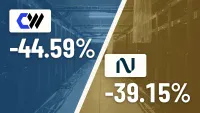
Investors punished Nebius more on Thursday. Its shares fell 16.84% to $128.64, while CoreWeave fell 6.86%. I think that reaction focuses on a timing problem and misses a more lasting advantage. Nebius has more cash, a much smaller loss and $12.30B of shareholders’ equity. CoreWeave has the bigger backlog, but interest costs absorb much of its operating profits. If CoreWeave’s renewals come through and interest expense stops rising, its balance-sheet risk would ease. Until then, CoreWeave carries the greater leverage, while Nebius has the stronger funding position against the same demand. Both names sit at the chip layer of the buildout; the power, thermal, and connectivity suppliers downstream of them are a separate trade we mapped out in a free report on seven AI infrastructure stocks that aren’t chipmakers.
Contact [email protected] for any questions or corrections.
Alex Sirois is a financial writer with experience spanning both retail and institutional investing. He has written for InvestorPlace and held roles at BNY Mellon and Bernstein, giving him a perspective that bridges Main Street portfolios and Wall Street analysis.
Alex holds an MBA from George Washington University and has built his career across multiple industries, including e-commerce, education, and translation — a breadth of experience that informs how he breaks down complex financial topics for everyday investors. His writing is conversational, actionable, and grounded in long-term, buy-and-hold investing principles.
At 247 Wall St., Alex focuses on delivering analysis that is both accessible and useful, with a clear emphasis on helping readers make more informed decisions with their money.