3 Dividend Aristocrats Wall Street Analysts Like Most
Decades of rising payouts earned these three stocks a place among the Dividend Aristocrats, but Wall Street's opinions on them could not be more different. One has near-unanimous praise, one has fallen hard, and one has analysts split down the…

This post may contain links from our sponsors and affiliates, and Flywheel Publishing may receive compensation for actions taken through them.

A long dividend streak shows a company’s record. Analyst ratings show how Wall Street views what comes next. Three Dividend Aristocrats pair decades of rising payouts with strong analyst support and fresh operating results: Linde (NASDAQ:LIN | LIN Price Prediction), Caterpillar (NYSE:CAT) and Chubb (NYSE:CB). Linde has the most bullish following of the three, with 6 Strong Buy and 17 Buy ratings against a single Sell. All three offer modest yields. Each one pays out a modest share of its earnings, which gives the dividend lot of room to keep growing for retirement income.
Linde: Wall Street’s Favorite Aristocrat Runs on Contracted Cash
Linde pays a quarterly dividend of $1.60, or $6.40 annualized. At a share price of $511.04, that works out to a forward yield of about 1.25%. Analysts give the stock 6 Strong Buy, 17 Buy, 5 Hold and 1 Sell ratings. Their consensus target of $550.85 sits about 7.8% above the current price.

Dividend safety: Linde paid $6.30 in dividends over the trailing 12 months against diluted EPS of $15.06, a payout ratio near 41.8%. Third-quarter operating cash flow reached $3.17 billion (+8%). Free cash flow came to $1.78 billion after $1.39 billion of capex, and the company returned $1.69 billion to shareholders in the quarter. The CFO summed up the approach: "Balance sheets and cash flow matter." Linde is a member of the S&P 500 Dividend Aristocrats index. Its dividend records show the quarterly payment rising every year, from $0.875 in 2019 to $1.60 in 2026.
Bull case: Industrial gas contracts tend to produce steady revenue, and Linde’s growth pipeline is getting bigger. The project backlog totals $11.00 billion, including $7.9 billion of contractual sale-of-gas projects. Electronics sales grew 15%, and the CEO said, "I fully expect to see electronics growth in the double-digit rate going forward." Management guides full-year adjusted EPS to $17.82 to $17.92, and analysts value the stock at a forward P/E of about 26. For income investors, this means a dividend backed by a growing stream of long-term contracts.
Risk analysts may be underweighting: Lincare, Linde’s home care unit, is a drag. Linde took a $425 million restructuring charge, mostly linked to severance and Lincare, and GAAP diluted EPS fell to $3.66 (down 11% YoY). Management also said Europe has "no catalyst" at this point.
Caterpillar: Biggest Gap Between Price and Analyst Targets
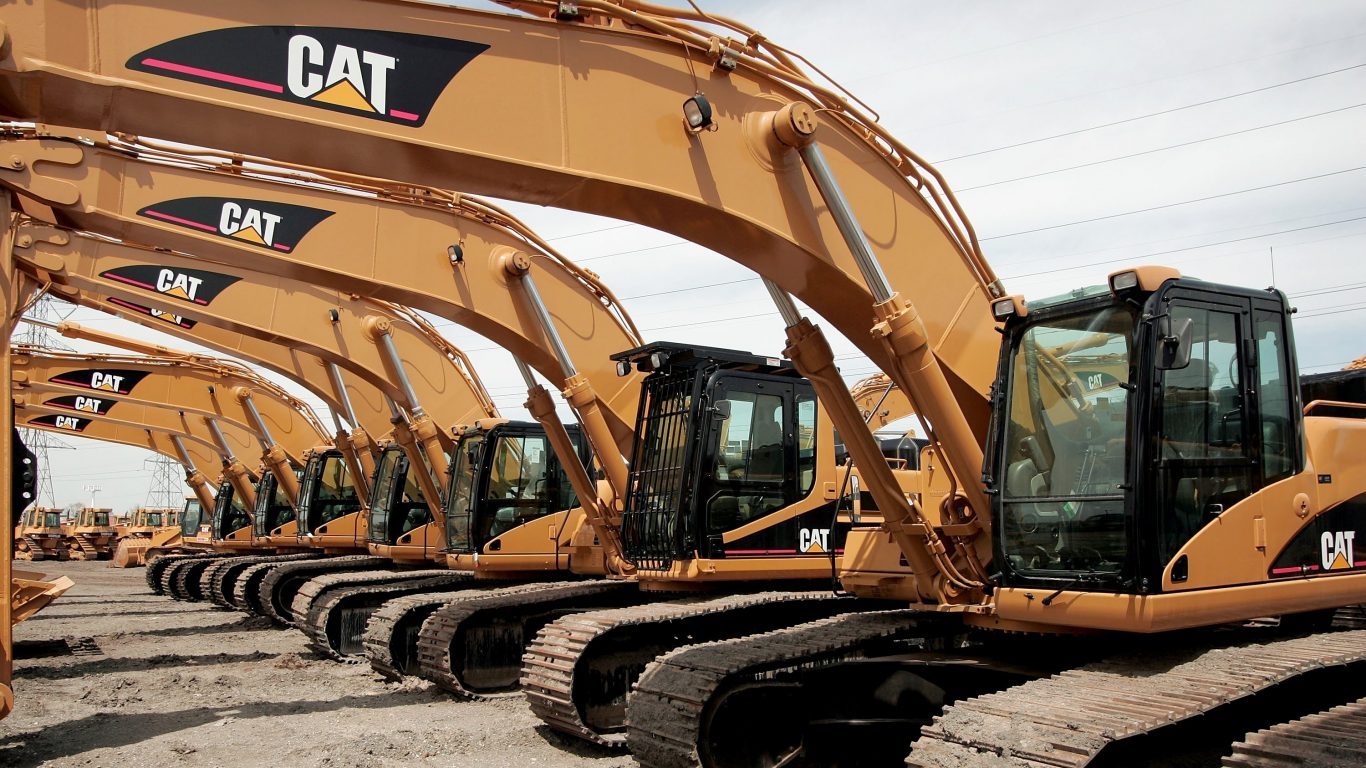
Caterpillar raised its quarterly dividend to $1.63 from $1.51, bringing the annualized payout to $6.52. At $572.81 a share, the forward yield is about 1.14%. Analysts rate the stock 2 Strong Buy, 15 Buy, 11 Hold and 1 Sell, and their consensus target of $823.41 is about 43.7% above the current price. That gap opened after a sharp drop. Shares are down 33.5% over the past month and trade far below their 52-week high of $1,068.93.

Dividend safety: Caterpillar has the best-documented streak in this group. The CFO said "this year will mark 33 consecutive years of paying higher annual dividends to our shareholders," and this is the sixth consecutive year of a high-single-digit quarterly dividend increase. Trailing dividends of $6.28 equal about 24.6% of TTM EPS of $25.48. In the third quarter, machinery, power and energy (MP&E) free cash flow came to $3.8 billion, while the dividend cost nearly $750 million. Enterprise cash was at $7.9 billion, and management plans to "return substantially all of our MP&E free cash flow to our shareholders through dividends and share repurchases over time."
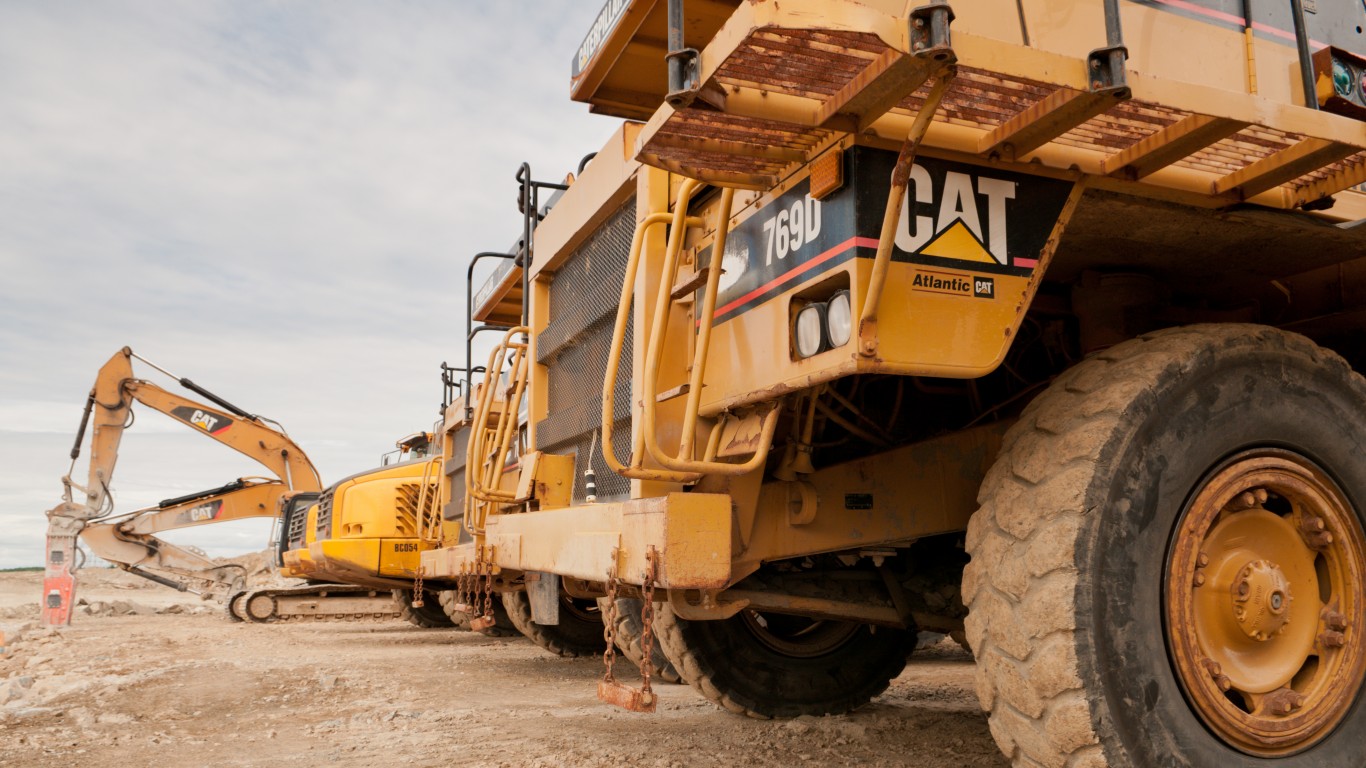
Bull case: Demand from data centers has changed Caterpillar’s story. Backlog hit a record $78 billion, up 96% from a year earlier. Power generation sales to users grew 75%, and turbine orders now run into 2030. Third-quarter revenue rose to $20.68 billion (+17.3% YoY), and adjusted EPS of $7.20 beat the $7.04 estimate. At a forward P/E of about 19, investors get a payout that has been rising quickly, backed by years of booked orders.
Risk analysts may be underweighting: Tariffs are a real cost. Management expects full-year tariff costs of about $2.2 billion, not counting IEEPA tariff refunds, and the adjusted operating margin is expected to land near the bottom of the target range.
Chubb: Most Coverage, Most Divided Analysts
Chubb raised its quarterly dividend to $1.02 from $0.97, for an annualized payout of $4.08. At $371.24, that is a forward yield of about 1.10%. Analysts are the most split on this name: 2 Strong Buy, 7 Buy, 13 Hold and 3 Strong Sell. Their consensus target of $373.22 sits only about 0.5% above the price, after shares gained 32.67% over the past year. Even so, Chubb’s forward P/E of about 13 is the lowest of the three.
Dividend safety: Chubb covers its dividend more comfortably than any other stock in this group. Trailing dividends of $3.98 equal about 14% of TTM EPS of $28.53. Third-quarter dividends cost $393 million, compared with core operating earnings of $2.98 billion. Adjusted operating cash flow over nine months set a record at $12.8 billion. Chubb is listed in the S&P 500 Dividend Aristocrats as of January 2026, and its records show a higher regular quarterly payment every year from 2016 through 2026.
Bull case: Chubb makes money from both underwriting and investing. The combined ratio came in at 84.1%, which means underwriting is solidly profitable. Adjusted net investment income hit a record $1.89 billion on more than $175 billion of invested assets. New money is being invested at 6.2%, above the portfolio’s 5.2% yield, so investment income has room to keep rising. The CEO called Chubb "a consistent compounder of wealth and an all-weather firm."
Risk analysts may be underweighting: Soft pricing is slowing growth. Total P&C premiums rose just 1.9%, and North America Commercial premiums fell 2.7% as Chubb pulled back from underpriced property and financial lines. If that weakness spreads into casualty, growth in book value and in the dividend could slow.
Analyst Backing Plus Low Payout Ratios Keep These Raises Coming
Linde gets the strongest analyst support, Caterpillar has the widest gap between its price and analyst targets, and Chubb has the deepest earnings cover for its dividend. All three pay out well under half of their earnings, leaving room for increases to keep coming. This series has looked at Aristocrats from several angles, and the takeaway for retirement income remains the same: a dividend that rises reliably every year, backed by cash flow, matters more than a high starting yield (we ranked ten more long-streak payers by valuation in a free Dividend Kings report). Analysts are pointing investors to these three names as candidates for that kind of income.
Contact [email protected] for any questions or corrections.
Lee Jackson has covered Wall Street analysts' equity and debt research and equity strategy daily for 24/7 Wall St. since 2012. His broad, diverse career, including a stint as creative services director at an NBC affiliate in Austin, Texas, gives him unique insight into the financial industry.
Lee Jackson's journey in the financial industry spans more than 30 years, including nearly two decades as an institutional equity salesperson at Bear Stearns, Lehman Brothers, and Morgan Stanley. His career spanned pivotal sell-side Wall Street events, from the dot-com rise and bubble to the Long-Term Capital Management debacle, 9/11, and the Great Recession of 2008. This reflects his resilience and adaptability amid market volatility.
Lee Jackson’s practical financial industry experience, gained through a career at some of the biggest banks and brokerage firms, is complemented by a lifetime of writing across various platforms. This unique combination allows him to shed light on the intricacies of Wall Street in a way only someone with deep insider experience and knowledge can. Moreover, his extensive network across Wall Street continues to provide direct access for him and 24/7 Wall St., a privilege few firms enjoy.
Since 2012, Jackson’s work for 24/7 Wall St. has been featured in Barron’s, Yahoo Finance, MarketWatch, Business Insider, TradingView, Real Money, The Street, Seeking Alpha, Benzinga, and other media outlets. He attended the prestigious Cranbrook Schools in Bloomfield Hills, Michigan, and has a degree in broadcasting from the Specs Howard School of Media Arts.