Wall Street’s AI Crash Just Hit Asia: Korea Halted, Japan in a Bear Market
Two memory chip makers drive one Korea fund, and Wall Street's AI selloff just hammered both before Asia even opened. Why did one ETF fall twice as hard as its Japan rival, and what would prove the panic is over?

This post may contain links from our sponsors and affiliates, and Flywheel Publishing may receive compensation for actions taken through them.
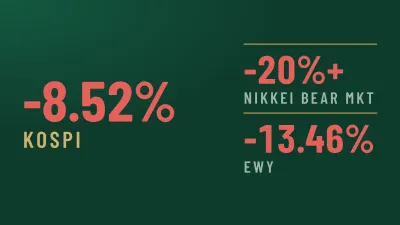
South Korea’s KOSPI fell 8.52% by 9:03 a.m. local time on November 6, 2026, dropping to 4,924.61 and triggering a 20-minute trading halt. In Tokyo, the Nikkei fell more than 20% below its June peak during the session. A 20% drop from a peak is the usual definition of a bear market.
The selling started in New York on November 5. That day, the S&P 500 fell 4.4%. The PHLX Semiconductor Index dropped 12.25%, driven by concerns that costly borrowing and Democrats’ midterm wins could slow AI data center construction. iShares MSCI South Korea ETF (NYSEARCA:EWY) fell 13.46% to $131.65. iShares MSCI Japan ETF (NYSEARCA:EWJ) lost 5.97% to $88.26. Neither close includes the Asian session, so both funds take on that move when New York reopens.
What Korea’s Halt and Japan’s Bear Market Actually Mean
A circuit breaker is a required trading pause after an index falls by a set amount, and a sidecar is a shorter pause on program trading only. Korea triggered both, with the sidecar at 9:34 a.m. This was the 11th first-level circuit breaker of the year, so these halts now happen often in Korea.
By 11:14 a.m., the KOSPI had climbed back to 5,123.41. That was still 4.84% below its 5,383.80 close. By our calculation, the index sat about 45% below its 52-week high of 9,385.59 for those who bought into the Korea rally. That is a deep loss for anyone.
Japan’s bear market came during the session, and the close is what makes it official. The Nikkei bottomed at 56,745.81 and was at 57,583.76 at 11:18 a.m. By our math, the 20% line sits near 58,265, so a close above that level would remove the bear market label.
Why EWY Fell So Much Harder Than EWJ
Two companies make up much of EWY. In its August 31 holdings, Samsung Electronics accounted for about 22.1% of net assets, and SK hynix about 21%. On the morning of November 6, they fell 10.07% and 12.26%. With that much weight in two memory chip makers, EWY moves like a concentrated position in AI memory demand.
EWJ spreads its money more widely. Advantest fell about 12%, and Tokyo Electron fell nearly 9%, but each made up under 3% of the fund.
Taiwan, the third market in the AI hardware supply chain, moved similarly. TSMC (NYSE:TSM | TSM Price Prediction) opened about 9.8% lower at NT$2,020 and recovered to NT$2,120 by 10:13 a.m.
Officials Spoke, but Nothing Was Activated
Finance Minister Lee Hyoung-il, also Deputy Prime Minister, said the government will act against excessive volatility and prepare measures in advance. He also said Korea’s fundamentals remain solid. Korea has not used its stock market stabilization fund or a temporary short-selling ban.
Prime Minister Sanae Takaichi told parliament she knew AI and chip stocks were falling sharply, but she said she could not tell whether the drop was temporary, and she announced no measures.
There were signs of relief: Nasdaq 100 futures were up 1.20% at 9:19 p.m. ET on November 5, and the KOSPI recovered well off its low.
What EWY’s Chip Concentration Means for Investors Now
The risks for EWY look greater than the rebound case, even though the bull case is that forced selling and trading halts often mark short-term lows. Even so, EWY was still up 35.41% for the year on November 5, despite a 29.37% drop over the prior month.
That leaves a lot of gains that could still disappear. The fund also depends on two companies that face the same risks behind this selloff: expensive borrowing and possible political pauses on data center building. Riding an AI-driven rally is one problem. Knowing when to step aside is another, and we wrote a free handbook on exactly that half of the trade: here.
EWJ is the stronger fund, but its chip equipment holdings fell for the same reasons, although its holders face a smaller problem.
A more diversified comparison is Vanguard FTSE Developed Markets ETF (NYSEARCA:VEA). It holds Japan and Korea alongside Europe, Canada and Australia, so one pair of memory chip stocks has far less influence on the fund’s returns. This view would be wrong if the KOSPI closes back above 5,383.80 without help from a stabilization fund or a short-selling ban.
Contact [email protected] for any questions or corrections.
Omor Ibne Ehsan is a writer at 24/7 Wall St. He is a self-taught investor with a focus on growth, cyclical, and dividend equities that have strong fundamentals, value, and long-term potential. He also has an interest in high-risk, high-reward investments such as penny stocks.