Wall Street Is Dumping AI Stocks Even as Business Booms. Something Doesn’t Add Up.
Both AMD and Palantir just posted record quarters, yet both stocks are sinking. For a retirement portfolio with no dividends to cushion the blow, one metric decides which AI name deserves your money, and it might not be growth.

This post may contain links from our sponsors and affiliates, and Flywheel Publishing may receive compensation for actions taken through them.
Advanced Micro Devices (NASDAQ:AMD | AMD Price Prediction) or Palantir (NASDAQ:PLTR): which AI stock better suits a portfolio built for retirement? Both companies just reported record quarters, and both stocks are falling anyway. AMD shares lost 30.47% over the past month to $449.04. Palantir fell 17.38% to $160.38, even after Friday’s rebound from what MarketWatch called a “violent” selloff in chip stocks.
Worries about huge AI spending commitments, debt financing and high valuations started the selling. Once institutions began cutting exposure, leverage and options hedging could have made the decline feed on itself without any deterioration in fundamentals. No one can yet say how much of the drop came from forced deleveraging. The filings do show that both businesses are speeding up.
Valuation: AMD Gives You Far More Cushion
Palantir carries multiples of 228 times earnings, 50.08 times book value and 176.12 times free cash flow. Its earnings yield is 0.44%. AMD is expensive too at 109.97 times free cash flow and 11.69 times book, but its earnings are catching up to the share price. Non-GAAP EPS of $2.09 rose 74%, faster than revenue growth of 45%, and beat estimates by 7.92%. Palantir’s multiple only works if it performs perfectly for years. Winner: AMD.


Growth Trajectory: Palantir Is Growing Faster
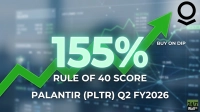
Palantir’s third-quarter revenue rose 95.9% to $2.313 billion. Executives called it “the highest growth rates we’ve ever delivered as a public company.” U.S. commercial revenue jumped 148% to $984 million and exceeded U.S. government revenue for the first time. Net dollar retention reached 165%, and full-year guidance rose for the third straight update to $8.530 billion to $8.534 billion, or 91% growth.
AMD is accelerating too. Data Center revenue rose 97% to $8.546 billion, fourth-quarter guidance calls for about $17 billion in revenue, and CEO Lisa Su expects revenue to grow more than 80% in 2027. Palantir is already posting that kind of growth, with gross margins of 82.4%. Winner: Palantir.


Volatility and Risk: Palantir’s Balance Sheet Is Stronger
AMD’s record quarter had weak spots. Operating cash flow fell 44.33% to $1.2 billion, free cash flow dropped 70.86% to $554 million, and inventory rose 35% sequentially to $11.46 billion. Total debt reached $7.08 billion after an August notes offering, and a $1,097M customer warrant charge pulled GAAP EPS down to $1.46.
Palantir has a debt-to-equity ratio of 0.031, holds net cash and has $10.4 billion in cash and Treasuries. It generated $1.216 billion of adjusted free cash flow in the quarter, and its one-month decline was smaller than AMD’s. There are still risks to track: stock-based compensation rose to $318.9 million from $172.3 million, and total contract value grew just 6%. Winner: Palantir.


Verdict: AMD Fits a Retirement Portfolio Better
Palantir wins two of the three rounds. Valuation is the round that matters most for someone in retirement, though, and AMD wins it. Both companies give up dividends, so all of the return has to come from share price gains. That makes the price you pay the main protection against loss.
Palantir shows how a valuation correction can hit even excellent results. Its stock is down 9.77% this year while revenue grew at a 95.9% clip. AMD is up 109.68% year to date because its earnings are growing into its valuation.
Su put the demand picture simply: “We do have more demand than we have supply.” Customers including Anthropic, Meta, Microsoft, OpenAI, and Oracle are bringing Helios racks online. AMD’s cash flow dip comes from building inventory to fill those orders. That is a working-capital cost of growing fast, and the business itself remains intact.
On these metrics, AMD’s profile lines up more closely with retirement-focused priorities. Palantir suits younger growth investors with decades to wait out a correction and the stomach for a stock priced at 228 times earnings. AMD’s faster-rising earnings and lower valuation are the more relevant factors to research for investors looking to avoid a multiple collapse.
Contact [email protected] for any questions or corrections.
After two decades of patrolling the dark corners of suburbia as a police officer, Rich Duprey hung up his badge and gun to begin writing full time about stocks and investing. For the past 20 years, he’s been cruising the markets looking for companies to lock up as long-term holdings in a portfolio while writing extensively on the broad sectors of consumer goods, technology, and industrials. Because his experience isn’t from the typical financial analyst track, Rich is able to break down complex topics into understandable and useful action points for the average investor. His writings have appeared on The Motley Fool, InvestorPlace, Yahoo! Finance, Money Morning, and, of course, 24/7 Wall St. He has been featured in both U.S. and international publications, including MarketWatch, Financial Times, Forbes, Fast Company, and USA Today.