2 Chemical Giants Cut Their Dividends. This Third Stock Kept Raising
Overcapacity, Middle East turmoil, and shaky margins have forced some chemical makers to shrink the checks they send shareholders. Retirees chasing yield in this sector face one question: whose payout is built on cash flow, and whose still carries risk?

This post may contain links from our sponsors and affiliates, and Flywheel Publishing may receive compensation for actions taken through them.
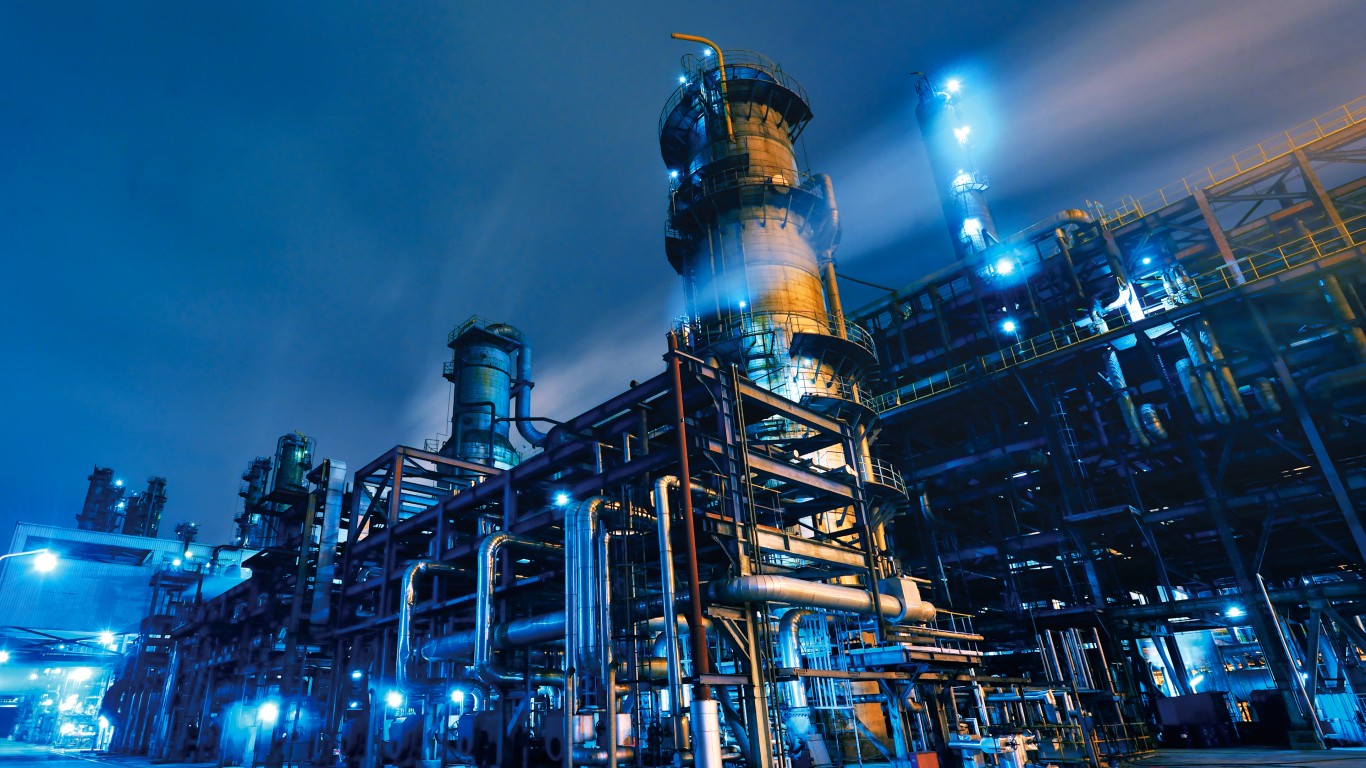
Chemical manufacturers have been stuck in a long period of petrochemical overcapacity. The Middle East conflict has added feedstock, freight, and pricing swings on top of that. A strong rebound this year still leaves Dow (NYSE:DOW | DOW Price Prediction) shares 29.32% below where they traded five years ago. For income investors close to retirement, the question is which of these producers can keep paying shareholders while the cycle plays out.
The three below still pay every quarter, and each is running a cost or cash program to protect that payout. Two of them reset their dividends to levels cash flow can support. The third has kept raising.
| Company | Recent Price | Dividend Yield | Quarterly Dividend | Forward P/E |
|---|---|---|---|---|
| LyondellBasell (NYSE:LYB) | $60.72 | 5.58% (trailing) | $0.69 | 9x |
| Dow | $31.40 | 4.38% | $0.35 | 17x |
| Eastman Chemical (NYSE:EMN) | $64.40 | 5.11% | $0.84 | 10x |
LyondellBasell Industries: Top Yield in the Group, Rebuilt on Cash Flow
LyondellBasell makes the basic plastics used in packaging, pipe, and auto parts: ethylene, propylene, polyethylene, and polypropylene. It also makes oxyfuels for gasoline blending and is the largest licensor of polyethylene and polypropylene technologies. Recently priced at $60.72, the stock has a trailing yield of 5.58%, the highest of these three high-yield names.
The dividend history matters for evaluating safety. LyondellBasell raised its regular quarterly dividend each year, from $1.05 in 2020 to $1.37 in 2025. It then reset the payout to $0.69 starting with the March 2026 payment. The trailing yield still includes one $1.37 payment, so the current-rate yield is lower. In exchange, the cut bought solid coverage.
Third-quarter free cash flow came in at $1.4 billion, compared with $224 million in dividends paid. The company ended the quarter with $3.2 billion in cash and $7.7 billion in available liquidity. Trailing EPS of $4.13 sits above the $3.44 in dividends per share paid over the past year. Management repaid a €500 million note in September and plans to repay $900 million in the first quarter.
The bull case rests on a diversified business and tight cash discipline. Intermediates and Derivatives posted record EBITDA of $795 million, more than double the prior quarter, helped by strong oxyfuels margins and the Bayport PO/TBA restart. Over the past 12 months, LyondellBasell turned about 84% of EBITDA into operating cash. The company is also working toward a $500 million cash improvement goal. Selling its former Houston refinery site for $320.5 million should improve cash flow by $50 million to $100 million a year. CFO Agustin Izquierdo spelled out the priorities: “Investment grade is very important, making sure net leverage comes down, maintenance on our assets to run them safely and reliably, dividend growth and eventually buybacks to offset dilution.”
The biggest worry is that margins return to normal. Olefins and Polyolefins Americas EBITDA fell to $641 million from $1.27 billion in the prior quarter as polymer prices eased. Europe’s operating rate is guided to only 60% in the fourth quarter. Adjusted EPS of $2.54 missed the $2.59 estimate, and the stock fell 11.54% in the week after the earnings report.
Dow: A Smaller Payout With a Massive Liquidity Cushion
Dow is a commodity chemical giant. Its largest business sells polyethylene used in food packaging, films, and containers, and it also makes industrial intermediates, silicones, and coating materials. The shares yield 4.38% at $31.40, based on a $0.35 quarterly dividend, or $1.40 a year. The next payment goes out December 11, 2026, to holders of record on November 30, 2026.
Dow’s dividend record in its current corporate form starts with a $0.70 quarterly payment in May 2019. It held that rate through May 2025, cut it to $0.35 starting with the August 2025 payout, and has paid $0.35 every quarter since. Trailing diluted EPS is -$1.29, so free cash flow carries the payout. Third-quarter free cash flow reached $1.1 billion, following $692 million in the second quarter, compared with about $253 million in quarterly dividends. Dow has about $14 billion in liquidity and no substantial debt due dates until 2029. It bought back about $300 million of debt in the third quarter and plans about $200 million more in the fourth.
Self-help gives the bull case real weight. Dow expects about $1.3 billion in net benefits from its Transform to Outperform program this year and another $1.3 billion in 2027. CEO Karen S. Carter described the 2027 tailwinds as “firmly in our control.” Third-quarter net sales rose 13% year over year, with growth in every segment.
Polyethylene price increases of $0.07 per pound in October and $0.05 per pound in November could add about $200 million of upside to fourth-quarter EBITDA guidance of about $1.5 billion. CFO Jeffrey L. Tate expects cash conversion of 70% to 80% through next year.
The catch is the cycle. Trailing earnings are negative, and the forward P/E is 17, the highest of the three, so Dow’s coverage depends on polyethylene prices holding up. Ongoing overcapacity, high European energy costs and weak housing demand could undo those gains.
Eastman Chemical: Still Raising Its Dividend Through the Slump
Eastman Chemical is a specialty materials manufacturer based in Kingsport, Tennessee. It makes advanced materials, chemicals, and fibers used in cars, consumer durables, and packaging. The stock yields 5.11% at $64.40, based on a $0.84 quarterly dividend, or $3.36 a year.
Eastman has the strongest dividend record of the three. Its quarterly payout has gone up every year, from $0.26 in 2012 to $0.84 in 2026, and its records show continuous quarterly payments going back to 1999. Coverage looks solid. Trailing EPS of $5.62 and full-year adjusted EPS guidance of $6.00 to $6.20 both clear the annual dividend.
Management expects about $850 million of operating cash flow and about $400 million of capex this year. Dividends recently ran $96 million a quarter. The stock trades at 11x trailing and 10x forward earnings.
The bull case combines pricing power with an expected cash rebound. Advanced Materials adjusted EBIT nearly doubled year over year to $103 million. Eastman is putting through about $500 million of price increases this year, and $125 million to $150 million in cost savings are on track. Working capital has grown by $560 million so far this year because of Middle East disruptions, and management expects it to start coming back in the fourth quarter. CFO William McLain said: “Even if we don’t release cash next year, as long as we avoid a headwind or re-escalation and things normalize, we will have significant cash flow above the $850 million in 2027.” A Department of Energy grant also cuts additional circular-recycling investment from 2028 forward by roughly 50%.
The risk is the balance sheet. Net debt rose to $4.45 billion from $4.22 billion, and third-quarter operating cash flow fell 27.86% year over year as inventory built up. If the fourth-quarter working-capital release slips, leverage keeps climbing while the dividend keeps growing.
Income Takeaway Across All Three Payers
LyondellBasell and Dow cut their dividends to levels their cash flow can carry, and both now pay for those dividends out of free cash flow while paying down debt. Eastman kept raising its payout through the slump, which makes it the steadiest income name of the three. For retired people, each offers something different: the highest trailing yield at LyondellBasell, the largest liquidity buffer at Dow, and the longest record of dividend growth at Eastman.
Contact [email protected] for any questions or corrections.
Chris Lange is a financial and geopolitical writer with more than a decade of experience covering a myriad of topics. He has published thousands of articles for 24/7 Wall St., with past coverage focused heavily on stocks, IPOs, healthcare, defense, global affairs, and technology.
His work has been quoted, or referenced by a number of outlets including Business Insider, USA Today, Yahoo Finance, MSN, The Motley Fool, and many other publications. A graduate of Southwestern University, he studied business with a focus on investments and has previous experience in banking and startups.
When not reading or writing the news, he is following his passion for Lacrosse, playing chess, or building solar projects with his dad.