SpaceX Cratered 20% in The Last Month: This Wall Street Pro Predicts 500% Returns at Today’s Price
A midterm sweep in Texas rattled SpaceX investors, yet most analysts held their Buy ratings and one still sees a far higher number. What do the bulls see that the market is ignoring, and where could the thesis break?

This post may contain links from our sponsors and affiliates, and Flywheel Publishing may receive compensation for actions taken through them.
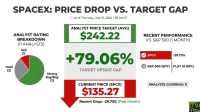
SpaceX (NASDAQ:SPCX | SPCX Price Prediction) currently trades at $134.27, with analysts’ average price target at $257.11. The spread suggests 91.49% upside.
SpaceX has three businesses: rocket launch, Starlink connectivity, and an AI unit built around Grok, Cursor and the COLOSSUS compute expansion. The company is worth roughly $1.77 trillion. Its third quarter showed what the bulls are paying for. Revenue came in at $14.60 billion, beating the $13.02 billion estimate, and the company turned to GAAP net income of $4.40 billion.
The Street-high call is even bolder. Raymond James holds an $800 target, which implies 495.81% upside from here.
A Democratic Midterm Sweep Knocked Nearly 20% Off SpaceX
The midterm elections did the most damage. SpaceX fell 19.89% over the past month, slipping from $167.60. Democrats took the House and Senate and flipped Texas, where SpaceX is building out its AI infrastructure. Investors now expect congressional probes and tighter rules on Elon Musk’s AI and merger plans (CNBC).
Deutsche Bank warned, “While policy is naturally hard to predict, we could envision SpaceX facing some incremental headwinds in this type of backdrop.” The bank pointed out that Texas’s governor-elect has called for a pause on new data center approvals. That could delay SpaceX’s Texas compute capacity and push its capex higher.
Stocks fell too, though far less. The S&P 500 lost 5.39% over the same month. SpaceX did bounce 8.62% in its latest session after Musk said sales are “exploding” and gave a revenue forecast about twice Wall Street’s estimate (Barron’s).
Wall Street’s Buy Ratings Survived the Election Selloff
Growth drives the bullish thesis. In the third quarter, Connectivity revenue rose 69% to $5.2 billion. AI revenue jumped 830% to $7.6 billion. Starlink reached 13.6 million consumer subscribers, and average revenue per user rose 5% from the prior quarter to $69. On trailing earnings, the stock trades at 584x. That falls to 43x on forward earnings.
Sentiment is still unbalanced. Of 39 analysts, 8 rate SpaceX a Strong Buy, 23 a Buy, 6 a Hold and 2 a Sell. Morgan Stanley’s Adam Jonas has a $300 target. Deutsche Bank’s Edison Yu is at $255 even after the bank’s post-election warning.
Raymond James analyst Brian Gesuale is the exception, with a Strong Buy and the $800 target. His thesis has three parts. Starlink has a moat in high-margin connectivity. Falcon 9 carries over 90% of the world’s payload mass to orbit. Starship could become the base layer for orbital logistics and compute. On CNBC’s Fast Money, one panelist said the target makes Jonas’s $300 call look conservative.
Analysts are watching a few specific drivers. The 800 MHz spectrum deal for Starlink Mobile is expected to close in the first half of 2027. COLOSSUS II is scaling to 1.7 GW of capacity. SpaceX also holds more than $6 billion in Starshield contracts with the Space Force. Those 12-month targets are estimates, and none of them is guaranteed.
Rocket Lab Fell With SpaceX While Lockheed Martin Held Up
Pure-play space stocks fell together while the defense prime gained.
Rocket Lab (NASDAQ:RKLB) dropped 22.2% over the past month and is down 23.92% year to date. At $53.07, it trades well below its $102.15 target, which implies 92.48% upside. It has 5 Strong Buys, 13 Buys, 4 Holds and no Sells. That upside is similar to SpaceX’s.
Lockheed Martin (NYSE:LMT) gained 11.28% over the month, though it slipped 11.83% in the past week. At $566.99 against a $660.86 target, it offers 16.56% upside. Its ratings lean toward Hold: 12 Holds versus 10 Buy or Strong Buy ratings, plus 1 Sell.
Rocket Lab just has the largest consensus upside in the group. SpaceX pairs similar upside with real profits, which makes its setup stronger.
SpaceX Fell Far Harder Than the S&P 500
SpaceX trades at $134.27, against a consensus target of $257.11 from 39 analysts. That works out to 91.49% implied upside. The stock is down 19.89% over the past month. Over the same stretch, the S&P 500 lost 5.39%. The index is up 7.83% year to date.
SpaceX also sits 16.58% below its early trading level of $160.95. Its 52-week range runs from $104.83 to $225.64.
Strong Fundamentals Face a Texas Political Test
The bullish thesis improves if AI revenue keeps growing, the Texas compute expansion moves ahead on schedule and the 800 MHz deal closes. It weakens if regulators stall the data centers while spending keeps climbing.
Second-quarter capex hit $18.37 billion, with $15.83 billion of it going to AI compute. Stock comp tied to Cursor reached $1.2 billion in the third quarter. Starlink ARPU has already been diluted once as the subscriber base expanded.
The $257.11 consensus is a more realistic benchmark than $800.
Contact [email protected] for any questions or corrections.
Alex Sirois is a financial writer with experience spanning both retail and institutional investing. He has written for InvestorPlace and held roles at BNY Mellon and Bernstein, giving him a perspective that bridges Main Street portfolios and Wall Street analysis.
Alex holds an MBA from George Washington University and has built his career across multiple industries, including e-commerce, education, and translation — a breadth of experience that informs how he breaks down complex financial topics for everyday investors. His writing is conversational, actionable, and grounded in long-term, buy-and-hold investing principles.
At 247 Wall St., Alex focuses on delivering analysis that is both accessible and useful, with a clear emphasis on helping readers make more informed decisions with their money.