4 Dividend Kings Paying the Highest Yields Today

This post may contain links from our sponsors and affiliates, and Flywheel Publishing may receive compensation for actions taken through them.
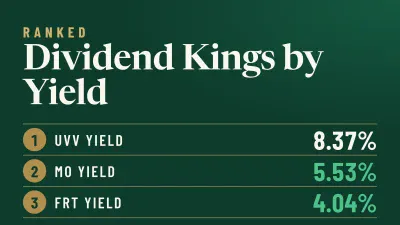
A Dividend King’s yield usually rises for an uncomfortable reason: the share price falls while the payout keeps growing. When a long run and a high yield show up together, the first job is to check whether earnings and cash flow still cover the dividend. Several former Kings broke their run after decades of raises, so a record of 50 or more years does not guarantee the next increase. The highest-yielding name in this group has the weakest coverage. Universal Corporation (NYSE: UVV) now yields 8.37%, and its weak coverage is the reason. Below are four verified Kings ranked by yield, each with a coverage check.
Universal Corp.: An Ultra-High Yield With the Weakest Coverage
Universal Corp. buys, processes, and ships leaf tobacco to the world’s largest cigarette and cigar makers. It also runs a smaller plant-based ingredients business. Its fiscal fourth-quarter report marked the 56th consecutive year of dividend increases, and its dividend records show a higher annual payout every year back to 1999.
At 8.37%, Universal Corp. is the only ultra-high-yield stock here, and the yield is high because the share price fell. Shares trade at $38.77, down 22.28% over the past year and close to the $37.38 52-week low. The cause is a tobacco glut cycle that pushed customers to commit later. Fiscal second-quarter adjusted EPS of $0.39 missed the $0.58 estimate, revenue fell 17.55%, and net income dropped 63.18%. The prior quarter ended in an adjusted loss of $0.20 per share.
Coverage is under pressure. Trailing diluted EPS stands at -$0.10, while the company paid $3.30 per share in dividends over the same period. Operating cash flow was -$117.1 million in fiscal Q1, cash fell to $47.0 million, and net debt reached 45% of net capitalization. The board’s latest declaration kept the quarterly payout at $0.83, unchanged from the prior quarter.
The bull case rests on timing. Leaf tobacco sales are seasonal, and management expects shipments to be heavily weighted to the second half of the fiscal year. It says customer commitments match the full-year plan, and available inventories sit at 19%, within its target range. The stock trades at 0.707 times book value and about 11x forward earnings so that a normal second half would rebuild coverage from a low starting valuation.
The risk is a repeat delay. If second-half shipments slip again, the dividend will depend on borrowed money, and a run paid for with debt cannot last.
Altria Group: A High Yield Backed by Earnings Guidance
Altria Group (NYSE: MO | MO Price Prediction) sells Marlboro cigarettes, Copenhagen and Skoal smokeless tobacco, and nicotine pouches and NJOY vapor products in the U.S. Its latest 4.7% raise was its 61st dividend increase in 57 years, lifting the annualized rate to $4.44 per share.
Altria yields 5.53%, which makes it high-yield, and the yield has held up through a strong rally. Shares at $76.39 are up 40.56% over the past year. The yield stays high because investors still apply a discount for the long decline in cigarette volumes, and the stock trades at about 13x forward earnings.
The coverage is solid. Management raised 2026 adjusted EPS guidance to $5.66 to $5.74, well above the $4.44 annual dividend. Altria paid $1.7 billion in dividends against net income of $2.518 billion during the third quarter. Shareholders’ equity of -$2.225 billion reflects years of buybacks. The board still added $1 billion to the repurchase program, and management repeated its goal of mid-single-digit annual dividend growth through 2028.
For income investors, the bull case is pricing power. The smokeable segment posted a 64.5% adjusted margin, and that cash supports both the raises and the buybacks.
The risk is shrinking volume. Industry cigarette volume fell an estimated 5%, and Marlboro’s retail share slipped 1.0 point to 39.5% as smokers traded down to discount brands.
Federal Realty: The REIT With the Longest Dividend Streak
Federal Realty (NYSE: FRT) owns open-air shopping centers and mixed-use properties such as Santana Row and Assembly Row, with 102 properties in its portfolio. It has increased its dividend for 59 consecutive years, the longest record in the REIT sector. Federal Realty replaces Target (NYSE: TGT) in this group. Target’s 2.89% yield is lower than every name here.
Federal Realty yields 4.04% at $113.81. Shares rose 14.89% over the past year but are still 11.82% below their level five years ago. That longer decline keeps the yield above 4%.
REITs are best judged on funds from operations (FFO), a measure of cash earnings for real estate companies. Third-quarter Core FFO was $1.87 per share, compared with a quarterly dividend of $1.16. Full-year Core FFO guidance was raised to $7.54 to $7.58, against an indicated annual dividend of $4.64. The latest raise was 3%.
The bull case is rising rents. The portfolio is 96.5% leased, comparable leases signed in the third quarter have 14% cash rent increases, and the $508.0 million purchase of The Summit in Birmingham, Alabama adds another source of rent.
The risk is borrowing costs. Second-quarter interest expense rose to $50.0 million from $44.6 million, and if rates stay high, that will keep eating into the FFO that pays for future raises.
Northwest Natural: 71 Years of Raises Backed by Regulated Earnings
Northwest Natural (NYSE: NWN) runs a regulated gas utility in Oregon and southwest Washington, along with the SiEnergy gas utility in Texas and a growing water business. Its latest declaration marked the 71st consecutive year of increases and its largest raise since 2012. The quarterly dividend rose to $0.50 from $0.4925, an indicated annual rate of $2.00.
The stock yields 3.81%, the lowest in this group, because the shares have been rising. At $52.02, they are up 15.66% over the past year and 10.08% over the past month.
The coverage is comfortable. Management raised 2026 EPS guidance to $3.10 to $3.20, against the $2.00 annual dividend. Regulators have approved new revenue: Washington granted $20.1 million in year one of a multi-year plan, Oregon added $13.0 million, and the Texas SiEnergy settlement adds $8.6 million.
The bull case is predictable growth. Management targets 4% to 6% annual EPS growth and 6% to 8% rate base growth through 2030. That supports steady raises, even if they stay modest.
The risk is the balance sheet. Long-term debt rose to 59.1% of capitalization from 55.0%, while nine-month operating cash flow fell to $213.1 million from $265.9 million. That is happening as the company plans $2.6 billion to $2.9 billion in capital spending.
How These Dividend Kings Compare on Yield and Coverage
Federal Realty and Northwest Natural offer reliable raises, coverage with room to spare, and yields around 4%. Altria pairs a shrinking core business with a 5.53% yield that its earnings guidance covers. Universal Corp. has the highest risk of a dividend freeze in this group. Its 8.37% yield reflects the market’s questions about coverage, and the second half of its fiscal year will show whether that coverage improves.
Income investors looking for payers that land on a monthly schedule rather than quarterly have options too (we rounded up seven monthly payers we like in a free guide you can get here).
Contact [email protected] for any questions or corrections.
Lee Jackson has covered Wall Street analysts' equity and debt research and equity strategy daily for 24/7 Wall St. since 2012. His broad, diverse career, including a stint as creative services director at an NBC affiliate in Austin, Texas, gives him unique insight into the financial industry.
Lee Jackson's journey in the financial industry spans more than 30 years, including nearly two decades as an institutional equity salesperson at Bear Stearns, Lehman Brothers, and Morgan Stanley. His career spanned pivotal sell-side Wall Street events, from the dot-com rise and bubble to the Long-Term Capital Management debacle, 9/11, and the Great Recession of 2008. This reflects his resilience and adaptability amid market volatility.
Lee Jackson’s practical financial industry experience, gained through a career at some of the biggest banks and brokerage firms, is complemented by a lifetime of writing across various platforms. This unique combination allows him to shed light on the intricacies of Wall Street in a way only someone with deep insider experience and knowledge can. Moreover, his extensive network across Wall Street continues to provide direct access for him and 24/7 Wall St., a privilege few firms enjoy.
Since 2012, Jackson’s work for 24/7 Wall St. has been featured in Barron’s, Yahoo Finance, MarketWatch, Business Insider, TradingView, Real Money, The Street, Seeking Alpha, Benzinga, and other media outlets. He attended the prestigious Cranbrook Schools in Bloomfield Hills, Michigan, and has a degree in broadcasting from the Specs Howard School of Media Arts.