4 Tobacco Stocks Turning Huge Cash Flow Into High-Yield Dividends
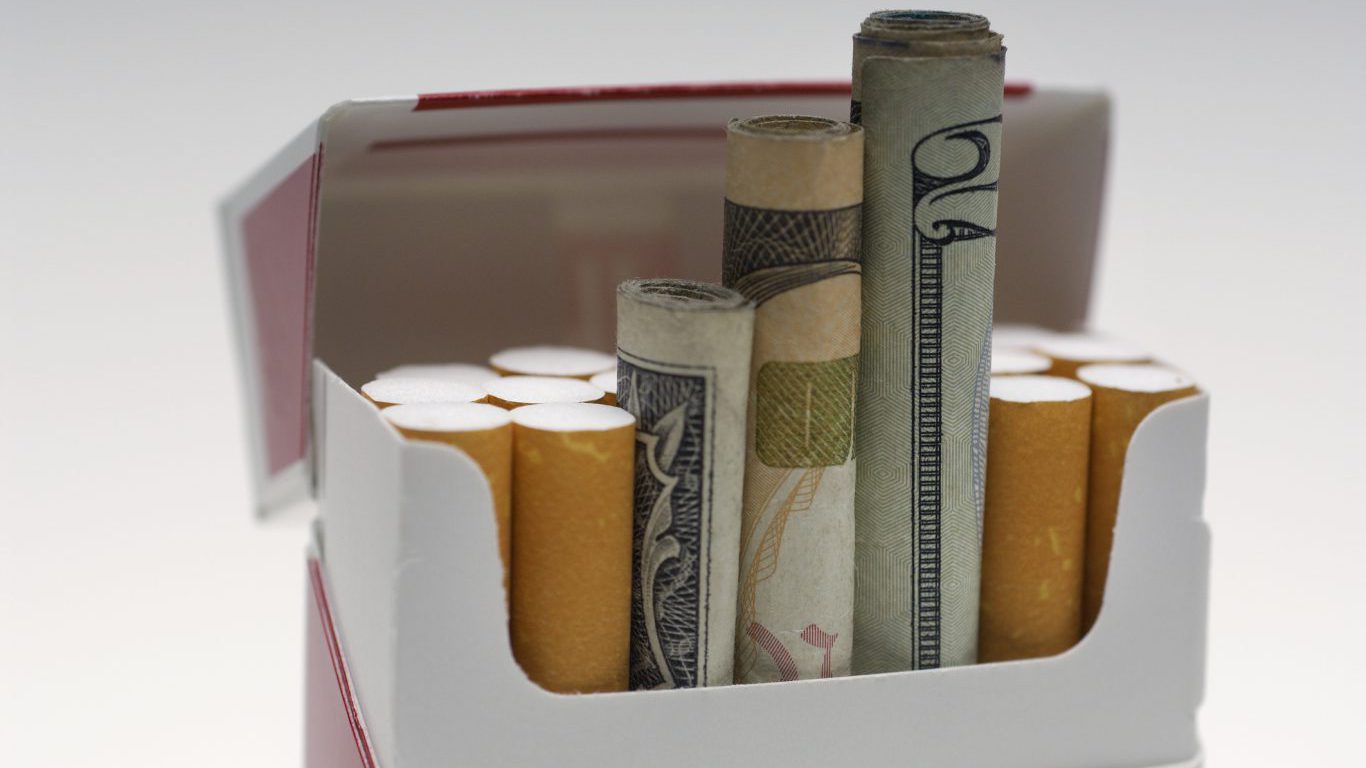
Tobacco companies spend almost nothing on new equipment yet generate billions in cash, and a handful of US-listed names funnel that surplus straight into shareholder pockets through yields that most sectors cannot touch.

This post may contain links from our sponsors and affiliates, and Flywheel Publishing may receive compensation for actions taken through them.
Tobacco is the rare defensive corner of the market where recurring cash flow still funds premium dividends. The four US-listed names below combine long payment histories with wide operating margins and shareholder-return programs that dwarf capex. As one anchor for the theme, Altria Group (NYSE:MO | MO Price Prediction) generated $9.29 billion of operating cash flow in fiscal 2025 against $216 million of capital expenditures, leaving plenty of room for a dividend that yields 6.07% today. That is the shape of the trade across this roster: modest reinvestment needs, heavy cash returns, and slow-motion volume declines offset by pricing and next-generation nicotine.
Altria Group (MO)
Altria is the US domestic tobacco anchor and the highest-quality ultra-high-yield name in the group by coverage. Shares trade at $69.51, up 26.4% year to date, with a current dividend yield of 6.07% on an annualized forward payout of $4.44 per share after the recent step up from $1.06 to $1.11 per quarter.
Dividend safety reads well against cash flow. Fiscal 2025 operating cash flow of $9.29 billion comfortably covered $6.96 billion in dividends and a token $216 million of capex, and management still returned buybacks on top. The prior fourth-quarter release flagged the 60th dividend increase in the past 56 years, a 3.9% raise in 2025. Q1 2026 adjusted diluted EPS came in at $1.32, beating the $1.25 consensus, and management reaffirmed FY2026 adjusted diluted EPS guidance of $5.56 to $5.72. Trailing EPS of $4.77 against the $4.24 declared dividend per share puts payout coverage inside the historical band.
Bull case: income investors get an ultra-high yield backed by 65%-plus smokeable segment margins, an in-place $2 billion buyback with $720 million remaining, and a management team that treats the dividend as sacred. Risk: US cigarette volumes are shrinking fast, with Q1 declines near 5% and FY25 near 10%, and Marlboro retail share slipped 1.4 points to 39.7%. Coverage is fine today, but the top line has to keep bending without breaking.
Philip Morris International (PM)
Philip Morris International (NYSE:PM) is the growth-tilted member of the bundle and, by yield, the lowest of the four. Shares at $192.83 yield 3.07% on an annualized forward payout of $5.88, after the quarterly moved from $1.35 to $1.47. The stock is up 22.3% year to date and 139.49% over five years, so investors are paying for smoke-free growth rather than pure yield.
Dividend safety is anchored by prolific cash generation. FY2025 operating cash flow reached $12.23 billion versus $8.62 billion in dividends and $1.57 billion in capex. Q2 2026 operating cash flow alone was $5.49 billion, up 61% year over year. Management raised FY2026 guidance to adjusted diluted EPS of $8.26 to $8.41, with full-year operating cash flow near $13.5 billion. Trailing EPS of $7.24 against the $5.88 per-share dividend keeps the payout inside management’s target zone even as the company runs net debt to adjusted EBITDA of 2.35x, targeting closer to 2.0x by year end.
Bull case: IQOS is now in 109 markets, ZYN just received FDA MRTP authorization on 20 nicotine pouch variants, and international smoke-free revenue grew 14.2% on 8.0% volume growth. That is real dividend fuel. Risk: at 26x trailing earnings, the stock now trades like a staples grower, so any hiccup in ZYN inventory normalization or FX would compress the multiple faster than the dividend can bail investors out.
British American Tobacco (BTI)
British American Tobacco (NYSE:BTI), the UK-based global peer, trades in New York as an ADR at $56.24, with a high-yield of 5.95%. The annualized forward dividend is $3.34 per ADR, with quarterly instalments recently stepping up to $0.834851 from $0.749068 in 2025. The FY2025 declaration of 245.04p per share, a 2.0% increase over 2024, keeps the dividend growing modestly in sterling terms.
Coverage is solid on an annual basis. FY2025 operating cash flow was $6.34 billion against $5.12 billion in dividends and $551 million in capex. On top of that, BAT has committed a £1.3 billion share buyback for 2026, up from £1.1 billion in 2025. Trailing EPS of $3.92 against the $2.45 per-ADR dividend gives a comfortable earnings cushion, and management is guiding to leverage of 2.0x to 2.5x adjusted net debt/EBITDA by year-end 2026.
Bull case: smokeless is finally scaling. FY2025 saw 34.1 million smokeless consumers, up 4.7 million, and Velo Modern Oral grew 48% at constant currency globally, with Velo Plus US revenue up 310%. US combustibles held up on 12.3% price/mix, and the ADR still trades at 11x forward earnings. Risk: unresolved litigation and tax exposures, including Dutch tax assessments of ~£1.08 billion and ongoing Canadian tobacco litigation payments, could pressure the pace of capital returns.
Universal Corporation (UVV)
Universal Corporation (NYSE:UVV) is the small-cap tobacco-leaf merchant and the highest-yielding, highest-risk name in the group. Shares at $44.37 yield 7.38%, an ultra-high-yield built on a forward annualized payout of $3.32. The quarterly rose to $0.83 from $0.82, with the next payment scheduled for November 2, 2026. The Q4 FY2026 release confirmed this was the 56th consecutive annual increase, putting Universal squarely in Dividend King territory.
Dividend safety is the real concern here. FY2026 operating cash flow of $129.1 million covered the $81.3 million dividend payout and $48.8 million of capex, but only narrowly, and it was well below the prior year’s $326.97 million. Trailing earnings paint a tighter picture: EPS of $0.75 against a $3.29 dividend puts the trailing PE at 59, though the forward PE compresses to 12 if guidance normalizes. FY2026 adjusted EPS came in at $2.64 versus a $4.17 estimate, and Q1 FY2027 adjusted diluted EPS was negative $0.20 versus a $0.25 consensus.
Bull case: an entrenched leaf-processing franchise with a Dividend King streak and a management team clearly willing to defend the payout through a leaf oversupply cycle. Uncommitted tobacco inventory sat at 27%, above the target range but expected to normalize in FY2027. Risk: earnings and cash generation have deteriorated sharply, with Tobacco Operations operating income collapsing 90% to $3.47 million in Q1 FY2027 and the Ingredients segment in outright operating loss. If the FY2027 normalization does not materialize, the payout goes from covered to strained.
Tying the Roster Together
Across these four tobacco names, income investors are choosing between reliability, growth, value, and stretch. Altria and Universal deliver ultra-high yields above 6%, with Altria offering the safer coverage and Universal the longer streak but the tighter cushion. Philip Morris trades the lowest headline yield for the strongest smoke-free growth engine, and British American Tobacco pairs a 5.95% yield with a 11x forward multiple and a fast-growing modern oral franchise. Own the industry through more than one of them and the payout stream is remarkably resilient, because that is exactly what tobacco has been engineered to do.
Contact [email protected] for any questions or corrections.
Chris Lange is a financial and geopolitical writer with more than a decade of experience covering a myriad of topics. He has published thousands of articles for 24/7 Wall St., with past coverage focused heavily on stocks, IPOs, healthcare, defense, global affairs, and technology.
His work has been quoted, or referenced by a number of outlets including Business Insider, USA Today, Yahoo Finance, MSN, The Motley Fool, and many other publications. A graduate of Southwestern University, he studied business with a focus on investments and has previous experience in banking and startups.
When not reading or writing the news, he is following his passion for Lacrosse, playing chess, or building solar projects with his dad.