I Bonds Pay 5.51%. Why Retirees Might Still Prefer Dividend Stocks

This post may contain links from our sponsors and affiliates, and Flywheel Publishing may receive compensation for actions taken through them.
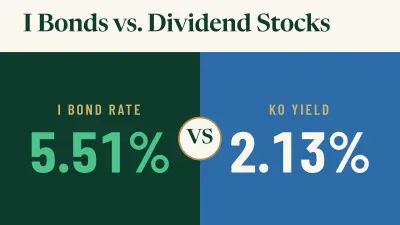
Series I savings bonds issued from November 1, 2026, through April 30, 2027, earn a 5.51% composite rate. That rate is built from a 1.40% fixed rate and a 2.04% semiannual inflation rate. Only the fixed piece stays with the bond for life. The rest resets with inflation every six months. On the other side of this month’s comparison are three US-listed dividend payers: Coca-Cola (NYSE:KO | KO Price Prediction), Linde (NASDAQ:LIN) and Qualcomm (NASDAQ:QCOM). Coca-Cola and Qualcomm currently yield 2.13% and 2.10%, both as of November 9, 2026.
How I Bonds Work and When Their Rate Resets
An I bond is a savings bond sold directly by the US Treasury. Its interest rate has two parts. The fixed rate is set when you buy, and “The fixed rate never changes” for the life of that bond. The inflation rate is reset every May 1 and November 1, based on the non-seasonally adjusted Consumer Price Index for All Urban Consumers (CPI-U). Treasury runs both parts through a formula that produces the composite rate, and that composite “changes every 6 months. It can go up or down.”
So the 5.51% figure is a six-month rate. It applies until the bond’s next reset, and after that the inflation half moves to whatever the CPI-U data shows. If deflation hits, the composite can drop below the fixed rate. Treasury sets a floor at zero: “We stop at zero.” The fixed rate also differs from one purchase window to the next. Bonds issued from July through October 2026 carry a 0.9% fixed rate, and Treasury’s table shows a 5% composite for them under the November reset.
The mechanics retirees need to know:
- Purchase cap: Each Social Security Number can buy up to $10,000 in electronic I bonds per calendar year. There is no limit on how much you can own in total.
- Electronic only: Since January 1, 2025, I bonds have been sold only electronically through a TreasuryDirect account.
- Lockup: You can cash in a bond after 12 months.
- Early-redemption penalty: If you cash in before 5 years, you give up the last 3 months of interest.
- Maturity: The bond earns interest for 30 years. Electronic bonds pay out automatically at maturity.
- No cash flow along the way: Interest compounds semiannually into the bond’s value. You get it all when you cash in.
That last point matters for anyone who needs to pay bills. No quarterly check is sent to you. To spend the interest, you have to redeem bonds.
Dividend Safety Comes First in This Income Matchup
Start with the trade-off. A company can cut its dividend at any time, while the Treasury’s obligation to pay an I bond’s principal and accrued interest does not depend on any company’s earnings. A dividend can also grow year after year. An I bond’s fixed rate never grows, and the inflation half only follows the CPI. So the first question for each stock is whether the payout is safe. How fast it grows comes second.
Yields and rates also measure different things. The I bond composite rate is higher than the current yields on Coca-Cola and Qualcomm. But a dividend yield is a measure of a company’s payout against its share price. Your total result depends on price moves, which can wipe out years of dividends or add to them. You will never lose what you paid for an I bond. For comparison, the 10-year Treasury yielded 4.86% on November 6, 2026.
Coca-Cola: Well-Covered Payout, Steady Raises
Coca-Cola’s next payment is $0.53 per share, payable December 15, 2026. The quarterly amount has risen from $0.33 in 2015 to $0.51 in 2025 and $0.53 in 2026. The company behind it is getting stronger. Third-quarter revenue rose 7.4% year over year to $13.38 billion. Adjusted EPS of $0.91 beat the $0.88 consensus, with management raising its 2026 free cash flow guidance to at least $13.0 billion. Interest coverage stands at 8.32x. Executive Henrique Braun said the quarter showed “our system’s sustained momentum, giving us confidence in our updated full-year guidance.” One catch: the stock is up 40.62% year to date, which explains why its yield looks thin today.
Linde: Contracted Cash Flow Behind the Growth
Linde pays $1.60 per share quarterly, with the next payment due December 17, 2026. That is up from $1.50 in 2025 and $0.825 in 2018. Industrial-gas contracts give the company recurring, utility-like revenue. Its project backlog stands at $11.0 billion, and third-quarter operating cash flow rose 8% to $3.17 billion. Management guides 2026 adjusted EPS to $17.82 to $17.92. Linde shows the growth half of the comparison most clearly: pricing power that has historically turned into higher payouts, which no fixed coupon can match.
Qualcomm: Bigger Payout, More Moving Parts
Qualcomm’s next payment is $0.92 per share, payable December 17, 2026. Fiscal 2026 dividends came to $3.62 per share, or $3.854 billion, and its dividend history shows no cuts. The concern is concentration. Fourth-quarter handset revenue fell 26% year over year, while automotive jumped 89%. The stock dropped after a weak forecast as a memory shortage weighed on smartphone sales (CNBC). Its 52-week range runs from $120.88 to $257.56, reminding investors that the price behind a dividend can swing widely. Cash generation is still strong, with a free cash flow yield of 4.72%. But a payout that depends on a business in transition carries more risk than a Treasury obligation.
Where I Bonds Carry Risk, Too
I bonds have risks of their own. Rate risk: the composite will fall if inflation cools off, and the bond keeps only the fixed rate it started with. Reinvestment risk: new I bonds may carry a lower fixed rate when bonds mature, or you cash them in. The gap between 0.9% and 1.40% in back-to-back purchase windows shows how much fixed rates can move. Liquidity risk: savings bonds have no market price, and the 12-month lockup and the three-month interest penalty are what it costs to get out early. Limits of the government guarantee: Treasury backing guarantees payment, but the CPI-U may vary from a retiree’s actual costs, such as healthcare. It also caps how much you can put in each year.
| Feature | I Bonds | Dividend Stocks (Coca-Cola, Linde, Qualcomm) |
|---|---|---|
| Current rate or yield | 5.51% composite (Nov. 1, 2026 to Apr. 30, 2027) | Coca-Cola 2.13%, Qualcomm 2.10% (Nov. 9, 2026) |
| Can the payment be cut? | Composite can fall, with a floor at zero | Yes, at the board’s discretion |
| Can the payment grow? | Only through the inflation component | Yes, through dividend raises |
| Cash paid out along the way | None until redemption | Quarterly |
| Access to principal | Locked 12 months | Sell any trading day at market price |
Tax Treatment Often Settles the Question
I bonds: Interest is subject to federal income tax but exempt from state and local income tax. IRS guidance sets it: “Interest on U.S. savings bonds is exempt from state and local taxes.” Cash-method taxpayers can put off reporting the interest until the earlier of the year you cash or dispose of the bonds or the year they mature, or they can choose to report the increase in value each year. Deferral lets a retiree time redemptions for lower-income years. Interest may also be excluded entirely if it pays for qualified higher-education expenses for you, your spouse, or your dependent. That requires the bond to have been issued to you when you were 24 or older, and income limits apply. A grandchild who is not your dependent does not qualify.
Dividend stocks: Qualified dividends from domestic corporations and qualified foreign corporations are taxed at net capital gain rates of 0%, 15% or 20%, depending on taxable income, provided you meet a holding-period test. Ordinary dividends are taxed at regular income rates. Most states tax dividends as ordinary income, and you owe the tax every year you receive the payments, with no option to defer. Dividend stocks can sit in an IRA, where taxes are deferred until withdrawal. I bonds are held in a TreasuryDirect account outside any retirement account.
For a retiree in a high-tax state, the state exemption on I bonds can count for more than the headline rate. For a retiree whose taxable income stays inside the 0% qualified-dividend bracket, dividends may come with no federal tax at all.
Who Each Income Stream Suits
I bonds suit retirees who want principal that can’t fall, protection against measured inflation and a state-tax break, and who can live with the $10,000 annual cap, the one-year lockup and getting no cash until they redeem. Dividend stocks like Coca-Cola, Linde and Qualcomm work for retirees who need quarterly cash, have time for payouts to grow, and can ride out price swings and the possibility of a cut (turning a lump sum into something that acts like a paycheck is the whole exercise in our free Paycheck Portfolio guide, which walks through the mix, the payment calendar and the withdrawal order). Within that group, Coca-Cola and Linde suit readers who rank payout safety first, and Qualcomm suits those willing to accept more business risk to own a cash-rich payer.
Contact [email protected] for any questions or corrections.
Chris Lange is a financial and geopolitical writer with more than a decade of experience covering a myriad of topics. He has published thousands of articles for 24/7 Wall St., with past coverage focused heavily on stocks, IPOs, healthcare, defense, global affairs, and technology.
His work has been quoted, or referenced by a number of outlets including Business Insider, USA Today, Yahoo Finance, MSN, The Motley Fool, and many other publications. A graduate of Southwestern University, he studied business with a focus on investments and has previous experience in banking and startups.
When not reading or writing the news, he is following his passion for Lacrosse, playing chess, or building solar projects with his dad.