Corporate Bonds vs. Dividend Stocks: Which Pays a Retiree More Reliably?

This post may contain links from our sponsors and affiliates, and Flywheel Publishing may receive compensation for actions taken through them.
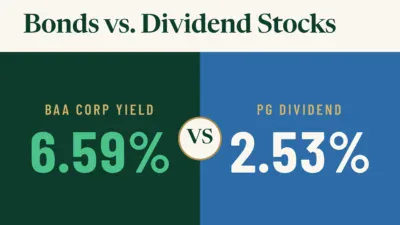
Investment-grade corporate bonds are paying their highest yields in a year. Moody’s Seasoned Baa Corporate Bond Yield, a benchmark for the lowest tier of investment-grade debt, stood at 6.59%[1] in its October 1, 2026 monthly reading. That was the most recent figure available on November 25, 2026, and the 12-month high. For comparison, the 10-year Treasury yielded 4.92%[2] on November 23, 2026. Below, we line those rates up against two of the market’s most reliable dividend payers.
How a Corporate Bond Pays You and What Happens at Maturity
A corporate bond is a loan you make to a company. In return, the company promises a fixed interest payment, called the coupon, usually twice a year, and agrees to repay the bond’s face value on a set maturity date. The coupon is locked in when the bond is issued. The market yield changes every trading day, though, because the bond’s price moves.
When rates rise, existing bond prices fall; when rates drop, prices rise. A buyer today gets about the current market yield only by holding the bond to maturity, and only if the issuer pays in full. Some corporate bonds carry floating coupons that reset with short-term rates, so their income isn’t locked in.
Credit ratings from agencies like Moody’s and S&P measure the odds of getting paid, with investment grade running from the top AAA/Aaa tier down to BBB-/Baa3. Baa is the lowest rung before junk territory. The Baa series quoted above tracks bonds with maturities of 20 years and above[1]. Shorter bonds and higher-rated issuers generally yield less. Corporate bonds carry no FDIC insurance and no government guarantee, so if the issuer defaults, recovery depends on the company’s assets and where your bond ranks among its creditors. Even Treasuries, backed by the U.S. government, protect only principal and interest paid at maturity, and if you sell before then, the price can be lower than what you paid.
A bond fund works differently. It holds hundreds of bonds, never matures, and has a share price that moves with interest rates every day. Its monthly payout rises or falls as old bonds mature and the manager buys new ones at whatever rates the market offers. Individual bonds have their own version of that problem, called reinvestment risk. When a bond matures, or the issuer calls it early (which usually happens after rates fall), you have to reinvest at whatever rate is available then.
The Baa yield’s 12-month path shows both risks. It bottomed at 5.81%[1] in February 2026 and then rose to its October high. Rising yields meant falling prices for anyone who already owned those bonds.
Dividend Safety Comes First in a Coupon Comparison
Bonds and dividends trade safety against growth. A bond coupon is a contract: missing a payment is a default, and bondholders get paid before shareholders if a company runs into trouble. A dividend is a board decision that can be cut or suspended at any meeting, but a dividend can grow every year, while a fixed coupon never rises. That makes dividend safety the first thing to check, ahead of yield.
Among dividend payers, Procter & Gamble (NYSE:PG | PG Price Prediction) has one of the strongest records available. Its current quarterly dividend of $1.0885[3] marks the 70th consecutive year of dividend increases and 136th consecutive year of dividend payments. P&G generated $15.835 billion[3] in free cash flow in fiscal 2026 and plans to pay over $10 billion[4] in dividends in fiscal 2027. Management has flagged headwinds, including about a $1.4 billion after-tax commodity cost hit and $300 million in higher net interest expense, but it remains committed to raising the dividend. The payout has grown steadily, from $0.7459 per share per quarter in early 2020 to today’s level. P&G’s trailing dividend yield is 2.53% as of November 25, 2026, with the stock at $172.73.
Coca-Cola (NYSE:KO) reached its 63rd consecutive year of dividend increases[5] in 2025. Its quarterly dividend of $0.53 goes ex-dividend on December 1, 2026, and is paid on December 15, 2026. In 202,0 the quarterly payout was $0.41. Coca-Cola’s 2025 dividend coverage was thin. Coca-Cola paid $8.8 billion[5] in dividends in 2025 but generated only $5.296 billion in free cash flow that year, so free cash flow did not cover the dividend. Coverage looks much stronger in 2026: management raised its free cash flow guidance to at least $13.0 billion[6], and interest coverage stands at 8.32x. Ongoing IRS tax litigation remains the main open risk. Coca-Cola’s dividend yield is 2.17% as of November 25, 2026.
On the current numbers, the Baa benchmark yield is well above both dividend yields. That gap is the price of giving up dividend growth. Total return also depends on price changes. Stock prices move more than bond prices do. P&G’s 52-week range runs from $133.74 to $173.59, while Coca-Cola trades between $65.9andto $100.56. Inflation affects both sides as well. The Consumer Price Index rose 0.35%[7] from September to its October 2026 reading of 337.476. A fixed coupon buys a little less each time prices rise. A growing dividend can keep pace, but nothing guarantees it will.
Tax Treatment Can Flip the Answer
Taxes often matter more than the yield gap. Interest is part of gross income under 26 U.S.C. § 61(a)(4)[8] and is taxed at ordinary income rates. For tax year 2026, those rates run from 10% up to a top rate of 37%. Corporate bond interest is also generally subject to state income tax.
Qualified dividends get a better deal. Under 26 U.S.C. § 1(h)(11)(A), qualified dividend income is taxed like net capital gain, at rates of 0%, 15%, or 20% according to IRS Publication 550. Dividends from U.S. companies like P&G or Coca-Cola usually qualify if you meet the holding period. IRS Form 1040 instructions exclude dividends on stock held for less than 61 days during the 121-day period that began 60 days before the ex-dividend date.
Bond fund owners should watch one detail. Fund payouts usually arrive labeled as dividends, but a fund can report as qualified-only income that was qualified when the fund received it, under 26 U.S.C. § 854(b)(1)(C)(ii). Since bond funds earn interest, the IRS generally treats their distributions as ordinary income. Higher-income retired people may also owe the net investment income tax, which applies to interest and dividends alike under 26 U.S.C. § 1411(c)(1)(A)(i). In an IRA, none of these differences apply until you take withdrawals, which the IRS then taxes at ordinary income rates.
Who Each Option Suits
Investment-grade corporate bonds suit retired people seeking a fixed, contractual payment on a known schedule, who plan to hold to maturity, and who keep income-producing assets in tax-deferred accounts. Dividend stocks like P&G and Coca-Cola make sense for retirees with a long time horizon who hold taxable accounts, can live with share-price swings, and want income with a record of rising faster than a fixed coupon. Keep an eye on Coca-Cola’s full-year 2026 free cash flow and the November Baa yield reading. Those are the next two data points that will shift this comparison.
Contact [email protected] for any questions or corrections.
Chris Lange is a financial and geopolitical writer with more than a decade of experience covering a myriad of topics. He has published thousands of articles for 24/7 Wall St., with past coverage focused heavily on stocks, IPOs, healthcare, defense, global affairs, and technology.
His work has been quoted, or referenced by a number of outlets including Business Insider, USA Today, Yahoo Finance, MSN, The Motley Fool, and many other publications. A graduate of Southwestern University, he studied business with a focus on investments and has previous experience in banking and startups.
When not reading or writing the news, he is following his passion for Lacrosse, playing chess, or building solar projects with his dad.