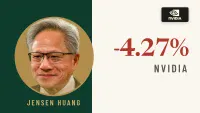
Nvidia Just Fell 8.3% After Hours on a Report of a Second Jensen Huang Affair. Here’s What 2,000 Shares Have Lost This Week

This post may contain links from our sponsors and affiliates, and Flywheel Publishing may receive compensation for actions taken through them.

Nvidia (NASDAQ: NVDA) fell 8.3% in after-hours trading Wednesday after The New York Times reported that CEO Jensen Huang also had a relationship with a senior Nvidia executive, Kimberly Powell. The report came three days after Huang’s own admission: on Sunday, Huang told employees in an email that he had been unfaithful to his wife, after reports linked him to Alice Huang, a former executive at Singapore’s Megaspeed whom U.S. officials suspect of spying for China. China has called that claim groundless, and Huang has not been accused of any crime.
At 5:35 PM ET, the stock was at $159.37, down from Wednesday’s close of $173.73. No Nvidia close has been that low since July 7, 2025. At that price, Nvidia is worth about $3.85 trillion, about $347 billion less than at the close and about $658 billion less than on Friday, November 6, the last close before Huang’s email.
Shareholders now face two questions: whether Huang keeps the job, and what Nvidia is worth if he does not.
What the Times reported
According to the Times, Huang and Powell were seen being affectionate at a hotel during a company conference in March. Wednesday’s close was already 6.9% below the November 6 close. The new report lands on a board that is already investigating him. Nvidia’s independent directors have hired Joon Kim, the former acting U.S. Attorney for the Southern District of New York, and the law firm Wachtell, Lipton, Rosen & Katz to examine whether Huang was the target of a foreign intelligence operation. The board has said it has no reason to believe national security or company secrets were compromised.
Washington is moving too. Senator Kevin Cramer of North Dakota has called for Huang to step down. House committee chairmen John Moolenaar, Brian Mast and Rick Crawford have asked for a closed-door briefing and said subpoenas are ready if Huang does not agree to one. A proposed class action filed Monday in San Jose accuses Nvidia and Huang of hiding the relationship from shareholders.
What 2,000 shares have lost
Take a holder with 2,000 Nvidia shares, a position many longtime owners reached by buying early and never selling. At the Friday, November 6 close of $186.64, those shares were worth $373,280. At $159.37 after hours, they are worth $318,740. That is $54,540 gone in three trading sessions and one evening, $28,720 of it after Wednesday’s closing bell. Against the record close of $239.24 on October 6, worth $478,480, the loss is $159,740, or 33.4%.
| Price point | NVDA price | 2,000 shares |
|---|---|---|
| Record close, October 6 | $239.24 | $478,480 |
| Friday, November 6 (before Huang’s email) | $186.64 | $373,280 |
| Wednesday close | $173.73 | $347,460 |
| After hours, 5:35 PM ET | $159.37 | $318,740 |
Two analysts, two prices for the same exit
Wall Street is split on what Huang himself is worth to the stock. Dan Ives of Yorkville Ives wrote on November 9 that if Huang were removed, Nvidia would be worth 25% to 30% less, and he put the chance of removal at about 15%. Applied to the after-hours price, a 25% to 30% cut would take the stock to between $111.56 and $119.53, and the 2,000 shares to between $223,118 and $239,055: another $79,685 to $95,622 off a position that has already lost $54,540 this week.
Baird went the other way on Wednesday, before the Times report. Analysts Tristan Gerra and Tyler Bomba downgraded Nvidia to neutral, cut their price target to $200, and wrote that the odds of a CEO change are rising heading into 2027. They said a new leader, likely from outside, is needed “to re-establish trust both externally and internally.” Even their reduced $200 target is 25% above the after-hours price, and would put the 2,000 shares at $400,000.
The people closest to Huang want him to stay. In a Blind survey of 232 Nvidia employees taken November 9 and 10, 88% said he should remain CEO. Dan Niles of Niles Investment Management told Yahoo Finance the company would hold up either way, pointing to Apple after Steve Jobs: “Did it collapse?”
What a holder can actually decide
Nobody outside the boardroom knows how the investigation ends, and the after-hours price can move again before Thursday’s open. What a holder controls is how exposed they are to the outcome. Three numbers settle that.
The first is the share of the portfolio. For someone with $1 million saved, 2,000 shares at $159.37 is about 32% of everything, and an Ives-sized drop of 25% to 30% would cost 8.0% to 9.6% of the whole portfolio. A holder who would lose sleep over that number owns too much, whatever happens to Huang.
The second is the tax bill. Shares bought years ago carry large gains, and selling in a taxable account turns part of the drop into a tax payment. Trimming inside an IRA costs nothing in taxes today, which makes the IRA the cheaper place to cut a concentrated position.
The third is time. A holder who needs the money in the next few years is betting on how this scandal ends. A holder with ten years is betting on Nvidia’s chips. Those are different bets, and only the second one has a track record behind it.
Contact [email protected] for any questions or corrections.
I've been writing about stocks and personal finance for 20+ years. I believe all great companies are tech companies in the long run, and I invest accordingly.