The IRS Takes Up to 37% of These 5 BDC Dividends (Unless You Move Them)

This post may contain links from our sponsors and affiliates, and Flywheel Publishing may receive compensation for actions taken through them.
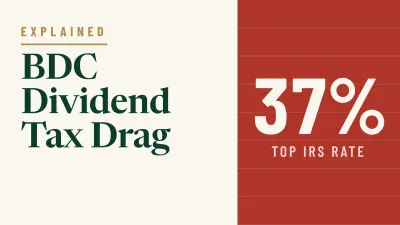
Business development companies pay some of the highest yields in the market, and the IRS taxes most of that income at your ordinary rate. At the 24% bracket, a $500,000 BDC portfolio generating about $70,000 a year hands $16,800 to the IRS every year.
What You Actually Own in a BDC
A BDC lends to and invests in private middle-market companies. It must distribute most of its income, and that requirement creates the large yields. BDCs carry more risk than ordinary dividend stocks. The borrowers are private companies, credit losses reduce net asset value (NAV), and many BDCs use leverage. FS KKR Capital (NYSE:FSK | FSK Price Prediction) has net debt to equity, for example, of 125%[1].
Why BDC Payouts Get Taxed Like a Paycheck
IRS Publication 550 (2025) says ordinary dividends "are ordinary income to you," and only qualified dividends receive the 0%, 15%, or 20% rates that apply to net capital gain. BDC income comes mostly from loan interest, so most BDC distributions are not qualified dividends. The 37% in the headline is the highest marginal rate, and it applies only to income that falls in that bracket. Most readers sit in lower brackets and pay less. Publication 550 (2025) also adds a 3.8% net investment income tax above certain income thresholds.
A Roth fixes this only for qualified distributions. Publication 590-B (2024) requires that the distribution come after the 5-year period that starts with your first Roth contribution year. It must also be made at or after age 59½, because of disability, after death, or for a first home up to a $10,000 lifetime limit.
$500,000 in Five BDCs: $16,800 a Year Separates the Accounts
The model puts $100,000 into each of the five BDCs. Yields use November 11 closing prices and annualized regular distributions.
| Scenario (24%) | Gross | Tax | Net |
|---|---|---|---|
| Roth IRA | $70,000 | $0 | $70,000 |
| Taxable | $70,000 | $16,800 | $53,200 |
That’s a Roth advantage of $16,800 a year and $168,000 over 10 years, before any reinvestment.
Ares Capital: Ultra-High-Yield With a Thin Coverage Gap
Ares Capital (NASDAQ:ARCC) lends to more than 636 sponsor-backed middle-market companies. On a $1.92 annual payout, it yields 9.9%. Third-quarter core EPS of $0.46[2] fell short of the $0.48 dividend. Non-accruals rose to 2.4%[3] from 1.8%.
Main Street Capital: Covered Payouts Plus Taxable Supplementals
Main Street Capital (NYSE:MAIN) provides debt and equity to lower middle market companies. It yields 5.6% on its regular monthly dividend alone, which puts it in the high-yield category rather than ultra-high-yield. Supplemental dividends of $0.30 add more ordinary income that a Roth would shelter. Distributable NII of $0.96 covered $0.795 in quarterly regular dividends. Non-accruals sit at 3.5%[4] of cost.
FS KKR Capital: Coverage Depends on a Fee Waiver
FS KKR makes mostly senior secured loans to middle-market companies. It yields 14.8%. Adjusted NII of $0.46[5] covered the $0.44 distribution, but a $12 million[1] advisor fee waiver helped. Coverage is stressed. The quarterly payout was $0.70 through 2025, and non-accruals stand at 6.4%[1] of cost.
Hercules Capital: Strongest Base Coverage, Highest Rate Sensitivity
Hercules Capital (NYSE:HTGC) makes venture loans to technology and life sciences companies. It yields 11.7%, and NII covered the base distribution at 118%[6]. A 100bp cut in the Prime Rate would reduce annualized NII by about $0.07 per share.
Prospect Capital: A 28% Yield Signaling Distress
Prospect Capital (NASDAQ:PSEC) puts 84% of its portfolio at cost in middle-market lending. It yields 28.0%. The monthly payout fell to $0.035 from $0.045 in May 2026. NAV dropped to $5.36 from $6.45, and the company noted distributions exceeding NII in its fiscal fourth quarter. Coverage is stressed. A Roth shields the tax but does nothing to stop NAV erosion. A 28% yield coupled with a payout cut and falling NAV is exactly the pattern we flagged in a free report on seven warning signs a big dividend is about to be cut.
Bracket Multiplier: What 22% to 37% Costs
| Bracket | Taxable Net | Roth Advantage |
|---|---|---|
| 22% | $54,600 | $15,400 |
| 24% | $53,200 | $16,800 |
| 32% | $47,600 | $22,400 |
| 37% | $44,100 | $25,900 |
Reinvested, the Tax Gap Reaches $500,000 in 20 Years
If you reinvest the $16,800 annual delta at a conservative 4%, assuming the share price stays flat, it grows to about $201,700 after 10 years and $500,300 after 20. At 37%, the 20-year figure is about $771,300. That is the permanent cost of holding these payouts in a taxable account.
Plug your own bracket and balance into the compounding math:
What to Do Before Your Next Tax Filing
- Get your 2026 Form 1099-DIVs and compare box 1a with box 1b for every BDC you own. Multiply the nonqualified part by your bracket to find your actual annual tax cost.
- Consider modeling a phased Roth conversion starting with ordinary-income payers. Run the conversion tax against the annual delta shown here.
- FS KKR and Prospect Capital have the weakest coverage in this group, and a Roth cannot deduct capital losses.
Contact [email protected] for any questions or corrections.
Lee Jackson has covered Wall Street analysts' equity and debt research and equity strategy daily for 24/7 Wall St. since 2012. His broad, diverse career, including a stint as creative services director at an NBC affiliate in Austin, Texas, gives him unique insight into the financial industry.
Lee Jackson's journey in the financial industry spans more than 30 years, including nearly two decades as an institutional equity salesperson at Bear Stearns, Lehman Brothers, and Morgan Stanley. His career spanned pivotal sell-side Wall Street events, from the dot-com rise and bubble to the Long-Term Capital Management debacle, 9/11, and the Great Recession of 2008. This reflects his resilience and adaptability amid market volatility.
Lee Jackson’s practical financial industry experience, gained through a career at some of the biggest banks and brokerage firms, is complemented by a lifetime of writing across various platforms. This unique combination allows him to shed light on the intricacies of Wall Street in a way only someone with deep insider experience and knowledge can. Moreover, his extensive network across Wall Street continues to provide direct access for him and 24/7 Wall St., a privilege few firms enjoy.
Since 2012, Jackson’s work for 24/7 Wall St. has been featured in Barron’s, Yahoo Finance, MarketWatch, Business Insider, TradingView, Real Money, The Street, Seeking Alpha, Benzinga, and other media outlets. He attended the prestigious Cranbrook Schools in Bloomfield Hills, Michigan, and has a degree in broadcasting from the Specs Howard School of Media Arts.