AMD Could Be Closing the Gap With Nvidia. Here’s Where I See the Stock in 2028

This post may contain links from our sponsors and affiliates, and Flywheel Publishing may receive compensation for actions taken through them.
AMD (NASDAQ:AMD | AMD Price Prediction) just reported the biggest quarter in its history, and the stock still moves like a small cap. Third-quarter Data Center revenue reached $8.546B, up 97% year over year, as Instinct MI450 GPUs and Helios racks shipped for revenue.
Shares are up 147.32% year to date at $529.66. Yet the valuation barely reflects management’s call for more than 80% revenue growth in 2027. That leaves one question to answer: can AMD hit $1,000 by the end of 2028?

Why AMD Shares Keep Whipsawing Despite Record Results
Volatility is the main obstacle. AMD’s beta is 2.542, and this week showed why. Shares rose 30.97% over the past week after William Blair upgraded the stock and Jensen Huang resigned as chief executive of NVIDIA (NASDAQ:NVDA) on Thursday. On Friday, AMD gave back 9.51%. Shares are still down 12.53% over the past month.
The quarter also had weak spots. Free cash flow fell 70.86% to $554M, and inventory rose to $11.463B. Gaming revenue dropped 40%, while a $1,097M customer warrant charge cut GAAP EPS to $1.46. Investors are paying for a growth that hasn’t shown up in cash flow yet.
Wall Street Sees 24% Upside. I Think Analysts Are Too Timid
The consensus target is $657.49, about 24.1% above today’s price. Analysts rate the stock 5 Strong Buy, 39 Buy, 11 Hold and 0 Sell.
Our model’s one-year base case of $559.80 is lower, about 5.7% above today’s price. Its range runs from $442.68 to $691.46, and the model rates its confidence as high (0.9).

Both views look conservative to me over a 2028 horizon. Earnings grew 93.8% year over year, and 80% of analysts are bullish. Even so, earnings growth adds only 0.03 to the model’s 247Factor because a mega-cap drag of 0.5 halves the boost. AMD is growing like a challenger, so I think that discount is too heavy.
Here’s What It Takes for AMD to Reach $1,000
A $1,000 price from today’s level of $529.66 would require a gain of 88.8%. With forward EPS of $16.1587, $1,000 would translate to a forward P/E of 62x. On the model’s earnings basis, our $559.80 base case points to 88x. The bold target is 26x below that, so the current multiple already supports it by that measure.
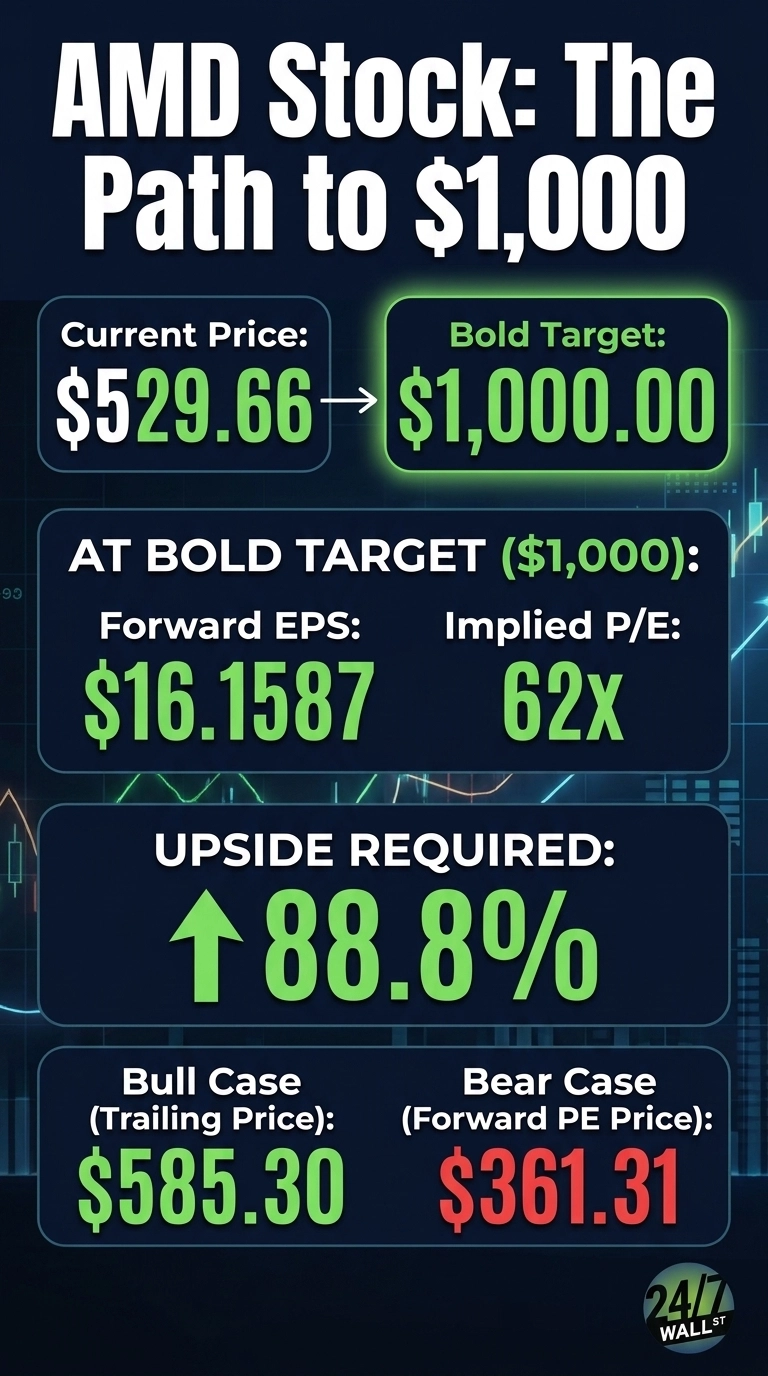
The target depends on earnings growth. At today’s 33x forward multiple, $1,000 requires about $30.51 in EPS. Management expects operating expenses to grow less than half as fast as revenue in 2027, so earnings should grow faster than sales. If that happens, the multiple contracts as EPS catches up.

Customer commitments back it up. Anthropic has committed to up to 2 GW of MI450 GPUs. Meta Platforms (NASDAQ:META) plans to deploy up to 6 GW of Instinct GPUs.
William Blair also says NVIDIA faces “a potential leadership vacuum.” On the earnings call, CEO Lisa Su said, “From everything that we see, demand continues to go up.”
The main risk is supply. Su acknowledged that “demand is higher than supply,” and shortages of wafers, packaging or memory could delay the earnings growth.
Where AMD Trades Today vs. Its Earnings Power
AMD trades at about 33x forward earnings. That looks reasonable for a company guiding to roughly 66% revenue growth in the fourth quarter. Shares range from a 52-week bottom of $188.22 to a peak of $658.52.
Over 10 years, the stock has returned 7700.59%. If earnings compound as guided, today’s multiple contracts quickly, and that sets up the $1,000 case.
$1,000 Is a Stretch, but Here’s Why It’s Possible
A move to $1,000 calls for a gain of 88.8%. My take is that it’s ambitious but plausible. Three key pieces must fall into place. Helios has to growth through 2027 on schedule. MI500 has to turn into multi-gigawatt deployments. Data Center has to grow past 80% of revenue with expanding margins.
A pullback in hyperscaler AI spending would undermine the thesis. Gains of this size are rare (we reverse-engineered what the biggest tech winners looked like early in a free playbook here), and the path above shows how AMD could reach $1,000 in 2028.
Contact [email protected] for any questions or corrections.
Vandita Jadeja is a financial publisher with over a decade of experience writing about financial topics, including investment, savings, retirement, insurance and banking. Vandita is a Chartered Accountant who loves to debunk financial concepts for readers.
Her work has appeared on sites that include The Motley Fool, InvestorPlace, and Benzinga. She covers investing and focuses on stock picks and price prediction for 24/7 Wall St.
When not looking for the next stock investment opportunity, she can be found traveling, reading, chasing sunsets and enjoying her iced latte.