Amgen Has Raised Its 2026 Outlook Twice, and $1,000 From Five Years Ago Is Now Worth More Than $2,500

This post may contain links from our sponsors and affiliates, and Flywheel Publishing may receive compensation for actions taken through them.
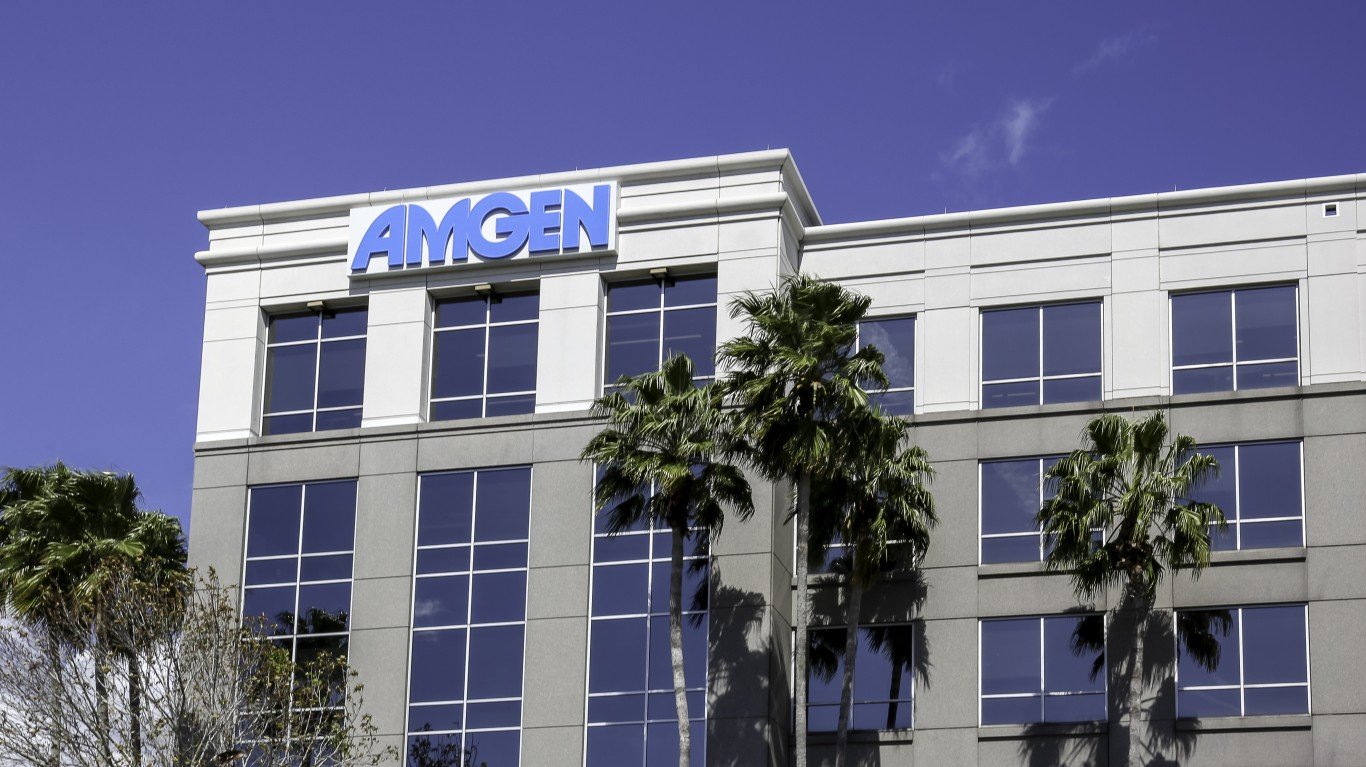
Amgen (NASDAQ:AMGN | AMGN Price Prediction) has spent five years replacing aging blockbusters with a newer growth portfolio, and 2026 is the year that shift showed up in the numbers. Management raised its full-year outlook in August and again in November, and the stock is up 44.13% year to date.

Out With Prolia, In With Repatha and IMDELLTRA
Amgen’s legacy franchises are shrinking fast. In the third quarter, Prolia fell 45%, and XGEVA dropped 47% as biosimilars launched globally. Medicare Part D price setting under the Inflation Reduction Act also cut Enbrel’s net selling price by 14%. The Horizon Therapeutics acquisition, which closed in 2023, brought in rare-disease drugs like UPLIZNA and TEPEZZA, plus debt that remains at $54.0 billion.
The newer drugs are now making up the difference. Third-quarter revenue reached $10.365 billion, up 8.45%. Repatha brought in $1.085 billion (+37%), UPLIZNA grew 191%, and IMDELLTRA rose 128%. Non-GAAP EPS of $6.45 exceeded the $5.7822 consensus, the sixth consecutive beat.

February’s starting guidance called for revenue of $37.0 billion to $38.4 billion[1] and non-GAAP EPS of $21.60 to $23.00. After six key growth drivers rose 26%[2] in the second quarter, Amgen lifted that to $38.2 billion to $39.4 billion and $22.30 to $23.50. November’s raise moved it to $38.9 billion to $39.7 billion and $22.90 to $23.70.
Your $1,000 Became $2,603 and Beat the Market Everywhere
Amgen returns include reinvested dividends, while the SPY benchmark reflects price changes only. Including SPY’s dividends would narrow Amgen’s reported lead. The S&P 500 benchmark uses the SPDR S&P 500 ETF Trust (NYSEARCA:SPY) price change.
1-Year Return
- Initial Investment: $1,000
- Current Value: $1,411
- Total Return: 41.08%
- S&P 500 (same period): $1,101 (10.12%)
5-Year Return
- Initial Investment: $1,000
- Current Value: $2,603
- Total Return: 160.26%
- Annualized Return: 21.08%
- S&P 500 (same period): $1,581 (58.06%)
10-Year Return
- Initial Investment: $1,000
- Current Value: $4,258
- Total Return: 325.81%
- Annualized Return: 15.59%
- S&P 500 (same period): $3,387 (238.65%)
Timing counted, as shares sat at $338.01[3] when first-quarter results landed in April, then reached $466.36 by the November report. Holders needed patience while biosimilars ate into Prolia before the newer drugs took over.
A 20x Earnings Multiple and a MariTide Catalyst Shape the Outlook
Investors are betting that Repatha, IMDELLTRA and UPLIZNA keep outpacing biosimilar erosion and that MariTide, a monthly obesity candidate in Phase 3, reaches market. At its November 13 closing price of $465.67, Amgen trades at roughly 20 times the midpoint of its 2026 adjusted EPS guidance. Management also stated, “we do not anticipate a step-down in operating margin” in 2027.

Skeptics worry that MariTide could stumble against established GLP-1 rivals, since the obesity program carries much of the long-term premium. The FDA’s request to withdraw TAVNEOS and the heavy debt load add pressure. On balance, a diversified portfolio is overcoming its decline at a reasonable multiple.
Contact [email protected] for any questions or corrections.
David Beren has been a Flywheel Publishing contributor since 2022. Writing for 24/7 Wall St. since 2023, David loves to write about topics of all shapes and sizes. As a technology expert, David focuses heavily on consumer electronics brands, automobiles, and general technology. He has previously written for LifeWire, formerly About.com. As a part-time freelance writer, David’s “day job” has been working on and leading social media for multiple Fortune 100 brands. David loves the flexibility of this field and its ability to reach customers exactly where they like to spend their time. Additionally, David previously published his own blog, TmoNews.com, which reached 3 million readers in its first year. In addition to freelance and social media work, David loves to spend time with his family and children and relive the glory days of video game consoles by playing any retro game console he can get his hands on.