4 Bank Stocks That Deliver Retirees Dependable Passive Income

This post may contain links from our sponsors and affiliates, and Flywheel Publishing may receive compensation for actions taken through them.
When you’re retired, the dividends that matter most are the ones that keep coming every quarter and keep growing, and big U.S. banks are built to pay them. They earn far more than they pay out. Regulators test their capital every year. Over the past several years, their boards have mostly been raising payouts. The four banks below include three national giants and one regional lender, and each paid its latest dividend from rising earnings. One example of the cash involved: in its most recent quarter, PNC Financial Services (NYSE:PNC | PNC Price Prediction) returned approximately $800 million of common dividends[1] to shareholders.
Wells Fargo: A Rebuilt Dividend With Plenty of Earnings Cushion
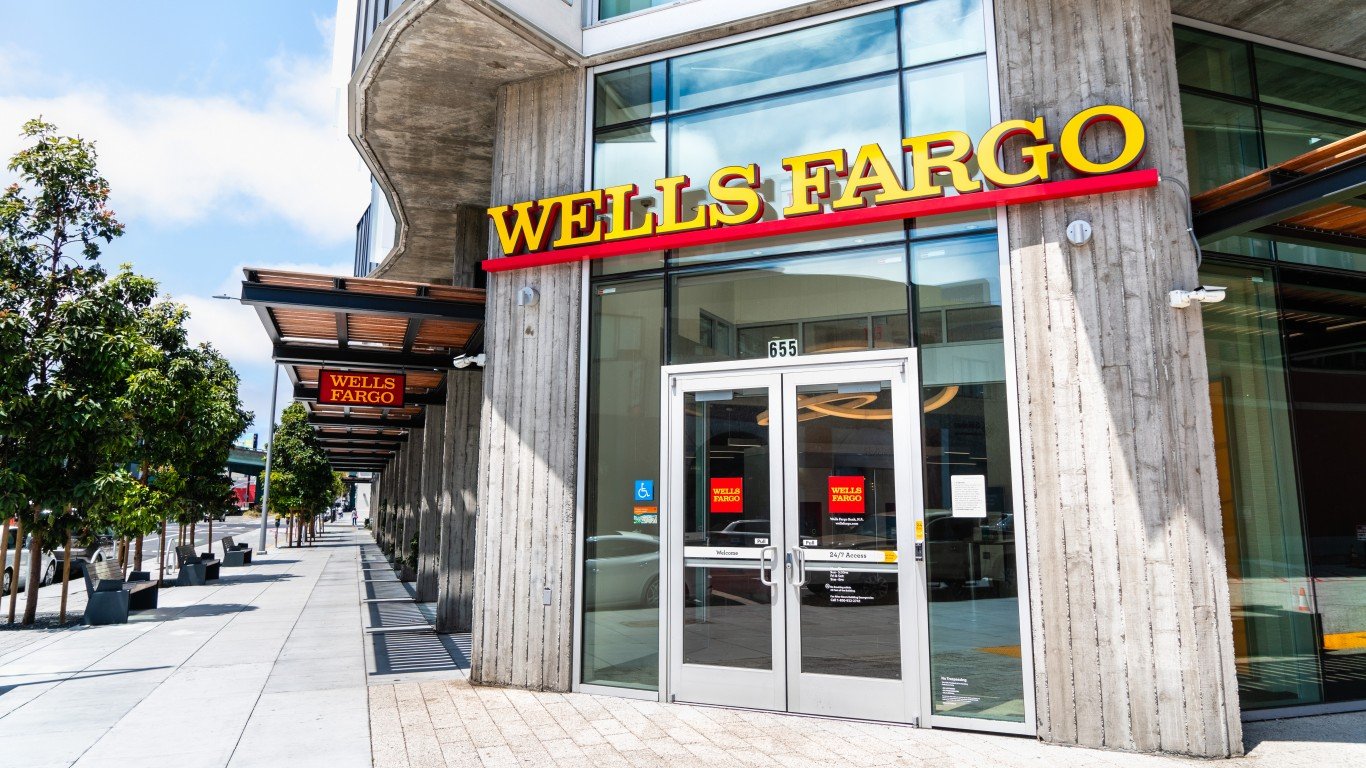
Wells Fargo (NYSE:WFC) is the largest bank in this group and pays out the lowest share of its profits. With trailing diluted EPS of $7.09 and a trailing dividend of $1.85 per share, the payout ratio is about 26.1%. That leaves most of its earnings available for loan growth, buybacks, and future raises. In its second-quarter report, Wells Fargo posted GAAP EPS of $2.00[2], net income of $6.407 billion, a tangible common equity return of 17.7%, and a CET1 capital ratio of 10.3%. Net charge-offs ran at just 0.34% of average loans.
The dividend has grown steadily. The quarterly payout rose from $0.35 per share in early 2024 to $0.50 per share, with a raise in each of the last three years. The latest raise was 11%[2], and the forward annualized dividend is now $2 per share.
At $81.57, the stock yields 2.47% and trades at about 12 times trailing earnings and 11 times forward earnings. Shares are down 10.5% year-to-date, and Jim Cramer recently called Wells Fargo “incredibly cheap.”
Why a retiree might own it: The asset cap that limited Wells Fargo’s growth has been removed, and the bank is growing again. Average loans reached $1.03 trillion, crossing $1 trillion for the first time. Markets revenue rose 24%,[2] and investment banking fees rose 36%. With a low payout ratio and profits still rising, the bank has plenty of room to raise the dividend in the future.
Risk: This dividend has been cut before. The quarterly payout fell from $0.51 per share in early 2020 to $0.10, and it took several years to rebuild.


U.S. Bancorp: Steady Raises Backed by Record Revenue
U.S. Bancorp (NYSE:USB), based in Minneapolis, is one of the largest banks in the country. Trailing EPS of $5.14 covers its $2.10 trailing dividend with room to spare, for a payout ratio of about 40.9%. In the third quarter, the bank earned $1.34[3] per share, and net income rose 10% year over year to $2.202 billion. Its efficiency ratio improved to 55.9%,[3] and net charge-offs fell to 0.51%. Its CET1 ratio held at 10.8%[4]. CFO John Stern said, “After dividend distribution, we generated 33 basis points of capital.”[4]
The dividend history is consistent. The quarterly payout rose from $0.42 per share in 2020 and 2021 to $0.46, $0.48, $0.49, $0.50, and $0.52, reaching $0.54 with the latest raise. The recent record shows no missed quarters. The forward annualized dividend is $2.16 per share. Management said it remains “very much committed to the 70% to 75% payout from a capital distribution standpoint.”[4]
At $58.25, U.S. Bancorp yields 3.71% and trades at about 12 times trailing earnings. Shares are up 32.04% over the past year.
Why a retiree might own it: Fees made up 44%[4] of total revenue, which makes earnings less dependent on interest rates. Capital markets revenue rose 69.3%[3] after the BTIG acquisition, and consumer deposits reached another record. Stern also pointed to further margin gains: “We continue to see a path to a 3% NIM at some point in 2027.”[4]
Risk: U.S. Bancorp is sensitive to interest rates. Higher Treasury rates and wider credit spreads cut 40 basis points[4] from capital, and the CET1 ratio, including unrealized bond losses, fell to 9.1%. Buybacks were paused during the quarter as a result.


PNC Financial Services: A Big Raise From a Bank That Held the Line
PNC is based in Pittsburgh and operates in 21 states and the District of Columbia. Trailing EPS of $18.78 covers its trailing dividend of $7.10 per share, for a payout ratio of about 37.8%. Third-quarter adjusted EPS was $5.09,[5] and net income rose 16% to $2.097 billion. Its tangible common equity return reached 18.3%[5]. The CET1 ratio of 9.8%[5] is slightly below management’s target, and CFO Robert Reilly explained the gap: “Our target is 10%, and that was simply a result of loans coming in higher than we expected.”[1]
PNC kept its dividend steady through the 2020 downturn. The quarterly dividend held at $1.15 throughout 2020. After that, it rose to $1.25, $1.50, $1.55, $1.60, and $1.70. The latest raise, 18%[6], took the quarterly payout to $2. The forward annualized dividend is $8 per share.
At $221.14, PNC yields 3.62% and trades at about 12 times trailing earnings.
Why a retiree might own it: PNC is growing quickly while keeping its lending standards. Loans grew 14%[1] through the first nine months of the year, and more than $30 billion of that growth came internally. The FirstBank deal added about 780K customers and 95 branches in Colorado and Arizona. CEO William Demchak summed it up: “Our organic growth is surprising even to us.”[1] The bank also returned $1.4 billion to shareholders last quarter.
Risk: Business loan quality is slipping. Commercial nonperforming loans rose to $1.314 billion from $1.149 billion, and new nonperforming assets climbed to $692 million from $335 million.


KeyCorp: The Regional Lender Paying the Richest Yield of the Group
KeyCorp (NYSE:KEY) is the only regional bank in this group. It is based in Cleveland and pays the highest dividend yield of the group. Trailing EPS of $1.78 covers its $0.82 annual dividend, for a payout ratio of about 46.1%. It is the highest payout ratio of the four, though it still leaves a solid buffer. Third-quarter EPS reached $0.51[7], and net income from continuing operations was $537 million, up from $454 million a year earlier. Net charge-offs improved to 0.32%[7] from 0.42%. Its regulatory CET1 ratio is 11.1%, and the bank plans $1.3 billion in buybacks this year.
KeyCorp’s dividend has been steady but flat. It has paid $0.205 per share every quarter since late 2022, after earlier increases from $0.17 to $0.185 to $0.195. That means it has no current run of annual raises. The board declared another quarterly cash dividend[8] in its most recent announcement.
At $20.62, KeyCorp yields 3.98%, the most of these four, and trades at about 12 times trailing earnings.
Why a retiree might own it: Earnings are improving. Net interest margin expanded to 2.95%[7], and about $19.9 billion of low-yielding securities will roll into higher-rate assets through 2027. CEO Chris Gorman said the results “reinforce our confidence in achieving and sustaining a return on tangible common equity of 15%+ by the end of 2027.”[7] As profits rise, KeyCorp will have more room to resume dividend growth.
Risk: Rate swings hit KeyCorp harder than the others. Unrealized losses on its bond portfolio total $3.865 billion. Including those losses, its CET1 ratio falls to 9.0%, and tangible book value per share fell 8% to $12.35.


Four Banks, One Income Theme: Payouts That Earnings Cover
All four banks pay less than half of their trailing earnings as dividends, keep regulatory capital near or above their targets, and are reporting improving operating results. Wells Fargo and PNC offer the fastest recent dividend growth, U.S. Bancorp offers a long run of steady raises, and KeyCorp pays the group’s highest yield. Together, they offer quarterly income supported by rising profits. (If you want to see how a mid-six-figure balance can be turned into a monthly paycheck using names like these, we laid out the math in a free income guide.)
Contact [email protected] for any questions or corrections.
Lee Jackson has covered Wall Street analysts' equity and debt research and equity strategy daily for 24/7 Wall St. since 2012. His broad, diverse career, including a stint as creative services director at an NBC affiliate in Austin, Texas, gives him unique insight into the financial industry.
Lee Jackson's journey in the financial industry spans more than 30 years, including nearly two decades as an institutional equity salesperson at Bear Stearns, Lehman Brothers, and Morgan Stanley. His career spanned pivotal sell-side Wall Street events, from the dot-com rise and bubble to the Long-Term Capital Management debacle, 9/11, and the Great Recession of 2008. This reflects his resilience and adaptability amid market volatility.
Lee Jackson’s practical financial industry experience, gained through a career at some of the biggest banks and brokerage firms, is complemented by a lifetime of writing across various platforms. This unique combination allows him to shed light on the intricacies of Wall Street in a way only someone with deep insider experience and knowledge can. Moreover, his extensive network across Wall Street continues to provide direct access for him and 24/7 Wall St., a privilege few firms enjoy.
Since 2012, Jackson’s work for 24/7 Wall St. has been featured in Barron’s, Yahoo Finance, MarketWatch, Business Insider, TradingView, Real Money, The Street, Seeking Alpha, Benzinga, and other media outlets. He attended the prestigious Cranbrook Schools in Bloomfield Hills, Michigan, and has a degree in broadcasting from the Specs Howard School of Media Arts.