Savings Accounts Pay Next to Nothing. Owning the Bank Pays $7,479 a Year on $195,000


This comparison looks at what a bank pays a depositor versus what it pays a part-owner, using three bank stocks. Most people keep their cash at a bank, and the bank pays very little for it. As of Oct. 1, 2026, the FDIC’s national average yield on a 12-month CD was 1.76%, and a CD usually pays more than a basic savings account. Banks make their money on the gap.
They pay depositors a low rate, lend the same money out at a higher one, and keep the difference. That spread is called net interest margin, and a bank’s owners get part of that profit as dividends.
A $65,000 stake in each of three bank stocks would produce the following. That’s $195,000 in total, earning about $7,479 a year. Prices are from the Nov. 9, 2026 close. Our recent look at super-regional bank dividends covered the group broadly. This one works through the income math on three names.
Savings and stocks involve a trade-off: savings are FDIC-insured, and stocks can fall, so many savers keep emergency money in cash. Our guides to high-yield savings accounts and emergency funds cover that side. Bank dividends are paid out of earnings, so the payout ratio (the share of profit paid out as dividends) is the safety check used here. These yields run high because bank shares often trade at modest valuations while their quarterly dividends have held steady or risen.
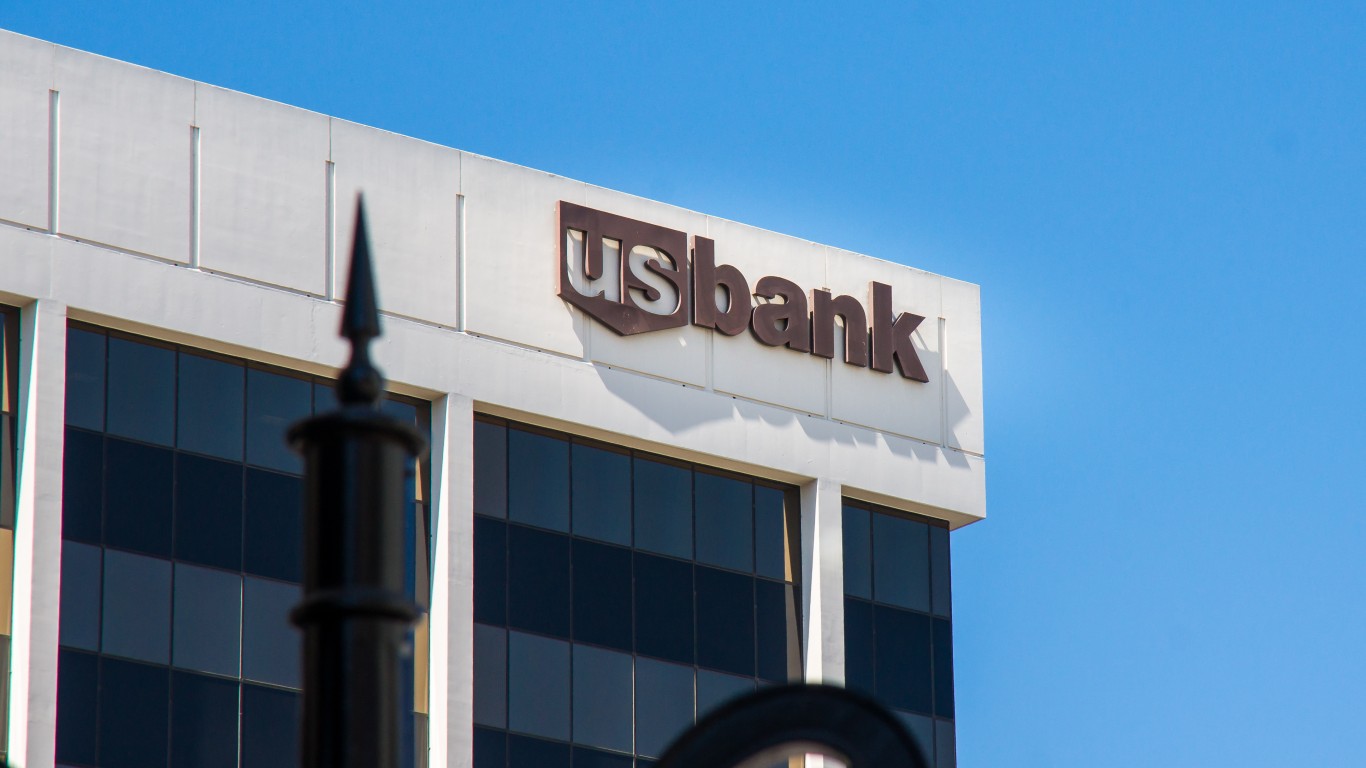
U.S. Bancorp
- Stock #3: U.S. Bancorp (NYSE:USB | USB Price Prediction)
- Yield: 3.54% (forward)
- Shares for $65,000: 1,066.45
- Annual Passive Income: ~$2,304
U.S. Bancorp, based in Minneapolis, is the parent of the fifth-largest commercial bank in the United States. Its business includes consumer banking, corporate lending, wealth management and payments, and it added capital markets firm BTIG on June 1, 2026. It’s the only bank in the group to raise its dividend this year, lifting the quarterly payout from $0.52 to $0.54. The new payout works out to about 40% of third-quarter diluted EPS of $1.34.
During the financial crisis, U.S. Bancorp cut its quarterly dividend from $0.425 in 2008 to $0.05 in 2009. Loan losses are the main risk to watch. Its net charge-off ratio, meaning loans written off as bad, was 0.51% in the third quarter, and that figure tends to rise in a downturn.
KeyCorp
- Stock #2: KeyCorp (NYSE:KEY)
- Yield: 3.83% (forward)
- Shares for $65,000: 3,035.96
- Annual Passive Income: ~$2,489
Cleveland-based KeyCorp runs KeyBank’s consumer and commercial lending businesses, along with KeyBanc Capital Markets. It has paid $0.205 a quarter since 2022 without an increase. That payout is about 40% of third-quarter EPS of $0.51. In the crisis, KeyCorp cut its dividend from $0.375 to $0.01 by May 2009.
For KeyCorp, the main risk is interest rate swings. Bonds it bought when rates were lower are carrying $3.865B in unrealized losses. Including those losses, its CET1 ratio is 9.0%, compared with 11.1% on the regulatory basis. CET1 is the core capital buffer regulators require, so any tightening of capital rules would matter here.
Truist Financial
- Stock #1: Truist Financial (NYSE:TFC)
- Yield: 4.13% (forward)
- Shares for $65,000: 1,291.48
- Annual Passive Income: ~$2,686
Charlotte-based Truist emerged from the 2019 merger of BB&T and SunTrust and operates about 1,912 branches. It’s slimming down by selling non-core loan books, including the $7.7B LightStream portfolio to Carlyle Group (NASDAQ:CG). The quarterly dividend has been $0.52 since 2022. That’s about 45% of third-quarter adjusted EPS of $1.16. Truist cut its payout from $0.47 to $0.15 in 2009.
Commercial real estate is the risk to track. Like most large lenders, Truist holds commercial property loans, and those can go bad when office and retail values fall. For now, its nonperforming loans stand at 0.40% of the total, and its CET1 ratio is 10.7%.
Income Breakdown for All Three Banks
| Name | Yield | Annual Dividend Income |
|---|---|---|
| U.S. Bancorp | 3.54% | $2,304 |
| KeyCorp | 3.83% | $2,489 |
| Truist Financial | 4.13% | $2,686 |
| Total | 3.84% | $7,479 |
What $195,000 in Bank Stocks Can Produce
Together, these three positions generate $7,479 in annual passive income from a $195,000 investment and yield 3.84% combined. Truist contributes $2,686, KeyCorp adds $2,489, and U.S. Bancorp rounds out the group with $2,304.
Two numbers are worth watching each quarter: each bank’s CET1 capital ratio and its net charge-offs. If capital shrinks or loan losses climb, the dividend comes under pressure, and all three banks cut theirs in 2009. Dividends paid out of earnings carry no guarantee. Still, cash that comes every quarter can be reinvested to buy more shares, and over time those reinvested dividends grow the income stream without adding new money.
Contact [email protected] for any questions or corrections.
David Beren has been a Flywheel Publishing contributor since 2022. Writing for 24/7 Wall St. since 2023, David loves to write about topics of all shapes and sizes. As a technology expert, David focuses heavily on consumer electronics brands, automobiles, and general technology. He has previously written for LifeWire, formerly About.com. As a part-time freelance writer, David’s “day job” has been working on and leading social media for multiple Fortune 100 brands. David loves the flexibility of this field and its ability to reach customers exactly where they like to spend their time. Additionally, David previously published his own blog, TmoNews.com, which reached 3 million readers in its first year. In addition to freelance and social media work, David loves to spend time with his family and children and relive the glory days of video game consoles by playing any retro game console he can get his hands on.