Nvidia Stock Just Lost $900 Billion in Its Worst Week Since 2008. The Last Time the SEC Examined Nvidia’s Accounting, the Stock Fell 81% in a Year

This post may contain links from our sponsors and affiliates, and Flywheel Publishing may receive compensation for actions taken through them.

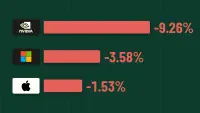
Nvidia (NASDAQ: NVDA) stock closed at $125.53 on Friday, down 14% for the day and 23% for the week. The week erased about $900 billion of market value, the largest one-week loss for any company on record, and it was Nvidia’s worst week since October 2008.
The last push came Friday afternoon, when Reuters reported that Securities and Exchange Commission staff are scrutinizing Nvidia’s accounting. The SEC declined to comment. An investigation is not an accusation, and many close with no action taken.
Nvidia has been through this once before. In 2002, the SEC questioned its books, and the stock fell 81% in a year. That’s one case, from the dot-com bust, and it ended with no fine.
The biggest one-week loss on record
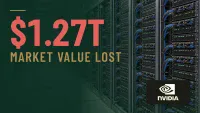
Last week, Nvidia lost $573 billion of market value by Dow Jones Market Data’s count, the most any company had ever lost in one week. This week’s loss came to about $901 billion, which is $328 billion more. Over the two weeks, about $1.5 trillion is gone.
It was Nvidia’s seventh straight weekly decline, the longest such run since 2008. The shares have fallen 48% from their record close on Oct. 6.
What happened to Nvidia in 2002
On Feb. 14, 2002, Nvidia disclosed that the SEC was looking into its accounting. Jensen Huang, who left the CEO job last week, was running the company then. The stock fell 8% the next day. On April 29, 2002, Nvidia’s audit committee decided to restate three fiscal years of results.
Six months after the disclosure, the stock was down 85%. A year after, it was down 81%.
The SEC closed the case on Sept. 11, 2003, 19 months after it became public. Nvidia agreed to a cease-and-desist order without admitting or denying the findings, and it paid no penalty or fine. The stock was still 69% below where it stood before the disclosure. It didn’t get back to that price until May 2006, more than four years later.
The investigation was only part of that fall. The Nasdaq-100 fund lost 34% in the same year, and Nvidia was a far smaller company with one main business, graphics chips for PCs and game consoles.
What happened at GE, Kraft Heinz, Under Armour and ADM
Here are the same numbers for four other large companies whose books came under SEC investigation and that later settled with the agency. Each change is measured from the last close before the news came out.
| Company | News came out | First session after | 6 months later | 1 year later | How it ended |
|---|---|---|---|---|---|
| Nvidia | Feb. 14, 2002 | -8% | -85% | -81% | Sept. 2003, no fine |
| General Electric | Jan. 24, 2018 | -3% | -23% | -48% | Dec. 2020, $200 million penalty |
| Kraft Heinz | Feb. 21, 2019 | -27% | -48% | -43% | Sept. 2021, $62 million penalty |
| Under Armour | Nov. 3, 2019 | -19% | -54% | -35% | May 2021, $9 million penalty |
| Archer-Daniels-Midland | Jan. 21, 2024 | -24% | -6% | -25% | Jan. 2026, $40 million penalty |
All five stocks were lower a year later, by 25% to 81%. The cases took from 18 months to almost three years to close, and the penalties ran from $9 million to $200 million, small sums next to the market value lost.
This is a short list of well-known cases, and each came with other bad news. Kraft Heinz cut its dividend and wrote down its brands the same day. Under Armour cut its sales outlook, and its year included the 2020 crash. Investigations that close quietly never make a list like this.
What’s known about this one
Reuters didn’t learn which parts of the books are under review, or when the review began. The Wall Street Journal first reported on Tuesday that the agency was investigating the company’s disclosures to shareholders. The same day, the Financial Times reported that Nvidia changed how it reports revenue by country last year, which removed Singapore from the breakdown.
Nvidia also hasn’t filed its quarterly report. It usually files the 10-Q the same day it reports earnings. On Tuesday, when Nvidia reported $115.8 billion in revenue, it said the filing would come “in the coming weeks,” MarketWatch reported. The deadline is Dec. 4.
What it means if you own Nvidia
Nobody outside the SEC knows what it will find, and the agency hasn’t accused Nvidia of anything. In these five cases, regulators took a year and a half or longer to finish. All five stocks were lower a year in, even where the final penalty was small.
If Nvidia has grown into a large share of your retirement savings, that’s a long time to wait for an answer. Decide how much of the position you’re willing to hold through it, and decide it on a calm day.
Contact [email protected] for any questions or corrections.
I've been writing about stocks and personal finance for 20+ years. I believe all great companies are tech companies in the long run, and I invest accordingly.