4 High-Yield Dividend Stocks for Retirees Who Want Income They Can Count On

This post may contain links from our sponsors and affiliates, and Flywheel Publishing may receive compensation for actions taken through them.

In choppy markets, retirees care most about whether the quarterly check shows up. The four companies below pay generous yields. Each one runs a business built to keep those payments coming: pipeline fees, long-term healthcare leases, and monthly wireless bills. Reliability is what links them together, and Enbridge (NYSE:ENB | ENB Price Prediction) has a long record of it. The company describes its latest raise as its 31st consecutive annual increase.
Enbridge: 31 Straight Annual Raises Backed by Regulated Pipes
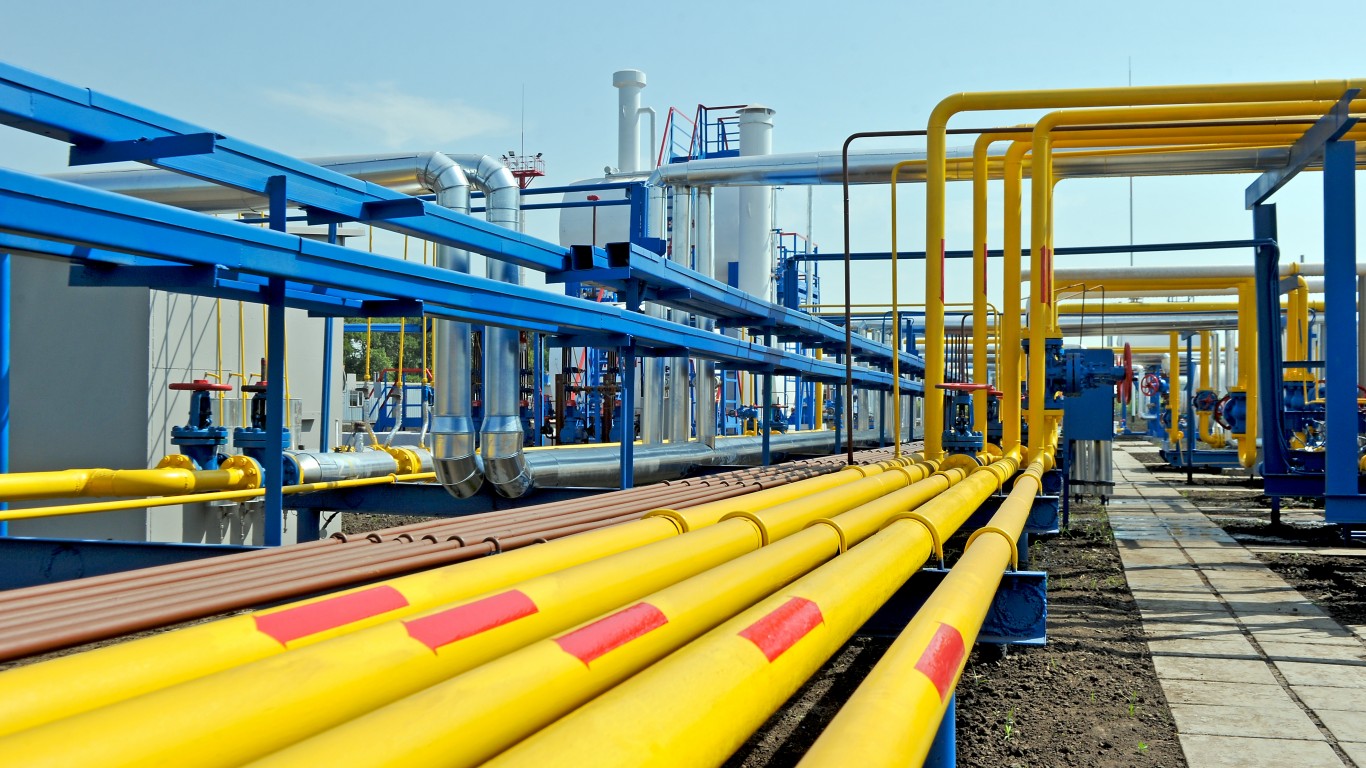
Enbridge yields 5.92%, based on a forward annualized payout of $2.72 per share and a recent price of $45.92. Enbridge and MPLX (NYSE:MPLX), the next name, both work in the same corner of energy: midstream pipelines. They charge fees to move and store oil and natural gas, much like a toll road charges per car, so their cash flow depends more on contracted volumes than on commodity prices. At Enbridge, most earnings come from contracted, cost-of-service or rate-regulated assets. That includes gas utilities in Ontario, Ohio, Utah, and North Carolina.
Dividend safety: The right yardstick for Enbridge is distributable cash flow (DCF). Management confirmed 2026 DCF guidance of C$5.70 to C$6.10 per share. The annualized dividend of C$3.88 works out to about 66% of the midpoint, which leaves a solid cushion. The company also says it is on track to meet guidance for the 21st consecutive year. On the dividend record itself, CEO-designate Michele Harradence said: “So, 31 consecutive years of dividend increases. That Dividend Aristocrat status is held by a very small group in energy.”[1]
For U.S. holders, Enbridge announces its dividend in Canadian dollars, and the 2026 rate is C$0.97 per quarter. As a result, the U.S. dollar amount moves with the exchange rate. The December 1 payment converts to $0.6906, compared with $0.712 on the February record. The Canadian-dollar rate stayed the same, so the difference comes entirely from currency movement. Canadian withholding tax can also apply to dividends held in taxable U.S. accounts, which cuts the net amount you receive.
Bull case: A ~$38B secured backlog supports management’s medium-term outlook of about 5% annual growth in EBITDA, DCF per share and EPS. CFO Patrick Murray said Enbridge returned $39 billion[1] in dividends over the past five years and expects $40 billion to $45 billion over the next five.
Risk: Debt-to-EBITDA stands at 5.1x, above the 4.5- to 5x[1] target. Management blamed currency moves and said leverage would sit inside the range on an FX-adjusted basis. Even so, interest costs rise as debt increases.
MPLX: 8.6% Yield With 1.3x Coverage
MPLX yields 8.67% on a forward annualized distribution of $4.8444 and a price of $55.92. Like Enbridge, it is a midstream toll collector. Its system runs from the wellhead to the water, covering gathering, processing, pipelines, fractionation, and export loading docks.
Distribution safety: The key metric is distribution coverage, at 1.3x. That means MPLX generated about $1.30 of distributable cash for every $1.00 it paid out. Third-quarter DCF came to $1.54B[2], and adjusted EBITDA rose 5.3% year over year. Leverage is 3.8x, below the partnership’s 4.0x target. The quarterly payout rose to $1.2111, a 12.5% increase for the third consecutive year[3]. Management calls this its fifth consecutive year of double-digit increases[3]. The record shows the regular payout climbing from $0.775 in early 2023 to its current level.
Bull case: More than 90%[3] of the $2.9 billion growth budget goes to Permian and Marcellus natural gas and NGL projects, which ride demand from LNG exports and gas-fired power. For 2027, CEO Maryann Mannen said: “We still expect a significant distribution increase in 2027, greater than distributable cash flow growth.”[3] She also said another 12.5% raise could be affected by the $750 million sale of assets that serve two Marathon Petroleum (NYSE: MPC) refineries.
Caveat: MPLX is a master limited partnership, so its payouts are distributions, and unitholders get a Schedule K-1 at tax time in place of a Form 1099, which makes filing more involved. Holding it in an IRA adds another step. The IRS has a rule here. An IRA owes tax on business income earned through a partnership of which it is a member, and an IRA with $1,000 or more of that gross income must file Form 990-T. The legal basis is 26 U.S.C. § 512(c)(1)[4].
Omega Healthcare Investors: Senior Care Rent With Record-Low Leverage
Omega Healthcare Investors (NYSE:OHI) yields 5.9% on an annualized $2.72 dividend and a price of $45.79. It is a healthcare REIT with skilled nursing facilities, senior housing, and U.K. care homes. Most of those properties are leased to operators under long-term triple-net leases, meaning the tenant bears the taxes, insurance, and maintenance.
Dividend safety: REIT earnings carry heavy non-cash depreciation, so the better measure of what the business can pay is adjusted funds from operations (AFFO). Third-quarter AFFO was $0.82[5] per share, and funds available for distribution were $0.78[6]. That puts the $0.68[5] quarterly dividend at about 83% of AFFO. Full-year AFFO guidance was raised to $3.28-$3.30[5] per share. Leverage is 3.1x[6], and fixed-charge coverage is 6.9x. The $2 billion[6] revolver had nothing drawn. The dividend held at $0.67 from 2020 into 2026 with no cut or skipped payment, then rose to $0.68.
Bull case: Tenants are getting stronger. Operator EBITDAR coverage improved to 1.67x, and Omega has put about $1.5 billion[6] to work so far this year. That includes an $845.7M[5] U.K. mortgage loan at 8.72%[5]. CEO Matthew Gourmand pointed to “our lowest leverage in the company’s history, EBITDA coverage at the highest level in over a decade.”[6]
Risk: Omega’s rent depends on how its operators are doing, and their revenue depends on Medicare and Medicaid reimbursement. Genesis went through Chapter 11, and its lease now sits with NewGen, which bears $13.3 million per quarter[6]. Management says Maplewood may need “one to two years”[6] to steady. Changes to reimbursement policy or staffing rules could squeeze tenant margins.
Verizon: Free Cash Flow Leaves Plenty of Room for the Dividend
Verizon (NYSE: VZ) yields 6.10% on an annualized $2.83 dividend and a $46.43 price. Customers pay their phone and broadband bills every month, which gives Verizon recurring, subscription-based cash flow.
Dividend safety: Free cash flow coverage is the measure to watch here. Verizon has covered its dividend so far. Over the first nine months, it generated $18 billion[7] of free cash flow and paid $8.8 billion in dividends, so the dividend used about 49% of free cash flow. Third-quarter free cash flow reached $7.80B[8], up 13.88% year over year, and full-year free cash flow growth is expected to approach 12%[7]. The quarterly dividend rose from $0.69 to $0.7075 this year. The record shows regular quarterly payments dating back to 1999, starting at $0.385 per share.
Bull case: Subscriber momentum is improving. Postpaid phone net adds reached 406K, and the adjusted EBITDA margin widened to 40.2%[8]. CFO Tony Skiadas said: “We remain committed to growing the dividend and delivering enhanced returns to our shareholders through share repurchases.”[7]
Risk: Verizon carries $166.2B[8] of debt, and its interest expense rose 17.2% year over year. Net unsecured debt to EBITDA improved to 2.3x[7], but management does not expect to reach its target range until 2027.
Four Payouts Built to Last
Each of these companies supports its check with a different cash source. Enbridge and MPLX collect pipeline tolls, Omega collects rent covered by its AFFO, and Verizon’s dividend uses about half of its free cash flow. All four have kept paying through very different markets, and their balance sheets and coverage figures support continued payments. Together, they form the start of a dividend ladder. That ladder can fund retirement without ever selling a share, the structure we walked through in a free guide here. Coverage ratios, leverage, and the next round of payout announcements are the figures to monitor in the coming quarters.
Contact [email protected] for any questions or corrections.
Lee Jackson has covered Wall Street analysts' equity and debt research and equity strategy daily for 24/7 Wall St. since 2012. His broad, diverse career, including a stint as creative services director at an NBC affiliate in Austin, Texas, gives him unique insight into the financial industry.
Lee Jackson's journey in the financial industry spans more than 30 years, including nearly two decades as an institutional equity salesperson at Bear Stearns, Lehman Brothers, and Morgan Stanley. His career spanned pivotal sell-side Wall Street events, from the dot-com rise and bubble to the Long-Term Capital Management debacle, 9/11, and the Great Recession of 2008. This reflects his resilience and adaptability amid market volatility.
Lee Jackson’s practical financial industry experience, gained through a career at some of the biggest banks and brokerage firms, is complemented by a lifetime of writing across various platforms. This unique combination allows him to shed light on the intricacies of Wall Street in a way only someone with deep insider experience and knowledge can. Moreover, his extensive network across Wall Street continues to provide direct access for him and 24/7 Wall St., a privilege few firms enjoy.
Since 2012, Jackson’s work for 24/7 Wall St. has been featured in Barron’s, Yahoo Finance, MarketWatch, Business Insider, TradingView, Real Money, The Street, Seeking Alpha, Benzinga, and other media outlets. He attended the prestigious Cranbrook Schools in Bloomfield Hills, Michigan, and has a degree in broadcasting from the Specs Howard School of Media Arts.