The Fed Cut Rates 1.45 Points and Mortgage Rates Rose to 7.28% Anyway. A $200,000 Loan Now Costs $158 More a Month

This post may contain links from our sponsors and affiliates, and Flywheel Publishing may receive compensation for actions taken through them.

If you’re 60 and planning to sell the family house and buy something smaller with a mortgage, the Federal Reserve’s rate cuts haven’t helped you. The Fed has cut its benchmark rate by 1.45 points since September 2024. Over the same stretch the average 30-year fixed mortgage rate went up, from 6.09% the week of the first cut to 7.28% the week of Nov. 19, 2026, according to Freddie Mac’s weekly survey.
On a $200,000 loan, that rise adds $158 to the monthly payment. Over 30 years it comes to $56,782.
The figures here come from 24/7 Wall St.’s new research report, “The State of the American Household,” which pulls rates from Freddie Mac and the Federal Reserve and home prices from the Census Bureau and HUD. Earlier this weekend I measured Kevin O’Leary’s “$5 million liquid” bar against what typical American families own at every age, and for most people near 60 the biggest item on that list is the house. This column is about what it costs to trade that house for a smaller one right now.
Why the Fed’s cut skipped your mortgage
The Fed sets a short-term rate: what banks charge each other overnight. It went from 5.33% to 3.88%. A 30-year mortgage is a long loan, and lenders price it off a long-term rate, the yield on the 10-year Treasury note. Most mortgages are paid off or refinanced well before 30 years, so the 10-year is the closest match.
The 10-year yield did the opposite of the Fed’s rate. It rose from 3.67% the week of the first cut to 5.11% the week of Nov. 19, by the Fed’s weekly averages. That’s a rise of 1.44 points, almost exactly the size of the Fed’s cut in the other direction.
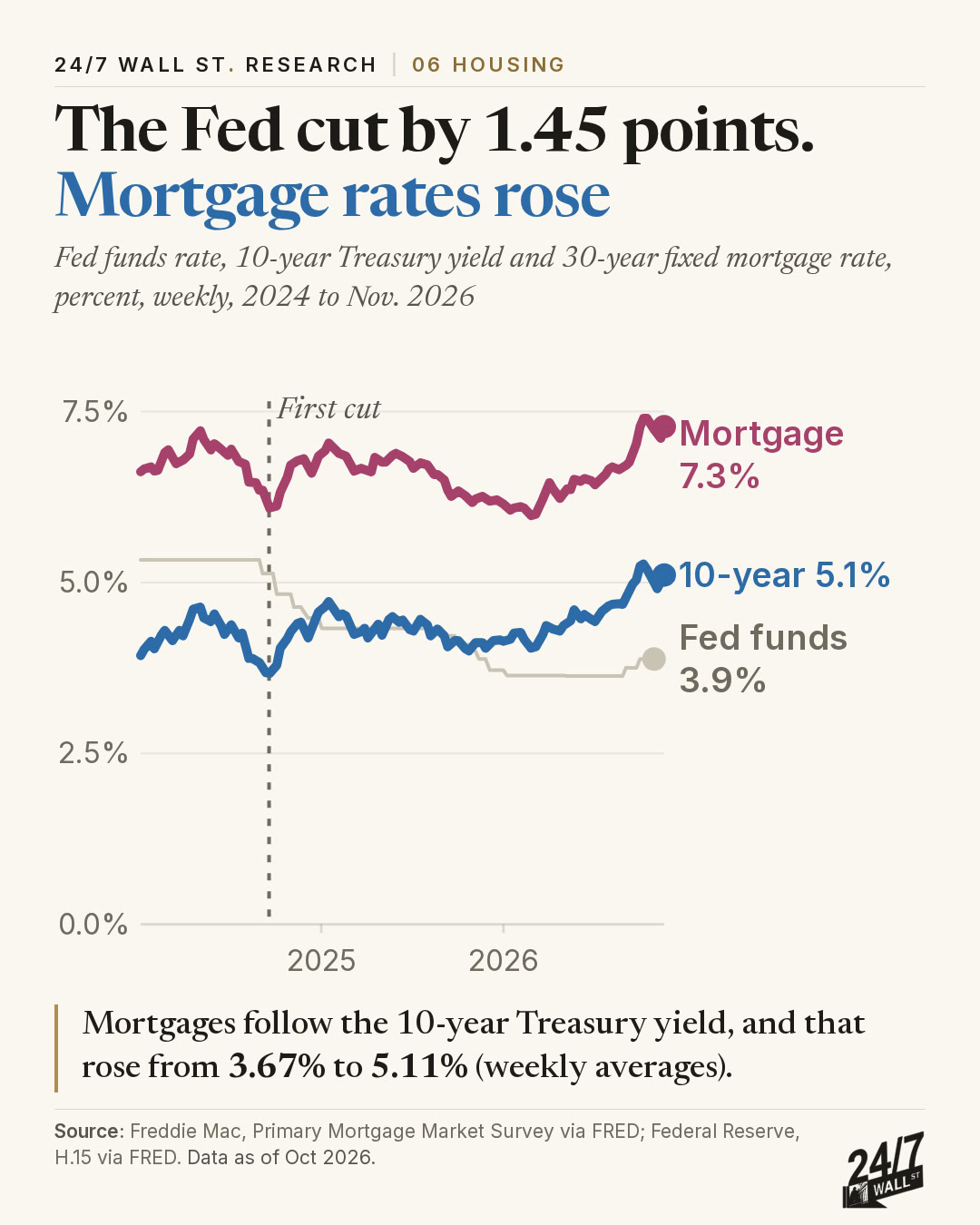
Mortgage rates followed the 10-year, though not all the way. The gap between the mortgage rate and the 10-year yield shrank from 2.42 points to 2.17 points, so the 30-year rate rose 1.19 points while the 10-year rose 1.44. That narrower gap saved borrowers some of the increase.
The practical lesson is to watch the 10-year yield if you’re timing a purchase. That’s the number that sets your rate.
What the move costs a downsizer
Say you sell your house, use part of the money for the next place and borrow $200,000 on a 30-year fixed loan to cover the rest. Here’s what principal and interest come to at each rate:
- At 6.09%, the rate the week of the Fed’s first cut: $1,211 a month.
- At 7.28%, the rate the week of Nov. 19: $1,368 a month.
- The difference: $158 a month, or $1,893 a year.
Taxes and insurance come on top of both. Over the full term, the higher rate means paying $292,633 in interest on the $200,000, against $235,851 at the lower rate.
A simple rule of thumb at today’s rate: every $100,000 borrowed costs about $684 a month, against $605 at the September 2024 rate. And each quarter point the rate moves near today’s level changes the payment on $200,000 by about $34 a month.
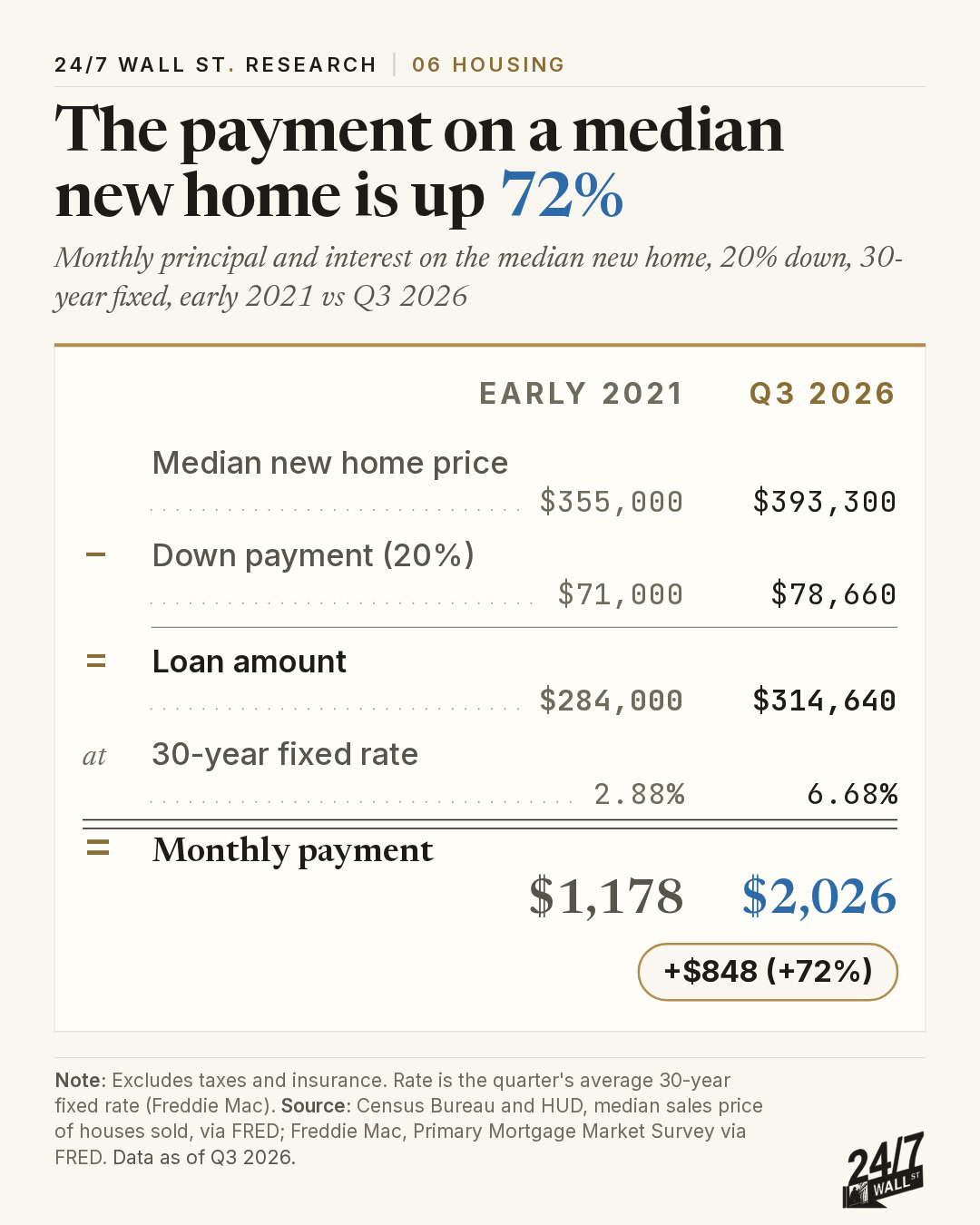
Buyers starting from scratch have it worse. The monthly payment on a median new U.S. home, with 20% down on a 30-year fixed loan, went from $1,178 in early 2021 to $2,026 in the third quarter of 2026, according to the report’s calculation from Census, HUD and Freddie Mac data. That’s up 72%, or $848 a month.
Three ways to keep the payment down
Downsizers have one big advantage over first-time buyers: equity from the house they’re selling. That gives you choices.
Put more down. To get the same $1,211 payment you’d have had at 6.09%, borrow about $176,900 at 7.28% instead of $200,000. That means putting about $23,100 more of your sale proceeds into the new place.
Borrow less by buying less. At 7.28%, a $150,000 loan costs $1,026 a month and a $100,000 loan costs $684. Every $50,000 you trim from the price, or cover with cash, takes about $342 off the monthly bill.
Pay cash, if the numbers allow. A 60-year-old who buys outright has no payment at all, which leaves more of each month’s income for retirement saving in the years before Social Security and Medicare. The trade-off is less cash on hand, so keep enough set aside for emergencies and repairs before you write the check.
If you do take a loan now, a lower rate later isn’t guaranteed. Refinancing is possible if the 10-year yield falls, but plan on the payment you sign for. A loan you can afford at 7.28% is one you can keep.
Before you list the house, run your own numbers: what the next place costs, how much of your sale price you’ll put down, and the payment at this week’s rate. Then check the 10-year yield the week you lock.
We follow the retirement rules that matter every weekday in The Daily Profit, our free email. Sign up and get our Top 10 stocks report too.
Contact [email protected] for any questions or corrections.
I've spent more than 15 years inside enterprise software, working alongside the finance, sales operations, and HR leaders who run the revenue engines at some of the largest tech companies in the country.
My day job is helping enterprise executives make smarter decisions about retention, compensation, and growth. These are the same operational levers that show up in every earnings report investors actually read. That perspective shapes my writing for 24/7 Wall St.
The headline numbers are easy. The interesting stuff is underneath: how companies make money, what executives are worried about, and what any of it means for the person checking their 401(k) on a Sunday afternoon. I write about personal finance and business as someone who has spent her career inside the rooms where these decisions get made.