These 9 Words From Kevin Warsh About Interest Rates Should Worry Every Investor
Fed Chair Kevin Warsh used nine words at a press conference that quietly redefined how investors should measure borrowing cost risk, and most shareholders missed the warning entirely.

Investors often treat Federal Reserve meetings as the starting gun for changes in borrowing costs. A rate hike means tighter household budgets and more expensive business loans. A pause offers breathing room. But that neat sequence overlooks something: Financial markets can move before policymakers do.
Treasury Department figures show the 10-year yield reached 4.94% on Oct. 30, up from 4.67% on July 29. That increase happened outside the familiar quarter-point announcements that dominate headlines. For shareholders, watching only the Fed’s decisions means overlooking a source of pressure on corporate profits and stock prices.
Kevin Warsh’s Nine-Word Interest-Rate Warning
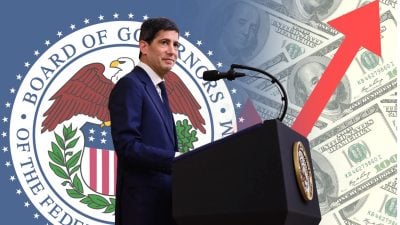
At his July 29 press conference, Fed Chair Kevin Warsh described certain increases in market interest rates as:
“Among the most significant in the last two decades.”
Those nine words describe an unusually sharp increase in borrowing costs — without a Fed rate hike. Warsh placed some increases between Fed meetings around the largest 10% over that period. He was discussing the preceding 42 days, rather than predicting what would happen next.
The context makes the observation more revealing. The Fed’s July statement maintained its benchmark rate at 3.5% to 3.75%. Yet the meeting minutes recorded Treasury yields rising 25 to 30 basis points between meetings, largely reflecting expectations of higher policy rates. One basis point equals 0.01 percentage point.
In other words, investors had already demanded higher returns before the Fed delivered another increase. The risk of interest rates staying higher was reaching markets through prices, rather than policy announcements.
July’s Warning Still Has Teeth
A three-month-old observation needs fresh evidence to deserve attention. Treasury’s daily yield tables provide it:
| Treasury Maturity | July 29, 2026 | Oct. 30, 2026 | Increase |
| Two-year | 4.22% | 4.56% | 34 basis points |
| 10-year | 4.67% | 4.94% | 27 basis points |
| 30-year | 5.20% | 5.31% | 11 basis points |
Source: U.S. Treasury daily par yield curve rates.
Every maturity shown finished October above its level when Warsh spoke. That doesn’t establish another historically rare increase. It shows the earlier tightening wasn’t simply erased.
Nor does a 27-basis-point Treasury increase translate automatically into an identical mortgage-rate increase. Lenders also price credit risk and other costs. But higher benchmark yields can make financing harder without another Fed announcement.
For homebuyers, the pressure is already tangible. Freddie Mac’s average 30-year mortgage rate climbed from 6.66% in the week of Warsh’s remarks to 7.24% by Oct. 29. On a $400,000 mortgage, that raises monthly principal and interest payments by about $155 — nearly $1,900 a year.
Washington faces that same arithmetic. The government’s growing debt burden makes borrowing costs relevant beyond the next central-bank meeting.
Expensive Money Separates Strong Businesses From Weak Ones
For shareholders, the most useful response is to examine financing needs. Consider two hypothetical competitors, each refinancing $10 billion of debt. One replaces a 3% loan with 6% financing. Its annual interest bill doubles from $300 million to $600 million. The other funds expansion from cash generated by its operations and avoids that additional borrowing.
The first company now needs another $300 million annually just to cover interest, before taxes. Its products haven’t improved. Its revenue hasn’t increased. Financing has simply claimed more money.
That is why refinancing exposure deserves attention alongside earnings growth. Compare competitors’ debt maturities, fixed versus floating rates, and free cash flow after capital spending in their SEC filings.
Granted, higher yields can accompany economic strength. July’s Fed minutes described solid activity and strong investment. Rising rates alone don’t establish that stocks must fall. They do make dependence on cheaper financing a vulnerability.
Key Takeaway
Warsh’s nine words justify scrutiny, not a rush to sell. Favor businesses that can finance investment internally and meet approaching debt payments without assuming rates will fall. Treat promised refinancing relief as a possibility, rather than part of the investment thesis.
The Fed can pause rate increases. Your portfolio still needs to handle expensive money.
Contact [email protected] for any questions or corrections.
After two decades of patrolling the dark corners of suburbia as a police officer, Rich Duprey hung up his badge and gun to begin writing full time about stocks and investing. For the past 20 years, he’s been cruising the markets looking for companies to lock up as long-term holdings in a portfolio while writing extensively on the broad sectors of consumer goods, technology, and industrials. Because his experience isn’t from the typical financial analyst track, Rich is able to break down complex topics into understandable and useful action points for the average investor. His writings have appeared on The Motley Fool, InvestorPlace, Yahoo! Finance, Money Morning, and, of course, 24/7 Wall St. He has been featured in both U.S. and international publications, including MarketWatch, Financial Times, Forbes, Fast Company, and USA Today.