5 High-Yield Dividend Stocks That Put Payout Safety Ahead of Yield

This post may contain links from our sponsors and affiliates, and Flywheel Publishing may receive compensation for actions taken through them.
A retiree’s income portfolio works best when the companies in it pay the dividend comfortably out of earnings. That is the test for this list. Enterprise Products Partners (NYSE:EPD | EPD Price Prediction) generated enough distributable cash flow last quarter to cover its payout 1.9x[1]. The other four picks show similar discipline across tobacco, pharma, regulated power and integrated oil. For each one, we checked the dividend record below against actual payment history, and the safety read comes before the yield.
Altria: Pricing Power Funds 61 Raises
Altria (NYSE:MO) pays an annualized $4.44 per share. Priced recently at $73.81, the stock yields 6.02%, which makes Altria one of two ultra-high-yield names on this list.
Dividend safety: The board’s August raise of 4.7%[2] was, in management’s words, the “61st dividend increase in 57 years.” Payment records show the quarterly payout rising from $0.80 in 2019 to $1.11 today, with no cuts or suspensions in the available history. Guidance for 2026 adjusted EPS was lifted to $5.66 to $5.74[2], so the dividend absorbs roughly 77% to 78% of earnings. That is a high payout ratio, but it matches a business that needs little reinvestment. Altria paid out $1.7 billion in dividends in the third quarter and still spent $400 million on buybacks. The goal of mid-single-digit annual dividend growth through 2028 also stands.
Bull case: The company keeps raising prices faster than it loses customers. The adjusted operating margin in smokeable products is 64.5%. Third-quarter revenue of $5.441 billion[2] rose 3.6% from a year earlier, and adjusted EPS of $1.52 exceeded the $1.51 estimate. Equity income from its ABI stake jumped to $228 million from $123 million, and on! PLUS gives it a foothold in smoke-free products.
Risk: U.S. cigarette volumes are shrinking about 5% a year. Marlboro’s market share also slipped 1.0 point to 39.5% as smokers switch to discount brands. Shareholders’ equity is also negative at -$2.225 billion. The stock fell 6.45% over the past week, showing how quickly sentiment can turn against tobacco.
AbbVie: Its Newer Drugs Have Already Replaced Humira’s Sales
AbbVie (NYSE:ABBV) has a forward annualized dividend of $7.28. At $288.59 a share, it yields 2.52%. The yield is the lowest in this group, but AbbVie’s dividend has grown quickly.
Dividend safety: AbbVie raised its quarterly dividend about 5.2% to $1.82 from $1.73, and the first higher payment arrives in February 2027. AbbVie became an independent company in 2013. Since then, it has lifted its quarterly payout from $0.40 to the new rate with no interruptions on record. Measured against 2026 adjusted EPS guidance of $13.95 to $13.99, the new dividend uses only about 52% of earnings. Its free cash flow yield of 3.49% is higher than its dividend yield. Interest coverage of 5.21x and net debt of 2.75x EBITDA are manageable for a drugmaker this size.
Bull case: Skyrizi sales rose 22.7% to $5.78 billion, and Rinvoq climbed 23.9% to $2.71 billion. Together they drove immunology revenue up 16.3% to $9.165 billion. Total third-quarter revenue grew 10.3% to $17.404 billion, and adjusted EPS of $3.82 beat the $3.78 estimate. Rinvoq also just won U.S. approval as the first systemic therapy for nonsegmental vitiligo[3]. That opens up a new patient group.
Risk: Older drugs are still losing sales. Humira revenue fell 31.2%, and Imbruvica dropped 26.1%. U.S. drug pricing policy and tariffs could also squeeze margins in ways management can’t fully control.
Enterprise Products Partners: Toll-Road Cash Flow Covers the Payout 1.9 Times
Enterprise pays $0.56 per unit each quarter, or $2.24 a year. At $35.65, that is a 6.28% ultra-high yield.
Dividend safety: Third-quarter operating distributable cash flow came in around $2.3 billion[1], up 27%. That covered the distribution 1.9x[1], which is very strong for a pipeline company. Enterprise also bought back $112 million[1] of units in the quarter and $437 million over the past 12 months. Payment records show quarterly distributions in every quarter going back to 1999. The payout rose from $0.445 in 2020 to $0.56 now, up 2.8% from a year ago.
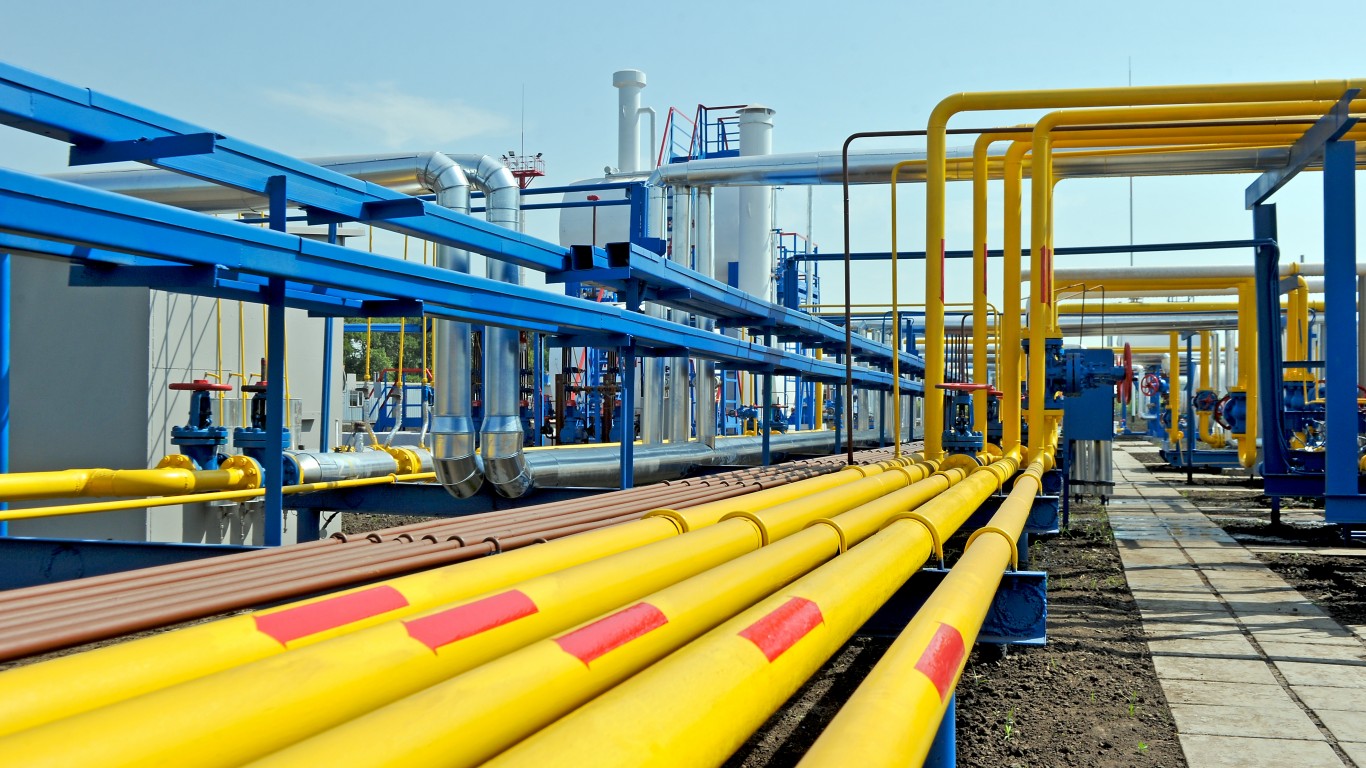
Bull case: Enterprise earns mostly fees for moving and storing energy through more than 50,000 miles of pipelines. Permian gas processing volumes hit a record 4.6 Bcf/d, up 12%. Another $6.3 billion[1] of growth projects are under construction through 2028. Two of them, the Athena processing plant and an expansion of the Houston Ship Channel LPG terminal, are expected to start up in the fourth quarter of 2026.
Risk: As a master limited partnership, Enterprise sends unitholders a K-1 tax form instead of a 1099, which complicates tax filing and makes the units a poor fit for some retirement accounts. The partnership also carries a large debt load. In addition, its marketing margins swing with commodity prices.
Duke Energy: Regulated Earnings and a Growing Rate Base
Duke Energy (NYSE:DUK) pays $1.085 per quarter, or $4.34 annualized. At $129.50, the stock yields 3.35%.
Dividend safety: The dividend takes about 65% of earnings at the low end of 2026 adjusted EPS guidance of $6.70 to $6.80[4], and management expects to finish near the top of that range. Most of those earnings come from regulated rates approved by state commissions, so they are more predictable than most. Payment records show quarterly dividends without interruption since 1999. It has risen each year from $1.025 to $1.045, then $1.065, and now $1.085.
Bull case: Demand from data centers is pushing up electricity use across Duke’s territory. The average number of retail customers grew 1.5%, and Duke plans to add 16 GW[4] of generation by 2031. Third-quarter adjusted EPS of $1.99[4] beat the $1.86 estimate, the sixth straight quarter above expectations. Management reaffirmed long-term adjusted EPS growth of 5% to 7%[4] through 2030, which leaves room for the dividend to keep rising.
Risk: Building at this scale costs money. Higher depreciation cut third-quarter earnings by $0.08 per share, and higher interest expense took another $0.04. Coal-ash cleanup costs and storm damage remain long-running risks.
Chevron: Strongest Balance Sheet in the Group
Chevron (NYSE:CVX) pays $1.78 per quarter, or $7.12 a year. At $206.17, that is a 3.45% yield.
Dividend safety: Chevron generated $12.003 billion[5] of free cash flow in the third quarter. Its quarterly dividend costs roughly $3.47 billion, so free cash flow covered it with plenty to spare. The annual dividend equals about 52% of trailing EPS of $13.62. The balance sheet is solid, with debt-to-equity of 0.22, net debt at just 0.94x EBITDA, interest coverage of 13.70x, and $3.5 billion[5] of debt paid down during the quarter. The quarterly payout has risen every year from $1.07 in 2016 to $1.78 today.
Bull case: Adjusted EPS of $5.28[5] beat the $4.83 estimate, the seventh straight quarter ahead of forecasts, and revenue rose 35.4%. U.S. refineries processed a record 1.09 million barrels per day[5]. The Hess deal is delivering $1.5 billion in cost savings, and the company reached $3 billion of structural cost cuts ahead of schedule. The chief executive described the strategy as “reinvesting to bring more energy to a supply-constrained market.”[5]
Risk: Chevron’s earnings rise and fall with oil prices. The stock dropped 10.8% over the past month even after strong results. That makes it the one name here that may need a closer look when crude prices fall sharply.
What Still Deserves a Periodic Check in a Hands-Off Portfolio
These five companies share three traits: payouts covered by earnings or cash flow, years of steady dividend increases, and businesses that customers depend on. The whole point of owning names like these is building a ladder of checks you never have to sell shares to collect (we laid out how to construct one in a free guide here: Never Touch the Principal). Even a hands-off portfolio needs a quick quarterly review. Watch Altria’s volume declines, Enterprise’s distribution coverage, how Duke’s borrowing grows with its building program, and whether Chevron’s free cash flow holds up if oil prices fall. For AbbVie, the key number is how fast Skyrizi and Rinvoq keep growing while Humira sales shrink.
Contact [email protected] for any questions or corrections.
Chris Lange is a financial and geopolitical writer with more than a decade of experience covering a myriad of topics. He has published thousands of articles for 24/7 Wall St., with past coverage focused heavily on stocks, IPOs, healthcare, defense, global affairs, and technology.
His work has been quoted, or referenced by a number of outlets including Business Insider, USA Today, Yahoo Finance, MSN, The Motley Fool, and many other publications. A graduate of Southwestern University, he studied business with a focus on investments and has previous experience in banking and startups.
When not reading or writing the news, he is following his passion for Lacrosse, playing chess, or building solar projects with his dad.