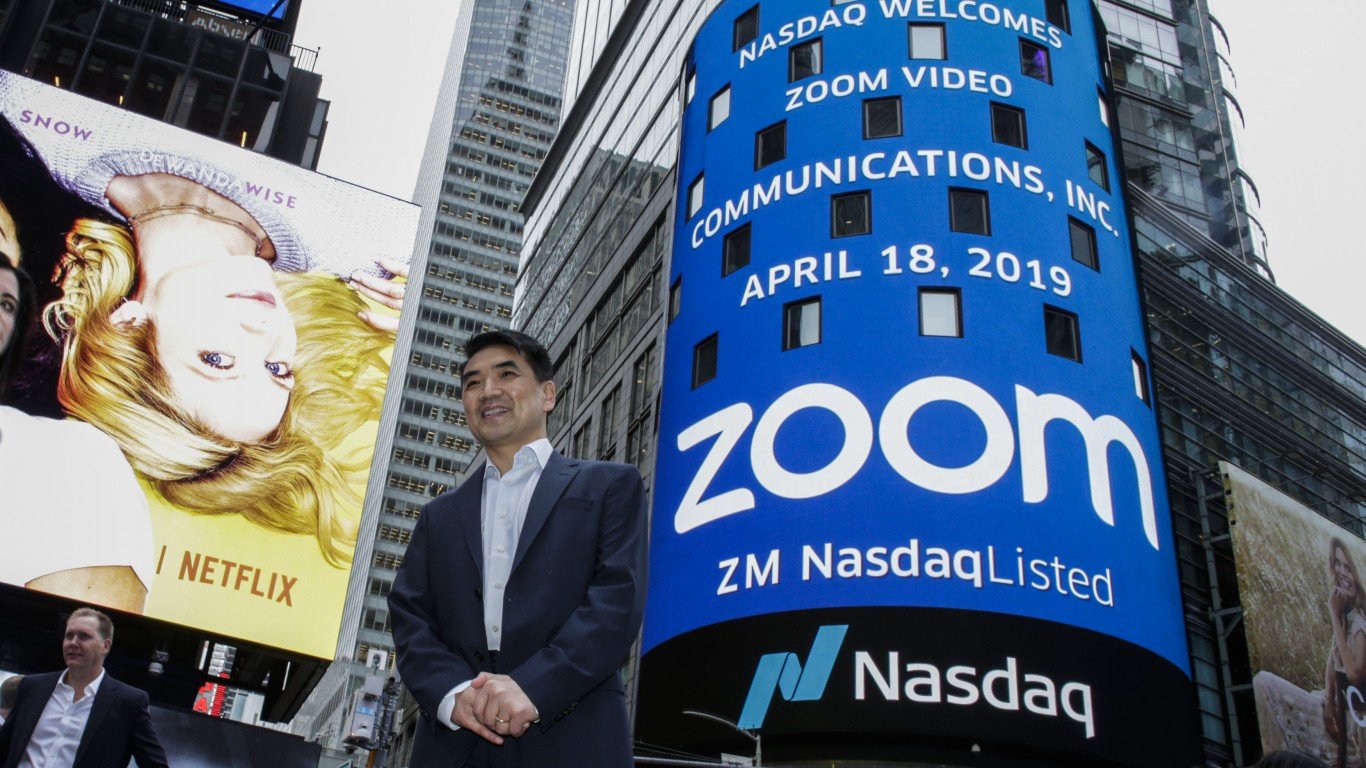
Pandemic Darling Zoom Is Starting to Pay Dividends

This post may contain links from our sponsors and affiliates, and Flywheel Publishing may receive compensation for actions taken through them.
Zoom (NASDAQ:ZM | ZM Price Prediction) said after the close on November 23, 2026,[1] that its board approved a quarterly cash dividend program. The first payment is $0.25 a share, payable December 17, 2026[1], to holders of record on December 3.
The stock rose 5.87% to $86.03 in regular trading before the release. At 7:36 p.m. ET, it was at $85.71, down 0.37%, so the news drew almost no reaction.
The quiet response reflects the price history. Zoom’s record close was $568.34 on October 19, 2020; the stock now sits about 85% below that peak, and revenue growth is still under 5%. Zoom now wants investors to value it on the cash it makes.

What Zoom Has Committed To
Only the December payment is declared and dated. Every later quarter needs its own board vote, so the program is a stated plan and carries no guarantee.
At the current rate, the payout comes to $1.00 a share a year, a yield of about 1.16%. Management described the dividend as incremental to buybacks. The CFO, Michelle Chang, linked it to “the strength in our balance sheet”[2] and free cash flow, the cash left after operating costs and capital spending.
Buybacks are still the bigger tool. Zoom repurchased about 3.9 million shares in the quarter and has now bought back 48.1 million shares for $3.8 billion under a $4.7 billion plan. About $0.9 billion of that authorization remains.
Cash Flow Easily Covers the New Payout
Free cash flow in the quarter was $558.1 million, and Zoom ended it with $7.3 billion in cash and marketable securities. Full-year free cash flow guidance of $1.780 billion to $1.820 billion leaves room to pay a small dividend and keep buying back stock.
Revenue rose 4.9% to $1,290.6 million. Enterprise revenue grew 8.6% to $805.4 million, its strongest pace in 13 quarters, but Online revenue slipped 0.6% to $485.3 million.
Zoom raised its full-year revenue guidance to $5.100 billion to $5.105 billion and its non-GAAP EPS guidance to $6.24 to $6.25. In August, those ranges were $5.085 billion to $5.095 billion and $6.08 to $6.12.

Why the Single-Digit P/E Overstates the Bargain
The trailing P/E (price-to-earnings ratio) is 8x. However, trailing net income of $3.26 billion includes $1.78 billion of net gains on strategic investments in the first nine months of the fiscal year.
Quarterly GAAP EPS was $1.05, while non-GAAP EPS, which excludes those profits and other items, was $1.59. At the midpoint of full-year non-GAAP guidance, the stock trades at about 14 times earnings, a fair price for mid-single-digit growth.

When a company this cash-rich starts paying a dividend, it usually has fewer internal projects that need the money. Online is the weak spot. Three price increases this year kept revenue roughly flat, while average monthly churn, the share of customers who cancel each month, edged up to 2.8%[1] from 2.7%.
What the Dividend Means for Zoom Shareholders
Zoom now offers a cash-rich software business at a modest multiple, although growth remains slow and the yield is small, so the dividend works as a modest supplement to buybacks for investors who focus on income.
The case for the stock rests on Enterprise. If that segment keeps growing near its current pace, each quarter’s Online softness carries less weight, and two guidance raises in a row suggest the momentum is real.
Many investors who bought pandemic winners near the peak paid prices that assumed growth would last for years, but Zoom’s current price assumes slow growth, so the company does not need a revival to justify it.
The December 3 record date and December 17 payment confirm the program is running. The real test is the fiscal fourth-quarter earnings report: if Enterprise growth falls back below 8.6% while Online goes down faster, or the stock closes below its 52-week low of $70.70, the bullish case weakens.
Contact [email protected] for any questions or corrections.
Omor Ibne Ehsan is a writer at 24/7 Wall St. He is a self-taught investor with a focus on growth, cyclical, and dividend equities that have strong fundamentals, value, and long-term potential. He also has an interest in high-risk, high-reward investments such as penny stocks.