8% Yields, Zero Taxes: 4 Dividend Stocks Built for Your Roth IRA

This post may contain links from our sponsors and affiliates, and Flywheel Publishing may receive compensation for actions taken through them.

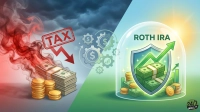
At the 24% federal bracket, a $500,000 portfolio split evenly across three high-yield BDCs and a mortgage REIT produces roughly $71,270 in annual distributions. In a taxable account, about $17,100 of that goes to the IRS every year, because these payouts are taxed as ordinary income rather than at the lower qualified-dividend rates.
For 2026, the 24% bracket applies to taxable income over $105,700 but not over $201,775 for single filers. Qualified dividends for most of those filers are taxed at 15%. BDC and mortgage REIT income generally gets no such break, so the account you hold these stocks in determines how much of the income you keep.
Four Ordinary-Income Payers and Their Current Yields
The model puts $125,000 into each stock. Yields use each company’s annualized forward dividend divided by the most recent share price.
Blue Owl Capital Corp. (NYSE:OBDC) | OBDC Price Prediction yields about 11.7%, based on a $1.24 forward dividend and a $10.61 share price. The BDC’s portfolio earns a weighted average yield of 10.1% at fair value, and that interest income passes through to shareholders at full marginal rates. Holding it in a Roth also shelters the supplemental payouts, which have been running between $0.01 and $0.02 per quarter in 2026.
Ares Capital (NASDAQ:ARCC) yields about 10.4% on a $1.92 annual dividend at $18.43. Management says the company has paid stable or increasing regular dividends for 69 consecutive quarters[1], and it carried $1.37 per share of spillover income into 2026. A payout that steady makes the yearly tax bill just as predictable.
AGNC Investment (NASDAQ:AGNC) yields about 18.6% on $1.44 in monthly payouts at a $7.73 share price. CEO Peter Federico said, “Our dividend continues to be well-aligned with the economics of our business,”[2] but tangible book value fell 16.9%[3] in the third quarter. It is the highest yielder of the four, so it carries the largest per-dollar tax cost outside a Roth.
FS KKR Capital (NYSE:FSK) yields about 16.3% on its $1.76 forward distribution at $10.81. That figure leaves out the $0.20[4] special distribution payable in December. Specials like that are taxable in the year they are paid. Non-accruals of 6.4%[4] at amortized cost remain the key risk to watch.
Roth Versus Taxable: $17,100 a Year at 24%
| Stock | Yield | Income on $125K | Tax at 24% |
|---|---|---|---|
| OBDC | 11.7% | $14,610 | $3,510 |
| ARCC | 10.4% | $13,020 | $3,130 |
| AGNC | 18.6% | $23,290 | $5,590 |
| FSK | 16.3% | $20,350 | $4,880 |
Taken together, the blended yield is 14.3%.
| Scenario | Gross Income | Federal Tax | Net Income |
|---|---|---|---|
| Roth IRA | $71,270 | $0 | $71,270 |
| Taxable (24%) | $71,270 | $17,100 | $54,160 |
The Roth keeps about $17,100 more each year. Over 10 years, with no new contributions and no growth, that adds up to about $171,000.
One adjustment applies to AGNC. Qualified REIT dividends may be eligible for the Section 199A deduction (26 U.S.C. § 199A(e)(3)[5]), which lowers the effective rate on that position. Higher earners may face the 3.8%[6] net investment income tax under 26 U.S.C. § 1411(a)(1), which raises the cost on all four. The model uses the federal marginal rate only.
How Much the Roth Saves at Each Bracket
| Bracket | Taxable Net Income | Roth Advantage per Year |
|---|---|---|
| 22% | $55,590 | $15,680 |
| 24% | $54,160 | $17,100 |
| 32% | $48,460 | $22,810 |
| 35% | $46,320 | $24,940 |
| 37% | $44,900 | $26,370 |
Each step up in bracket increases the cost of holding these stocks in a taxable account. A single filer in the top bracket (taxable income over $640,600) gives up about $26,370 a year on the same $500,000. That compares with about $15,680 for a filer in the 22% bracket.
Compounding Makes the Gap Much Larger
The annual figure understates the cost. When these stocks sit in a Roth, the $17,100 saved each year can be reinvested and compound tax-free. Assuming a conservative 5% reinvestment return and no change in share prices, the 24% bracket advantage reaches about $215,100 after 10 years and about $565,600 after 20 years. Without compounding, the same savings total $171,000 and $342,100. These figures are illustrative and show what holding these four stocks in a taxable account costs over time. Roth withdrawals stay tax-free as long as they are qualified distributions under 26 U.S.C. § 408A(d)(1), which requires age 59½ and the five-year holding period. For retirees still considering when to shift these positions, the low-tax years before required minimum distributions begin are often the cheapest time to convert, a window we sized up in a free Roth guide here.
These yields can change. Blue Owl’s base dividend fell to $0.31 from $0.37, and FS KKR paid $0.70 per quarter in 2025 before resetting lower. Lower payouts shrink the gap between Roth and taxable, but the math works the same way.
Three Steps to Take Before Your Next Filing
- If you hold any BDC or mortgage REIT outside a tax-advantaged account, multiply last year’s Form 1099-DIV ordinary dividends by your marginal rate to find your actual annual tax cost.
- Roth conversion math on these four stocks is worth going over before assuming the upfront tax on a conversion outweighs a yearly savings of $15,680 to $26,370 on a $500,000 position.
- For investors whose highest-yielding holdings sit in a taxable account, one approach worth going over with a tax professional is converting gradually, starting with positions paying ordinary rather than qualified dividends, such as AGNC and FS KKR, which have the highest yields.
Contact [email protected] for any questions or corrections.
Lee Jackson has covered Wall Street analysts' equity and debt research and equity strategy daily for 24/7 Wall St. since 2012. His broad, diverse career, including a stint as creative services director at an NBC affiliate in Austin, Texas, gives him unique insight into the financial industry.
Lee Jackson's journey in the financial industry spans more than 30 years, including nearly two decades as an institutional equity salesperson at Bear Stearns, Lehman Brothers, and Morgan Stanley. His career spanned pivotal sell-side Wall Street events, from the dot-com rise and bubble to the Long-Term Capital Management debacle, 9/11, and the Great Recession of 2008. This reflects his resilience and adaptability amid market volatility.
Lee Jackson’s practical financial industry experience, gained through a career at some of the biggest banks and brokerage firms, is complemented by a lifetime of writing across various platforms. This unique combination allows him to shed light on the intricacies of Wall Street in a way only someone with deep insider experience and knowledge can. Moreover, his extensive network across Wall Street continues to provide direct access for him and 24/7 Wall St., a privilege few firms enjoy.
Since 2012, Jackson’s work for 24/7 Wall St. has been featured in Barron’s, Yahoo Finance, MarketWatch, Business Insider, TradingView, Real Money, The Street, Seeking Alpha, Benzinga, and other media outlets. He attended the prestigious Cranbrook Schools in Bloomfield Hills, Michigan, and has a degree in broadcasting from the Specs Howard School of Media Arts.