3 Retail Dividend Stocks to Watch This Black Friday

This post may contain links from our sponsors and affiliates, and Flywheel Publishing may receive compensation for actions taken through them.

Black Friday puts retailers in the spotlight for one weekend, but income investors get paid all year. Target (NYSE:TGT | TGT Price Prediction) makes the point well: its $1.16 quarterly dividend lands in shareholders’ accounts on December 1, before most holiday sales are even totaled. Below are three big-box retailers whose dividends are supported by free cash flow, manageable balance sheets, and payment records we checked against actual dividend history. What matters here is whether these companies can keep paying and raising through every season.
Walmart: Fortress Finances Behind a Growing Payout
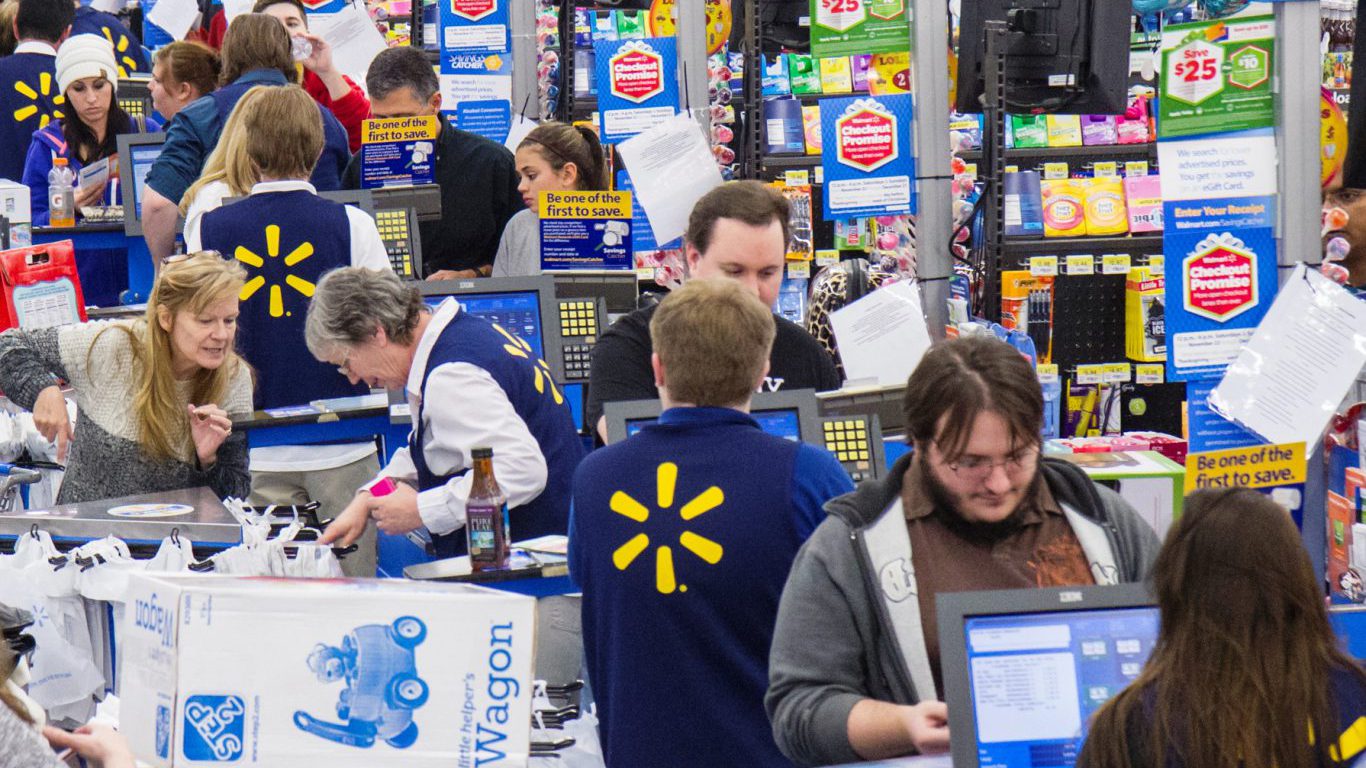
Walmart (NASDAQ:WMT) sells groceries, household goods, and general merchandise to about 280 million customers and members each week across more than 10,900 stores and digital channels in 19 countries. At $131.86, the stock yields 0.72%. That makes it an income staple with a modest starting yield.

Coverage is wide. The annualized forward dividend of $0.99 works out to about 35% of the low end of Walmart’s raised fiscal 2027 adjusted EPS guidance of $2.84 to $2.89[1]. On a cash basis, the free cash flow yield of 1.43% sits well above the dividend yield, which means the dividend takes up roughly 50% of free cash flow. Walmart paid $2.0B[1] in dividends in the third quarter and still bought back $2.7B of stock, with $22.4B left on its authorization.
Financial strength starts here. Debt to equity is 0.67, net debt to EBITDA is 1.28, and operating profit covers interest 10.66x. Cash rose to $13.43B[1].
The track record is long. Dividend records show continuous quarterly payments from 1999 through the upcoming ex-dividend date of December 11. The per-payment amount rose from $0.2075 in 2024 to $0.235 in 2025 and $0.2475 this year.
The case for owning it: the business behind the dividend keeps getting more profitable. Global eCommerce grew 17%[1], advertising 25%, and membership fee revenue 17%. All three carry higher margins than selling groceries. CEO John Furner described Walmart’s shoppers as "stable, resilient"[2] and said the company expects "a strong holiday season."
Risk: you pay a lot for that safety. The stock goes for 48 times earnings and 70 times free cash flow after a 19.11% gain this year, so the starting yield is thin. If growth slows, the stock could lose value faster than the dividend grows.
Target: Richest Yield of the Group, With Momentum Behind It
Target sells apparel, beauty, food and beverage, hardlines, home décor, and household necessities through 2,026 stores and its digital channels, mostly to budget-minded families. Roughly 80% of merchandise sales start in stores. At $173.13, the stock yields 2.6%, the most of the three.

Coverage is solid. Trailing dividends of $4.58 per share equal about 43% of trailing diluted EPS of $10.76. Target generated $2.835B of free cash flow last fiscal year after $3.727B of capital spending, and it paid $527M in dividends in the third quarter.
The balance sheet is conservative. Cash stood at $4.46B, net interest expense fell to $95 million from $115 million, and management linked its buyback pace to its commitment to keep its middle A credit ratings[3].
Raises come every year. Dividend history shows the quarterly payout rising from $1.10 to $1.12 to $1.14 to $1.16 in successive annual increases. Over the longer record, it has grown from $0.06 a quarter in 2003. The latest raise was modest at 1.8%.
The case for owning it: the turnaround is showing up in the numbers. Comparable sales rose 5.6% on 5.0% traffic growth, digital comps climbed 9.8%, and non-merchandise sales from advertising and memberships grew 19.3%. The stock is up 83.22% this year but still trades at 16 times trailing earnings and sits 17.6% below where it was five years ago. Management said November sales were accelerating from October trends. CFO James Lee put it this way: "That ability to reward our shareholders, invest back into the business and offer tremendous value to our guests reinforces our conviction in the strategy we’re pursuing."[3]
One caveat: tariff refunds are boosting this year’s earnings. Full-year EPS guidance of $10.65 to $11.40 includes about $2.14 of refund benefits that management does not expect to repeat. That makes today’s payout ratio look lower than it will once those one-time gains fade, at the same time capital spending rises to a planned $5 to $6 billion next year.
Lowe’s: Strongest Cash Coverage and a Verified Dividend King
Lowe’s (NYSE:LOW) serves do-it-yourself homeowners, professional contractors, and home services customers through 1,762 stores, and it has added Foundation Building Materials and Artisan Design Group to deepen its Pro business. At $236.01, the stock yields 1.99%.

Coverage is the best of the group. Lowe’s produced $7.7 billion[4] of free cash flow last fiscal year and returned $2.6 billion through dividends, so the dividend took about 34% of free cash flow. The forward dividend of $5 is about 41% of this year’s adjusted EPS guidance of about $12.25. The free cash flow yield is 5.79%.
This company carries the most debt of the three. Net debt to EBITDA is 3.54 and interest coverage is 6.65x. Shareholders’ equity is negative at -$6.4B, which comes from years of heavy buybacks, and cash rose to $3.43B.
Its dividend status is confirmed. Lowe’s describes itself as a Dividend Aristocrat and a Dividend King, the 50-plus-year raise club we rated by valuation in a free Dividend Kings report. Dividend records show payments every quarter since 1999 and growth from $0.05 a quarter in 2007 to $1.25 now, up from $1.20 a year ago.
The case for owning it: you get the strongest cash backing in the group at a reasonable price. Lowe’s trades at 20 times earnings, and the stock is up only 0.01% this year, so the yield hasn’t been squeezed by a big rally. Comparable sales rose 1.8%, the sixth consecutive quarter of positive comps, online sales grew 17.4%, and management raised its full-year sales outlook to about $92.5B.
Risk: stretched shoppers are putting off big projects. Management has said big-ticket DIY spending remains under pressure because consumers are reluctant to make significant investments in their homes[4], and gross margin slipped to 32.95% from 34.19%. CEO Marvin Ellison has pointed to mortgage rates moving "sustainably below 6%"[4] as the likely trigger for that demand to return.
Year-Round Income From Holiday Shopping Names
Walmart offers the safest balance sheet, Target the highest yield and a payout around 43% of earnings, and Lowe’s the widest free cash flow cushion along with a confirmed Dividend King record. Each one pays out less than half of what it makes or generates in cash, so there is room to keep raising. Dividends at all three have grown every year, supported by businesses people use every week. Target’s December 1 check is a reminder that the income keeps arriving long after the Black Friday crowds have gone home.
Contact [email protected] for any questions or corrections.
Lee Jackson has covered Wall Street analysts' equity and debt research and equity strategy daily for 24/7 Wall St. since 2012. His broad, diverse career, including a stint as creative services director at an NBC affiliate in Austin, Texas, gives him unique insight into the financial industry.
Lee Jackson's journey in the financial industry spans more than 30 years, including nearly two decades as an institutional equity salesperson at Bear Stearns, Lehman Brothers, and Morgan Stanley. His career spanned pivotal sell-side Wall Street events, from the dot-com rise and bubble to the Long-Term Capital Management debacle, 9/11, and the Great Recession of 2008. This reflects his resilience and adaptability amid market volatility.
Lee Jackson’s practical financial industry experience, gained through a career at some of the biggest banks and brokerage firms, is complemented by a lifetime of writing across various platforms. This unique combination allows him to shed light on the intricacies of Wall Street in a way only someone with deep insider experience and knowledge can. Moreover, his extensive network across Wall Street continues to provide direct access for him and 24/7 Wall St., a privilege few firms enjoy.
Since 2012, Jackson’s work for 24/7 Wall St. has been featured in Barron’s, Yahoo Finance, MarketWatch, Business Insider, TradingView, Real Money, The Street, Seeking Alpha, Benzinga, and other media outlets. He attended the prestigious Cranbrook Schools in Bloomfield Hills, Michigan, and has a degree in broadcasting from the Specs Howard School of Media Arts.