These 4 Conservative Dow Jones Industrials Dividend Stocks Are Built for Sell-Offs

This post may contain links from our sponsors and affiliates, and Flywheel Publishing may receive compensation for actions taken through them.
The Dow Jones Industrial Average tried to rally this morning but ultimately succumbed to selling pressure. That comes one session after the Dow fell 1,100 points in a broad sell-off led by AI stocks. The Dow is still down 5.8% over the past month. If you are at or near retirement, any bounce is a good time to check whether your income can get through the next drop. The four Dow components below each combine a long, verified dividend record with the cash flow and balance sheet to keep paying in a downturn. None of them depends on the AI spending story behind this sell-off.
Procter & Gamble: 70 Straight Years of Dividend Raises
Procter & Gamble (NYSE:PG | PG Price Prediction) yields 2.5%. It pays $1.0885 per share each quarter, which works out to a forward dividend of $4.354 a year. In its fiscal fourth-quarter release, the company called its latest raise the 70th consecutive year of dividend increases[1] and the 136th consecutive year of dividend payments. That record makes P&G a verified Dividend King.
Dividend safety: The forward dividend takes about 66% of trailing EPS of $6.58. It takes about 62% of the midpoint of fiscal 2027 core EPS guidance, which ranges from $6.89 to $7.11[2]. Cash covers the payout with room to spare. Fiscal 2026 free cash flow came in at $15.835 billion[1], up 12.74%. P&G plans to pay more than $10 billion[2] in dividends this fiscal year, about 63% of last year’s free cash flow, and to buy back about $5 billion of stock. Cash stood at $15.365 billion[2] after the first quarter.
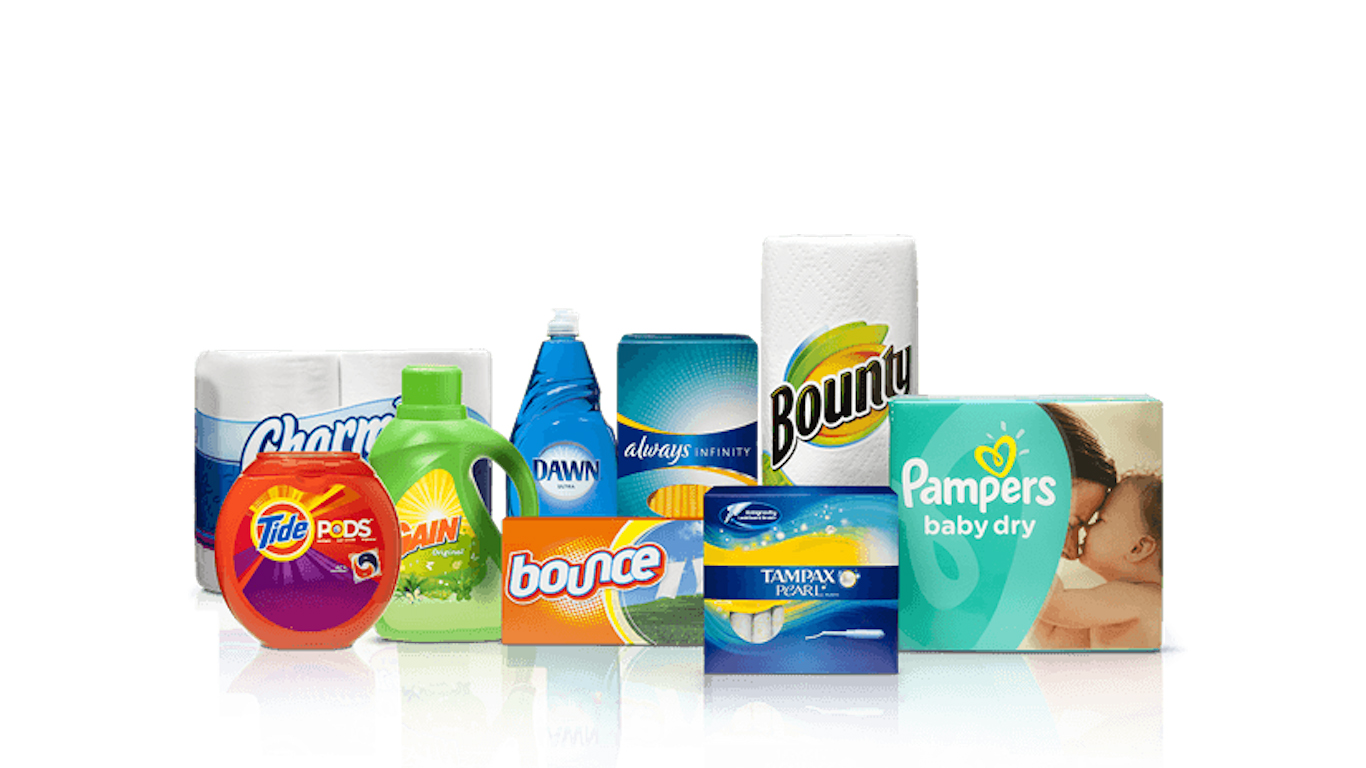
Why it holds up: Families keep buying Tide, Pampers, Charmin, Crest, and Gillette in a recession. During the financial crisis, P&G raised its quarterly dividend from $0.35 to $0.40 in 2008 and from $0.40 to $0.44 in 2009. In the 2020 pandemic sell-off, it raised the payout from $0.7459 to $0.7907. The stock has a beta of 0.361 and is up 8.04% over the past month, while DIA declined. First-quarter organic sales rose 4%[2], with all five segments growing.
Risk to watch: Management expects about a $1.4 billion after-tax commodity cost headwind in fiscal 2027. That would squeeze margins and could hold future raises to a modest size.


Coca-Cola Kept Raising Through 2008 and 2020
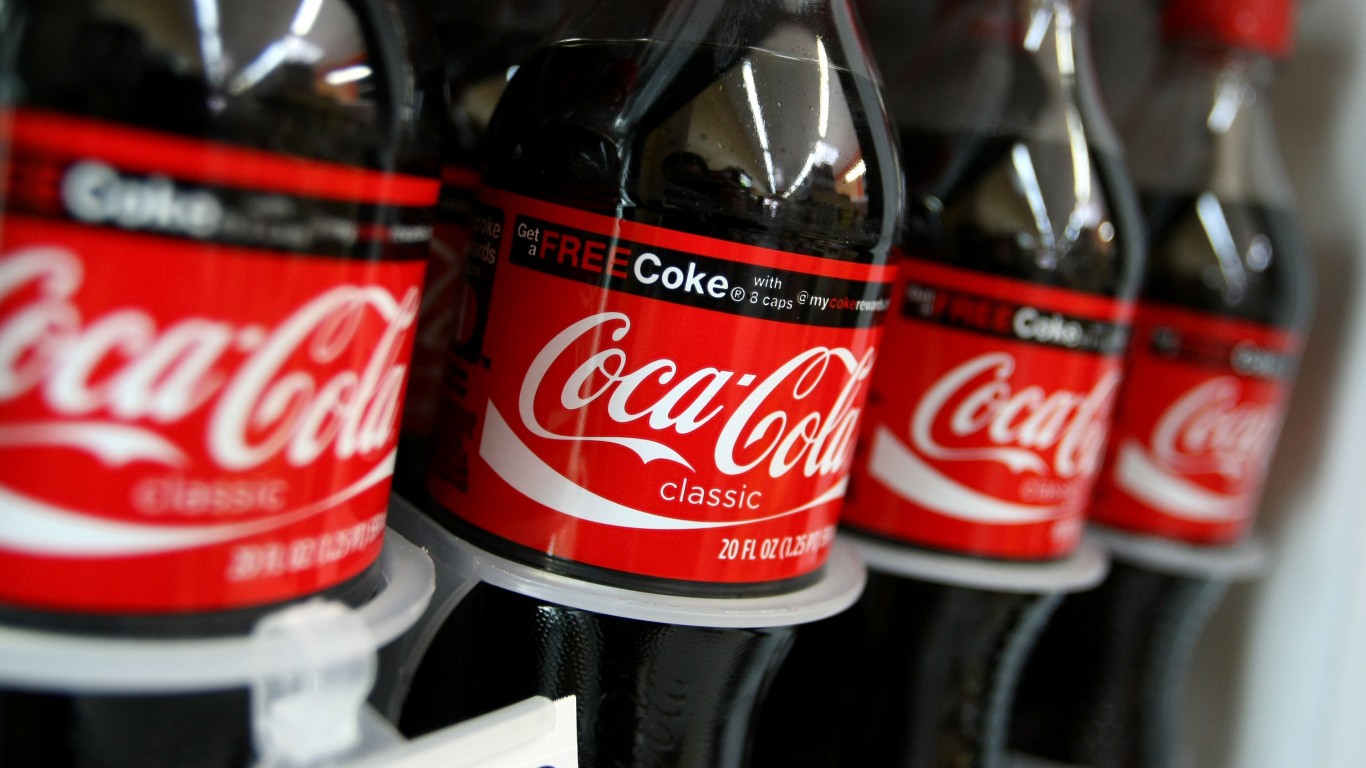
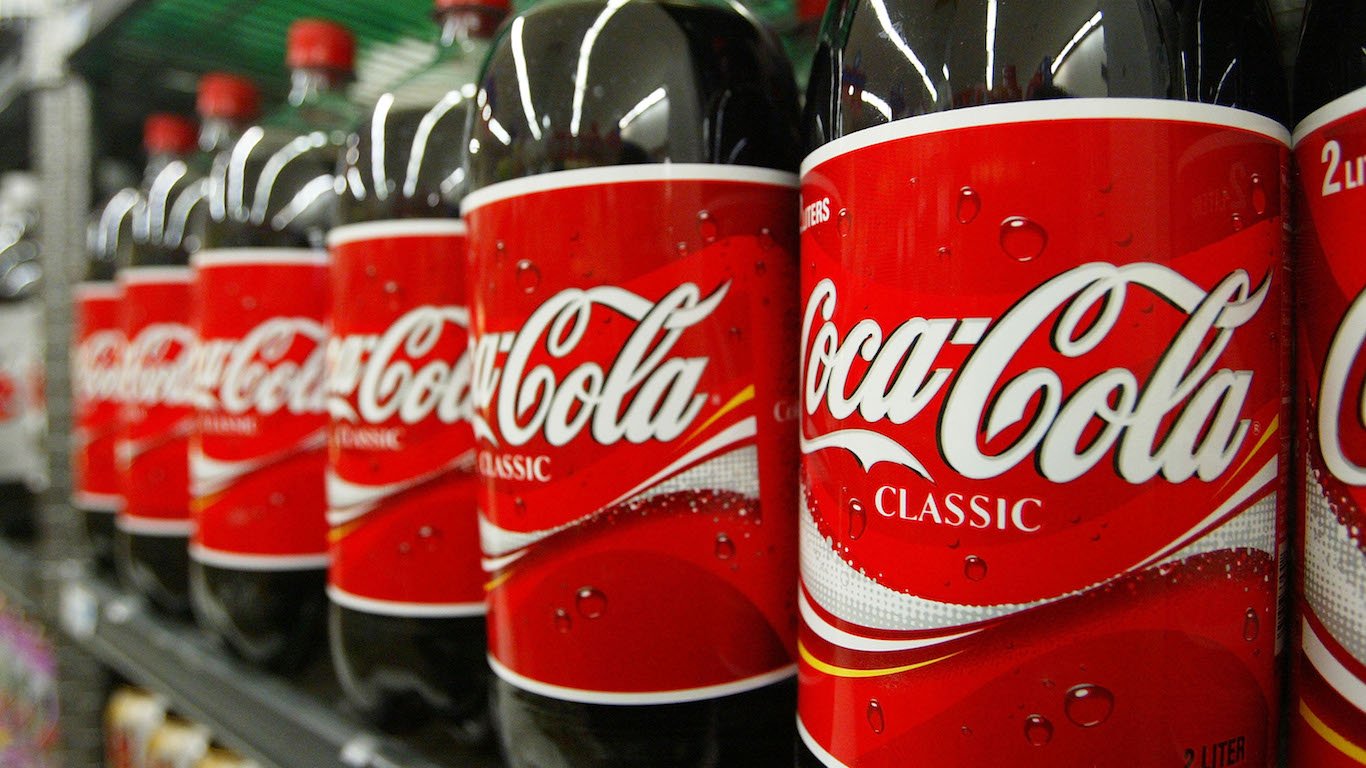
Coca-Cola (NYSE:KO) yields 2.12% on a quarterly dividend of $0.53, or $2.12 a year. The next payment arrives Dec. 15 for shareholders who own the stock before the Dec. 1 ex-dividend date.
Dividend safety: The dividend takes about 63% of trailing EPS of $3.39. Coca-Cola raised its 2026 free cash flow guidance to at least $13.0 billion[3], up from about $12.4 billion. At the current share count, the dividend costs about $9.12 billion a year, roughly 70% of that target. Net debt is 2.49 times EBITDA, and interest coverage is 8.32 times. That is manageable leverage for a business with a 28.71% operating margin. The dividend record shows a higher quarterly payout every year, from $0.28 in 2013 to $0.53 in 2026.
Why it holds up: Coca-Cola raised its quarterly dividend straight through the financial crisis, from $0.38 in 2008 to $0.41 in 2009 and $0.44 in 2010. It rose again from $0.41 in 2020 to $0.42 in 2021. Demand is holding firm now. Third-quarter global unit case volume grew 5%[3], revenue rose 7.43% to $13.38 billion, and comparable operating margin widened to 32.9% from 31.9%. The stock has a beta of 0.269 and has gained 3.93% over the past month.
Risk to watch: The stock is expensive. It trades at a trailing P/E of 29, and Barron’s warned this week that Coca-Cola’s valuation is stretched by its own historical standards. In a sell-off, that multiple can shrink even while the dividend keeps arriving on schedule.


Chevron Offers the Highest Yield of the Four
Chevron (NYSE:CVX) yields 3.16%, the highest of the four. It pays $1.78 per quarter, or $7.12 per year, and the next payment goes out Dec. 10.
Dividend safety: The dividend takes about 52% of trailing EPS of $13.62. Third-quarter free cash flow reached $12.003 billion[4], against a quarterly dividend bill of about $3.47 billion at the current share count. The balance sheet is the lightest of this group. Debt-to-equity is 0.22, net debt is 0.94 times EBITDA, and interest coverage is 13.70 times. Chevron cut debt by $3.5 billion[4] in the third quarter, after a record $8.4 billion[5] reduction in the second. The quarterly payout has risen every year, from $1.42 in 2022 to $1.78 in 2026.
Why it holds up: Chevron’s cash flow depends on energy prices, which gives you a different kind of exposure from the tech-driven selling now hitting the market. When oil demand collapsed in 2020, Chevron kept its quarterly dividend at $1.29 through the year and raised it to $1.34 in 2021. Cost savings support the payout: the company has reached a $3 billion run rate in structural cost cuts and is targeting up to $4 billion by year-end. Synergies from the Hess deal add a $1.5 billion run rate.
Risk to watch: Third-quarter results got a lift from Brent crude averaging $97 a barrel[4], compared with $69 a year earlier. If oil falls back, free cash flow will shrink. The stock has already dropped 6.78% over the past month.


Johnson & Johnson: 64 Years of Dividend Growth
Johnson & Johnson (NYSE:JNJ) yields 1.89%, the lowest of the four. It also has the deepest safety margin. The company raised its quarterly dividend 3.1%[6] to $1.34, marking its 64th consecutive year of dividend growth. That makes J&J a verified Dividend King. The next payment arrives Dec. 8.
Dividend safety: As of J&J’s second-quarter release, the forward dividend of $5.36 took about 46% of the midpoint of the 2026 adjusted EPS guidance it gave then, $11.60 to $11.75[7], the group’s lowest payout ratio. That release also raised 2026 sales guidance to $100.8 billion to $101.4 billion[7]. J&J is also one of only two U.S. companies with a AAA credit rating.
Why it holds up: Cancer and immunology patients keep getting treatment in a recession. J&J raised its quarterly dividend in 2008 (from $0.415 to $0.46), in 2009 (from $0.46 to $0.49), and in 2020 (from $0.95 to $1.01). Growth comes from several products. In the second quarter, Darzalex sales rose 18.9%[7] to $4.207 billion, and Tremfya sales rose 72.5%. This week J&J agreed to buy Ollin Biosciences, adding to its pipeline. The stock has a beta of 0.2 and is up 4.57% over the past month.
Risk to watch: Biosimilar competition is eroding Stelara. Its second-quarter sales fell 55.2%[7] to $740 million, so newer drugs have to keep growing fast enough to replace that revenue.


Income That Keeps Arriving
Household staples, beverages, energy, and healthcare each face different risks, so one shock is unlikely to hit all four at once. Each company covers its dividend with real free cash flow or earnings, carries manageable debt, and has a dividend record that held through 2008 and 2020. Two of them are verified Dividend Kings. (We ranked ten Dividend Kings by valuation in a free report you can grab here.) Whether the market keeps bouncing or turns lower, these four are set up to keep paying shareholders on schedule.
Contact [email protected] for any questions or corrections.
Lee Jackson has covered Wall Street analysts' equity and debt research and equity strategy daily for 24/7 Wall St. since 2012. His broad, diverse career, including a stint as creative services director at an NBC affiliate in Austin, Texas, gives him unique insight into the financial industry.
Lee Jackson's journey in the financial industry spans more than 30 years, including nearly two decades as an institutional equity salesperson at Bear Stearns, Lehman Brothers, and Morgan Stanley. His career spanned pivotal sell-side Wall Street events, from the dot-com rise and bubble to the Long-Term Capital Management debacle, 9/11, and the Great Recession of 2008. This reflects his resilience and adaptability amid market volatility.
Lee Jackson’s practical financial industry experience, gained through a career at some of the biggest banks and brokerage firms, is complemented by a lifetime of writing across various platforms. This unique combination allows him to shed light on the intricacies of Wall Street in a way only someone with deep insider experience and knowledge can. Moreover, his extensive network across Wall Street continues to provide direct access for him and 24/7 Wall St., a privilege few firms enjoy.
Since 2012, Jackson’s work for 24/7 Wall St. has been featured in Barron’s, Yahoo Finance, MarketWatch, Business Insider, TradingView, Real Money, The Street, Seeking Alpha, Benzinga, and other media outlets. He attended the prestigious Cranbrook Schools in Bloomfield Hills, Michigan, and has a degree in broadcasting from the Specs Howard School of Media Arts.