Down 15% in November, Is It Time to Buy the UnitedHealth Stock Dip?

This post may contain links from our sponsors and affiliates, and Flywheel Publishing may receive compensation for actions taken through them.

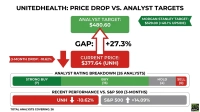
UnitedHealth Group (NYSE:UNH | UNH Price Prediction) closed at $346.19, while Wall Street’s average price target stands at $478.48. That leaves the stock 38.2% below where analysts think it belongs.
UnitedHealth pairs its UnitedHealthcare insurance arm with Optum, which runs care delivery, health data, and pharmacy benefits. After a punishing 2025, this was supposed to be the recovery year, and the results largely delivered.
Third-quarter adjusted EPS rose to $4.69 from $2.92. Management raised its 2026 outlook to at least $20.50 in adjusted EPS, up from more than $17.75[1] at the start of the year.

The policy backdrop then changed as a Medicare for All push and proposed curbs on private Medicare plans sent the stock down 14.9% in November with two sessions left, which leaves investors considering an improving earnings recovery against the risk of a smaller Medicare profit pool.
Three Sessions Did Most of the November Damage
Shares fell from $412.02 to $330.48 over three sessions, including a 10.2% drop in a single day. Across that stretch, the stock fell as much as 21% intraday, which covers a different window than the monthly decline.
Sen. Bernie Sanders laid out a four-year path to Medicare for All as regulators proposed tougher audits of private Medicare plans. Another proposal could cut payments to those plans by about $107 billion over ten years.
If November holds, it will be the worst month since July 2025, when the stock fell 20.0%. Shares sit 20.7% below their 52-week closing high of $436.35.
The S&P 500 fell 5.2% in November and is up 5.1% this year, close to UnitedHealth’s 4.9% gain.
Payment Cuts Matter More Than Medicare for All Headlines
President Trump praised Michigan Sen.-elect Abdul El-Sayed, who pitches Medicare for All as “TrumpCare,” calling him “a smart guy” and saying “Maybe there’s some place in the middle that we could go.” Trump did not endorse Medicare for All.
A compromise looks more likely than single-payer. Barclays analyst Andrew Mok said bringing down the eligibility age to 55 while keeping private plans “would not be inherently negative for Medicare Advantage.”
The audits and payment cut are more concrete because they hit money UnitedHealth already takes in. Medicare & Retirement revenue slid to $42.4 billion in the third quarter from $43.4 billion.
Some of that shrinkage is deliberate. Medicare Advantage membership is down 935,000 since the end of 2025 as management cut residual PPO[2] plans, which protects margin but shrinks the base for future revenue.
Cheap Multiples Sit on Thin Margins
The trailing P/E of 20 sits below its ten-year median of 22, and the forward P/E of 15 compares with a median of 19. At $346.19, the stock trades at about 17 times the adjusted 2026 outlook.
Those multiples are low partly because profits are thin. The trailing net margin of 3.53% compares with a 5.51% median.
I expect margins to recover first because the repair is already visible. The medical care ratio improved to 88.4% from 89.9%[3], although commercial cost trends above 11%[2] remain a drag.
Debt totals $74.3 billion against $28.5 billion of cash and short-term investments. Still, roughly $22.8 billion of trailing free cash flow, lumpy because of Medicare payment timing, covered $5.0 billion of buybacks and $6.2 billion of dividends through nine months.
Rivals Fell Less and Offer Less Upside
Among 26 analysts, six rate UnitedHealth Strong Buy, 15 Buy and five Hold, with no Sells. Targets are estimates, and they can lag fast policy shifts.


Elevance Health (NYSE:ELV) fell 7.2% in November to $389.70, and its $482.38 average target implies 23.8% upside from three Strong Buy, 12 Buy, and seven Hold ratings.
Cigna (NYSE:CI) dropped 9.0% to $271.42, and its $344.40 target implies 26.9% upside from five Strong Buy, 12 Buy and seven Hold ratings. UnitedHealth fell the most and carries the largest implied upside of any stock here, so the market is putting the biggest Medicare player at a steeper discount.
What Could Close UnitedHealth’s Gap to Its Target
The bull case for UnitedHealth rests on margins continuing to improve and the payment proposal softening in final form. That path supports the company’s 13% to 16%[2] long-term EPS growth target and narrows the gap to $478.48 without needing a higher multiple.

The bear case is that regulators nail down the full cut and tougher audits while commercial costs stay high. Falling Medicare revenue on thin margins would likely keep the stock’s low multiple in place.
All told, the downside looks cushioned because a 2.51% dividend yield, ongoing buybacks, and an earnings base that has already improved provide a cushion, while compromise talks keep private plans in the picture.
Cigna carries less Medicare exposure because most of its business runs through employers. UnitedHealth carries more policy risk but trades at the bigger discount to its average target.
Contact [email protected] for any questions or corrections.
Omor Ibne Ehsan is a writer at 24/7 Wall St. He is a self-taught investor with a focus on growth, cyclical, and dividend equities that have strong fundamentals, value, and long-term potential. He also has an interest in high-risk, high-reward investments such as penny stocks.