Ethereum Is at Its Weakest Against Bitcoin Since July. Is ETH or BTC the Better Crypto to Hold Through 2027?

This post may contain links from our sponsors and affiliates, and Flywheel Publishing may receive compensation for actions taken through them.
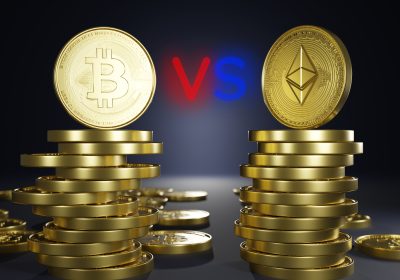
Ethereum (CRYPTO:ETH) closed at 0.0284 BTC on November 8, 2026, its weakest level against Bitcoin (CRYPTO:BTC) since July 12, when it was 0.0283. The ETH/BTC ratio shows how much Bitcoin one Ethereum can buy, so a falling ratio means Ethereum is losing value relative to Bitcoin.
Ethereum currently trades at $2,143, down 4.3% over 24 hours, 4.8% over a week, and 14.4% over 30 days. Meanwhile, Bitcoin trades at $75,034, down 1.2%, 3% and about 9% over the same periods, so Ethereum has fallen harder over each one.
Investors keep asking which cryptocurrency will bounce back to its peak first. Bitcoin peaked at $126,080 on October 6, 2025, while Ethereum reached its high of $4,946 on August 24, 2025. So which crypto is better to hold through 2027?
Ethereum Needs a 131% Climb to Reclaim Its All-Time High While Bitcoin Needs 68%
Ethereum trades 56.7% below its all-time high, meaning it needs to rise 131% to reach that peak again. In contrast, Bitcoin is 40.5% below its highest price and requires a 68% increase. Ethereum’s path to recovery has grown longer since our September look at which coin gets back to its all-time high first.
One factor complicating Ethereum’s recovery is supply dilution. Dilution means the total number of coins grows, so the same price buys less. Ethereum has no maximum supply, and around 122.2 million ETH circulate, up from approximately 120.7 million in October 2025. If Ethereum returned to its peak price with its current supply, its market value would be around $604.4 billion, compared to a current market cap of $262.2 billion.
On the other hand, Bitcoin’s supply is capped at 21 million coins, so it doesn’t face the same dilution. With 20.1 million coins in circulation, Bitcoin would have a market value of approximately $2.53 trillion at its peak price, versus its current market cap of $1.51 trillion. That limited supply helps explain why Ethereum falls harder than Bitcoin during market downturns.
Spot ETF Outflows Hurt Ethereum More Due to Its Smaller Holder Base
Spot ETFs, or exchange-traded funds backed by cryptocurrencies, allow investors to buy digital currencies through brokerage accounts. U.S. spot Bitcoin ETFs saw $1.28 billion in net outflows from November 2 to 6, while Ethereum ETFs saw $365.3 million in outflows. Bitcoin’s ETF holder base runs far deeper, with cumulative net inflows of $55.7 billion compared to Ethereum’s $11.9 billion as of November 6.
Ethereum’s outflow was smaller in dollar terms, but it did more damage, as it equals about 3% of Ethereum’s cumulative inflows, compared to about 2% for Bitcoin. Additionally, the average Ethereum ETF buyer is underwater, so any price rebound could trigger selling from holders aiming to break even.
BitMine Holds 4.97% of Ethereum, While Strategy Holds 4.2% of Bitcoin
Staking means locking up ETH to help secure the network and earn rewards. BitMine Immersion Technologies (NYSE:BMNR | BMNR Price Prediction) holds 6,070,092 ETH, worth about $13 billion and accounting for 4.97% of the total supply. In its latest filing, the company had staked 5,227,037 ETH and added 9,587 ETH in its latest weekly update.
Bitcoin has its own major holder in Strategy Inc. (NASDAQ:MSTR), which owns 850,364 BTC, about $64 billion or 4.2% of circulating supply, according to its November 9 filing. Both cryptocurrencies depend on a single corporate buyer, so any slowdown at either company could remove a steady source of demand. Staking is something Ethereum can do that Bitcoin can’t, but it has not stopped the ETH/BTC ratio from declining.
Ethereum’s On-Chain Money Has Shrunk 19% Since the KelpDAO Exploit
Token Terminal data shows that stablecoins and funds on the Ethereum network have fallen 19% since the KelpDAO exploit, a hack of a service that lets users reuse staked ETH to secure other networks. The total declined from $206.7 billion to $168.3 billion over nearly seven months. Less money on the network means lower transaction fees, and Ethereum burns part of every fee, removing ETH from circulation.
However, co-founder Vitalik Buterin has said Ethereum’s fee burn was never a price floor. So a declining on-chain economy could put more pressure on ETH without a built-in buffer.
Is ETH or BTC the Better Crypto to Hold Through 2027?
Bitcoin seems more likely to reach an all-time high by the end of 2027 because it needs a smaller gain, has a deeper ETF base, and isn’t dealing with a shrinking on-chain economy. While Ethereum has the potential for bigger gains if the ratio shifts in its favor, its road back is much steeper, a trade-off our look at whether to buy Bitcoin or Ethereum in 2026 also weighs.
To turn around, Ethereum needs to reclaim its 50-day average of $2,481, about 16% higher. It also needs to push the ETH/BTC ratio past 0.0320, roughly 13% higher, a level it last reached when ETH hit a 90-day high of $2,775 on September 21. If Ethereum ETFs return to weekly net inflows at the same time, ETH could take the lead. If the ratio closes below 0.0283, Bitcoin remains the stronger hold.
Contact [email protected] for any questions or corrections.
Sam Daodu is a crypto analyst and the editor of 24/7 Wall St.'s Crypto Desk, where he covers Bitcoin, XRP, Ethereum, Solana and the altcoins investors search for most. His work focuses on price levels, spot ETF flows, on-chain data and the regulatory decisions that move crypto markets, written so a first-time buyer and a seasoned trader can both use it.
Sam has written about crypto professionally since 2019 and has published more than 2,000 articles. Before joining 24/7 Wall St., he wrote for crypto media outlets and Web3 companies and ghostwrote for crypto founders and token launches. His analysis is syndicated on Yahoo Finance, MSN and AOL and has been cited by other crypto news sites. He also founded MacLabs Marketing, a content and personal branding agency for crypto founders and executives.
When he isn't reading charts, Sam is usually at the gym or watching One Piece, a series he maintains has better tokenomics than most altcoins.