Is Dogecoin a Long-Term Investment or Just a Trade?

This post may contain links from our sponsors and affiliates, and Flywheel Publishing may receive compensation for actions taken through them.
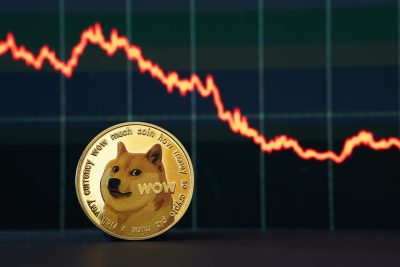
Dogecoin (CRYPTO: DOGE) has often favored traders who take profits during price spikes rather than those who hold. The coin is trading at around 5.7 cents, a staggering 92.3% below its all-time high of 73 cents reached in 2021. Over the past 30 days, it has dropped by 26.9%.
So, is Dogecoin a long-term investment or just a short-term trade?
Long-Term Dogecoin Returns Depend on Purchase Timing
Dogecoin’s potential returns vary dramatically based on when a buyer entered the market. For instance, someone who bought at the all-time high in 2021 now faces a 92.3% loss. However, buyers who invested at the December 31, 2020 close, when the price was around half a cent, have seen gains of about 1,100%.
Over the last five years, Dogecoin has decreased by 72.3%, so most long-term holders who bought after 2020 are at a significant loss. Past crashes have also taken considerable time to recover from, as a look back at what Dogecoin did after every 90% drop from its all-time high shows.
Dogecoin’s Unlimited Supply Works Against Holders
Dogecoin’s unlimited supply is a major hurdle for its long-term holders. Roughly 5 billion new coins enter circulation every year. At a price of 5.7 cents, that adds up to about $283 million of new Dogecoin flooding the market annually that new buyers must absorb.
As a result, unless demand grows consistently, prices are likely to decline. This means that holders need an influx of new buyers every year just to hold their value. A five-year outlook for Dogecoin runs through what this constant dilution means for its price.
Dogecoin’s Biggest Rallies Happened Quickly
Historically, Dogecoin has posted its biggest gains over short periods. For example, in April 2021, it surged from a low of 5.3 cents to a high of 45 cents, marking a gain of about 750%. Another significant rally came in November 2024, when it climbed from 14 cents to 48 cents, a rise of roughly 232%, after then-President-elect Donald Trump named Elon Musk to help lead a new “Department of Government Efficiency.”
However, both rallies ultimately faded. Dogecoin closed December 2021 at 17 cents and February 2025 at 20 cents—62% and 58% below the peaks of those respective surges.
Is Dogecoin a Long-Term Investment or Just a Trade?
Overall, Dogecoin seems better suited to trading than long-term investing. Its biggest price moves have been linked to short-term events involving high-profile figures like Elon Musk and major political announcements. Only those who sold their holdings near the peaks have managed to secure profits. Therefore, Dogecoin’s trading patterns are likely to appeal more to active traders with a profit-taking strategy than to investors looking for a long-term hold.
This perspective may evolve if demand begins to outstrip the annual addition of 5 billion new coins. Pieces on whether Dogecoin will recover in 2027, what 50,000 Dogecoin could be worth in five years, and two cryptos that could pass Dogecoin’s market value lay out the longer-term scenarios.
Contact [email protected] for any questions or corrections.
Sam Daodu is a crypto analyst and the editor of 24/7 Wall St.'s Crypto Desk, where he covers Bitcoin, XRP, Ethereum, Solana and the altcoins investors search for most. His work focuses on price levels, spot ETF flows, on-chain data and the regulatory decisions that move crypto markets, written so a first-time buyer and a seasoned trader can both use it.
Sam has written about crypto professionally since 2019 and has published more than 2,000 articles. Before joining 24/7 Wall St., he wrote for crypto media outlets and Web3 companies and ghostwrote for crypto founders and token launches. His analysis is syndicated on Yahoo Finance, MSN and AOL and has been cited by other crypto news sites. He also founded MacLabs Marketing, a content and personal branding agency for crypto founders and executives.
When he isn't reading charts, Sam is usually at the gym or watching One Piece, a series he maintains has better tokenomics than most altcoins.