Dogecoin Creates 5 Billion New Coins a Year and Bitcoin Is Capped at 21 Million. Does That Explain the Gap Between Them?
Dogecoin mints billions of new coins every year while Bitcoin guards a shrinking supply, yet the real story behind their staggering price gap goes beyond simple math.

This post may contain links from our sponsors and affiliates, and Flywheel Publishing may receive compensation for actions taken through them.

Dogecoin (CRYPTO:DOGE) introduces approximately 5.3 billion new coins each year and has no maximum supply cap. In contrast, Bitcoin (CRYPTO:BTC) releases about 164,000 new coins annually and has a strict cap of 21 million coins. Many believe this supply difference is a major reason Dogecoin continues to lag behind Bitcoin in value.
The data supports this view. As of October 9, 2026, Dogecoin trades at about $0.08, roughly 89% below its 2021 peak of $0.73. Meanwhile, Bitcoin is priced at $82,462, around 35% below its all-time high of $126,080 from October 2025. So, does Dogecoin’s unlimited supply explain this discrepancy, or is there more at play?
How Dogecoin and Bitcoin Issue New Coins
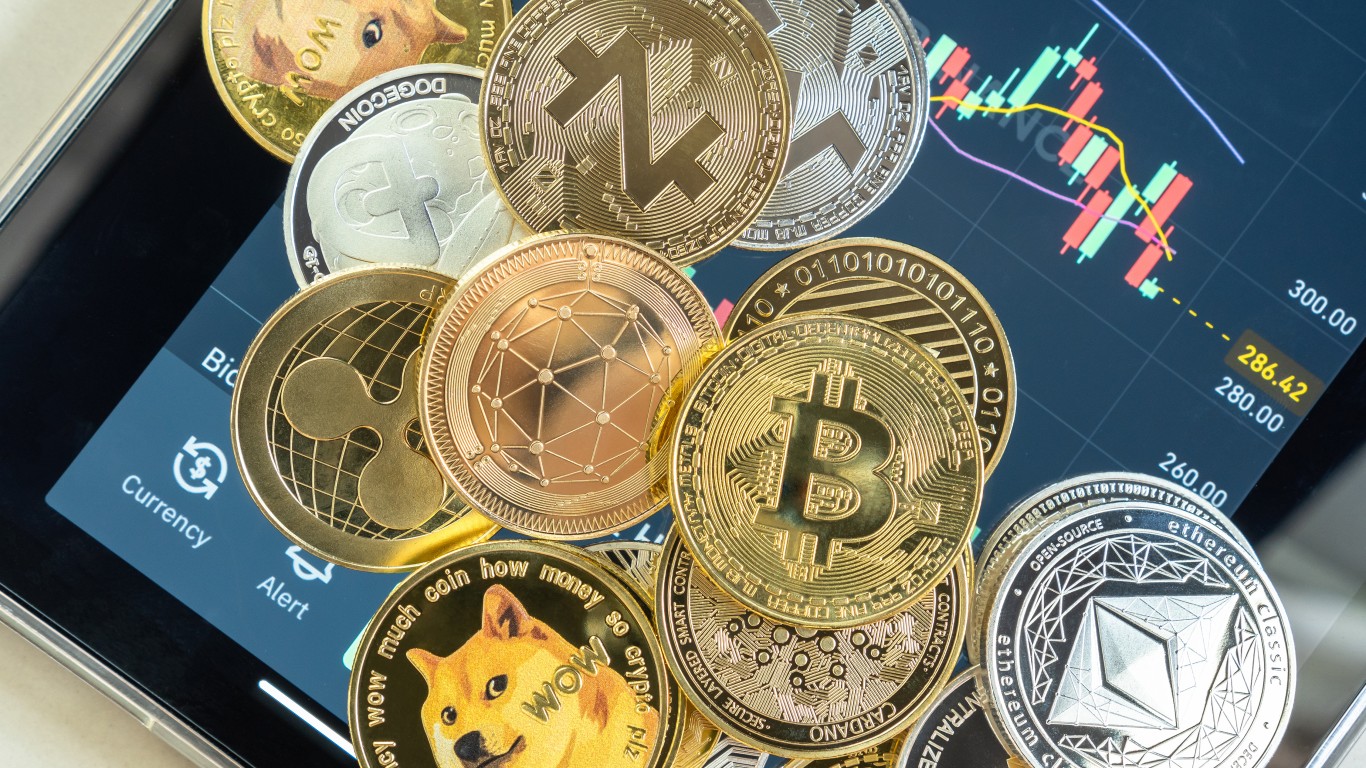
Both Dogecoin and Bitcoin create new coins through a process called mining. Miners use computers to validate transactions and add them to the blockchain in groups known as blocks. For their efforts, miners earn new coins, which increases the total supply of both cryptocurrencies.
However, their issuance schedules are quite different. Dogecoin rewards miners with a flat rate of 10,000 DOGE per block, generated about every minute. This adds about 5.3 billion new coins each year. By contrast, Bitcoin’s reward drops about every four years in an event called the halving, and it currently generates around 164,000 BTC annually.
Elon Musk has defended Dogecoin’s consistent inflation, calling it “a feature, not a bug.” Proponents argue that a currency designed for transactions needs a steady influx of new coins to facilitate spending.
Dogecoin Dilutes Holders About Four Times Faster Than Bitcoin

While Dogecoin’s supply may seem excessive, inflation rates provide a clearer picture of its effects. Each year, the 5.3 billion new coins make up about 3.4% of the 156 billion DOGE already in circulation. In comparison, Bitcoin’s 164,000 new coins represent only about 0.8% of its roughly 19.9 million circulating supply.
In dollar terms, Bitcoin’s new coins are far more valuable, totaling around $13.5 billion per year, compared with Dogecoin’s approximately $443 million. As a result, Dogecoin needs demand to grow by about 3.4% each year just to maintain the value of its holders’ coins. In contrast, Bitcoin needs only about 0.8% demand growth.
This added dilution places Dogecoin holders at a disadvantage. If demand remains stagnant, each DOGE becomes a smaller piece of the overall network over time.
Bitcoin’s Market Value Is About 125 Times Dogecoin’s

One clear reason for the price difference lies in the sheer number of coins. Dogecoin’s supply of around 156 billion keeps its price low, while Bitcoin’s limited supply of under 20 million keeps its price per coin higher.
However, the larger issue is the overall market value. Bitcoin’s market capitalization is about $1.65 trillion, while Dogecoin’s is only around $13 billion. The 3.4% annual inflation rate of Dogecoin cannot explain this substantial market value gap, suggesting that demand plays a crucial role. Recent data shows that Dogecoin, along with Litecoin and HBAR funds, attracted less than $10 million combined in the week leading up to October 4, which highlights the lack of strong demand for Dogecoin.
Does Dogecoin’s Supply Explain the Gap With Bitcoin?
In summary, Dogecoin’s supply dynamics explain some of the price differences. Its unlimited supply contributes to a lower price per unit and dilutes holder value more quickly than Bitcoin. However, demand for each cryptocurrency strongly influences its market value—consistent, substantial interest in Bitcoin far outpaces that in Dogecoin.
Dogecoin holders face an uphill battle: the coin would need about a 735% gain to return to its all-time high, and its 3.4% yearly issuance only adds to the challenge. Meanwhile, Bitcoin’s next halving, expected in 2028, could further reduce its inflation rate to about 0.4%, widening the supply gap even more. If Dogecoin’s market value grows faster than its supply in the coming years, it might start to narrow the gap somewhat.
Contact [email protected] for any questions or corrections.
Sam Daodu is a crypto analyst who's spent nearly a decade making blockchain understandable—no easy task when most whitepapers read like fever dreams. He writes for 24/7 Wall St., covering Bitcoin, altcoins, and crypto market analysis for investors. Before crypto, he was a tech writer (back when explaining "the cloud" was peak innovation). Since 2018, he's written for CoinTelegraph, Yahoo Finance, The Block, Cryptonews, Zypto, Rain, and more—basically anywhere people want crypto news without the headache. Sam runs MacLabs Marketing, a content agency for crypto brands tired of sounding like AI wrote their website. He also publishes free crypto education on his site for Web3 enthusiasts who think "gas fees" is a typo. When he's not writing or staring at charts, Sam's either: - Watching anime (currently convinced One Piece has better tokenomics than most altcoins) - At the gym sculpting himself into a Greek god - Listening to the music your mum warned you only bad boys listen to Connect: LinkedIn | Email | MacLabs Marketing