FEPI’s 25% Yield Masks a Painful Truth About Call-Writing Income
The REX FANG & Innovation Equity Premium Income ETF (NASDAQ:FEPI) is one of the most aggressive volatility-income products on the market, selling calls against a concentrated basket of AI and mega-cap tech names to fund weekly cash distributions. Recent payouts…

This post may contain links from our sponsors and affiliates, and Flywheel Publishing may receive compensation for actions taken through them.

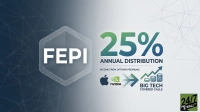
The REX FANG & Innovation Equity Premium Income ETF (NASDAQ:FEPI) is one of the most aggressive volatility-income products on the market, selling calls against a concentrated basket of AI and mega-cap tech names to fund weekly cash distributions. Recent payouts have run roughly $0.21 per week against a share price of about $42, which annualizes into the ~25% headline yield FEPI is marketed on. The question every holder should be asking is whether that check is real income or the fund quietly returning your own capital.
How FEPI actually generates its yield
FEPI holds the roughly 15 constituents of the Solactive FANG Innovation Index and writes short-dated call options against them. The latest NPORT filing shows the fund is net long the underlying stocks with a stack of short calls layered on top: $19.7 million in short call exposure, or about 3% of the $652 million net asset base. Premium collected from those calls is what funds the weekly distribution. FANG here is shorthand for the tech leaders driving the AI cycle, and the top positions reflect it: AMD at 8%, Micron at 8%, Alphabet at 7%, Broadcom at 7%, and NVIDIA at 7%.
The underlying businesses are not the problem
NVIDIA (NASDAQ:NVDA) just posted $81.6 billion in Q1 FY27 revenue, up 85% year over year, with $48.6 billion in quarterly free cash flow. Meta Platforms (NASDAQ:META) generated $56.3 billion in Q1 26 revenue at a 41% operating margin. Amazon (NASDAQ:AMZN) grew AWS 28% to $37.6 billion. These are cash-generative businesses with durable earnings, so credit risk in the equity sleeve is minimal. The sustainability risk lives entirely in the options mechanics.
Why the payout math is fragile
Two forces determine whether FEPI’s distribution is durable: implied volatility and the direction of the underlyings. The VIX is almost 17, below the trailing 12-month average of about 18 and in the 38th percentile of the past year. Lower volatility means thinner call premiums, which is why the 2026 weekly payouts of $0.20 to $0.22 represent a step down from the richer 2024 monthly distributions that ran $1.08 to $1.19 per share.
Direction is the second problem. When NVIDIA, Meta, or Amazon rally sharply past written strikes, gains get capped and the fund either buys back calls at a loss or lets shares get called away. Prediction markets currently peg a 90% probability that NVDA touches $192 in July and 50% odds of a close above $210, meaning meaningful call-assignment risk is priced in.
The total-return reality check
Yield without price performance is an illusion. FEPI is up 3% year to date on a total-return-adjusted basis, while the Nasdaq-100 via QQQ is up 16%. Over the past year, FEPI has returned 18% against QQQ’s 29%. The distributions are being paid, but roughly half of the underlying tech rally has been surrendered to the call-writing overlay. Holding NVIDIA outright would have delivered 24% over one year with no cap.
What FEPI is actually good for
FEPI’s distribution is safe in the sense that the fund is not on the verge of collapse. Its holdings are the strongest cash flow generators in the market, and the covered-call machine will continue producing premium as long as the underlyings remain volatile. What is at risk is the level of the payout and the NAV supporting it. The 2024 monthly distributions were roughly $13 per year in aggregate; 2025 totals came in lower, and the 2026 weekly run rate is tracking lower still. Investors who need income and can accept capped upside in exchange for a rich yield are the right audience. FEPI is a poor proxy for owning the AI trade outright, because a plain covered-call Nasdaq strategy has delivered better total returns with less NAV drag, and simply owning QQQ has run circles around both.


Contact [email protected] for any questions or corrections.
After 15 years on Wall Street with 7 of them as Director of Corporate and Municipal Bond Trading for a NYSE member firm, I started my own project and corporate finance consultancy. Much of the work involves writing business plans, presentations, white papers and marketing materials for companies seeking budgetary allocations for spinoffs and new initiatives or for raising capital for expansion or startup companies and entrepreneurs. On financial topics, I have been published under my own byline at The Motley Fool, 247wallst.com, DealFlow Events’ Healthcare Services Investment Newsletter and The Microcap Newsletter, among others. Additionally, I have done freelance ghostwriting writing and editing for several financial websites, such as Seeking Alpha and Shmoop Financial. I have also written and been published on a variety of other topics from music, audiophile sound and film to musical instrument history, martial arts, and current events. Publications include Copper Magazine, Fidelity (Germany), Blasting News, Inside Kung-Fu, and other periodicals.