This Monthly Dividend ETF Pays $2,260 a Year on a $100,000 Stake From Mid-Caps Income Investors Skip
Most dividend investors never look past familiar large-cap names, which means an entire tier of dividend-paying companies keeps collecting cash with almost no competition for attention. One ETF has quietly built a $4 billion portfolio around exactly that blind spot.

This post may contain links from our sponsors and affiliates, and Flywheel Publishing may receive compensation for actions taken through them.

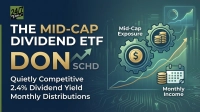
Most dividend portfolios start in the same place. Investors buy large-cap funds stuffed with familiar names, collect quarterly checks, and rarely look further down the market-cap ladder. The WisdomTree U.S. MidCap Dividend Fund (NYSEARCA:DON) takes the opposite approach. It targets dividend-paying companies outside the market’s largest names, pays distributions monthly, and currently offers a 2.26% trailing-twelve-month yield. On a $100,000 investment, that works out to roughly $2,260 per year.
That yield alone is not enough to make DON a high-income ETF. Plenty of covered-call and high-dividend funds pay considerably more. The appeal is different. DON gives income investors access to a part of the market that tends to receive far less attention than the mega-cap stocks dominating the S&P 500, while still providing a diversified dividend stream and room for capital appreciation.
DON Goes Where Most Dividend Funds Do Not
DON tracks the WisdomTree U.S. MidCap Dividend Index, but WisdomTree does not define mid-caps using a simple dollar market-cap cutoff. The index starts with its broader U.S. dividend universe, removes the 300 largest companies, and then selects companies representing the next 75% of market capitalization. Constituents are weighted based on the amount of cash dividends they are projected to pay rather than simply by market value.
That methodology creates a portfolio that looks very different from a traditional large-cap dividend ETF. DON held roughly $4.12 billion in assets as of August 13, 2026, and charges a 0.38% expense ratio. Its largest positions include Franklin Resources, Best Buy, Viatris, APA, and Stanley Black & Decker, yet no individual stock represents greater than 1.4% of assets. The top 10 combined account for only about 11% of the fund’s AUM.
The result is diversification without depending on just a handful of mega-cap stocks that now dominate many broad-market portfolios.
The Income Comes From Actual Dividends
DON also generates its distributions differently from the option-income ETFs that have become popular with retirees (and that we have covered in numerous articles). There is no covered-call overlay manufacturing a double-digit distribution rate. The income comes from actual dividends paid by the companies DON owns.
The fund has a 2.26% TTM dividend yield as of August 13, while the fund’s 30-day SEC yield stands at 2.28%.
Mid-Caps Have Added More Than Income
DON has delivered respectable long-term returns alongside those monthly payments. Through July 31, the ETF returned 16.51% over the previous year and an annualized 11.88% over three years. Its five- and 10-year annualized returns were 9.30% and 9.23%, respectively.
The portfolio also carries a noticeably different sector mix than the technology-heavy broader market. Financials represent 24.07% of assets, followed by industrials at 18.16%, consumer discretionary at 10.79%, and real estate at 9.68%. Technology accounts for just 4.56%.
That makes DON particularly interesting for investors whose existing portfolio is already loaded with large-cap growth stocks. It adds dividend income while shifting exposure toward financials, industrial companies, real estate, utilities, energy, and other areas that receive relatively little weight in today’s mega-cap-heavy indexes.
| Metric | DON |
| Inception Date | June 16, 2006 |
| Expense Ratio | 0.38% |
| Yield | 2.26 TTM (2.28% 30-Day SEC Yield) |
| Dividend Frequency | Monthly |
| AUM | $4.12 billion |
| Index | WisdomTree U.S. MidCap Dividend Index |
| Strategy | Dividend-weighted U.S. mid-cap equities |
Who Should Own DON?
DON is not the ETF to buy if your only objective is chasing the highest current yield. An approximate 2% distribution rate will not replace a paycheck on its own, and the monthly payment can change from one month to the next.
Its value is as a portfolio complement. Investors already holding an S&P 500 or large-cap dividend ETF can use DON to add exposure to hundreds of dividend-paying companies outside the usual mega-cap names. You get monthly income, broader diversification, and participation in a segment of the U.S. market many income portfolios largely skip.
For a $100,000 position, roughly $2,260 in annualized distributions is useful. The bigger reason to own DON, however, is everything surrounding those checks.
Contact [email protected] for any questions or corrections.
Ryne Mauck is an investment writer covering exchange-traded funds, retirement planning, and portfolio strategy. Through his work at 24/7 Wall St. and other investment platforms, including Seeking Alpha, he aims to provide clear, research-driven insights that help investors make more informed decisions while maintaining a long-term approach to investing.
Ryne holds a B.Sc. in Finance and an M.A. in Political Science. He is a formerly registered Municipal Advisor Representative and has passed the Series 50, Series 63, and Series 65 exams. His articles are not intended to be, nor should they be interpreted as, financial advice.