Why JEPQ’s 10.7% Yield Looked Irresistible Until Nvidia Rallied
JEPQ's monthly paycheck looks generous until a single Nvidia session reveals exactly what income investors are trading away to collect it.

This post may contain links from our sponsors and affiliates, and Flywheel Publishing may receive compensation for actions taken through them.

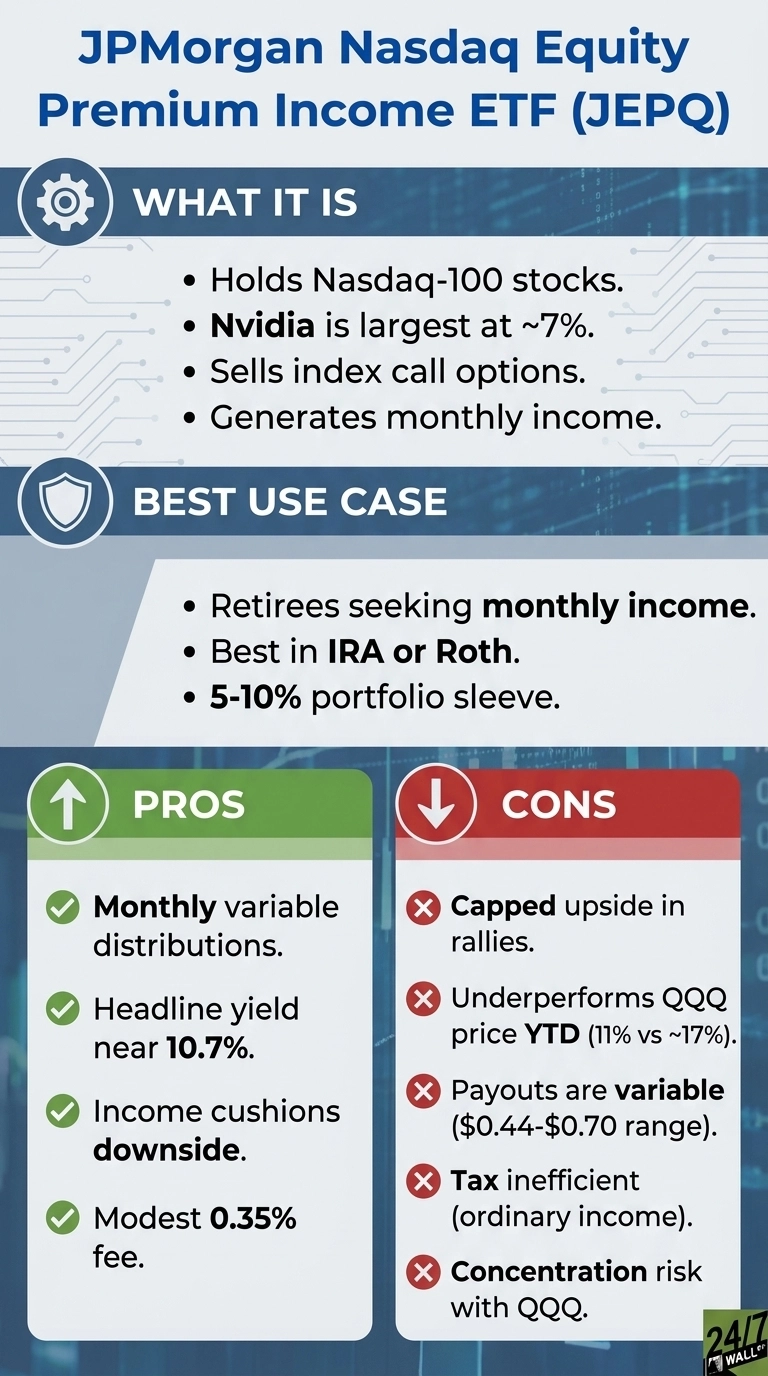
The JPMorgan Nasdaq Equity Premium Income ETF (NASDAQ:JEPQ) sells the promise most retirees want: a monthly paycheck on the growthiest corner of the U.S. market. Its trailing distributions total about $6.52 per share over the past year, yielding a headline yield near 10.7% at the current $60 share price. That is why JEPQ has become one of the most-held income ETFs on Nasdaq.
Wednesday’s session showed the cost of that yield. NVIDIA (NASDAQ:NVDA | NVDA Price Prediction) jumped nearly 9% on August 27 and added roughly $442 billion in market value after guiding to about 70% revenue growth for its next fiscal year, per Reuters. The Invesco QQQ Trust (NASDAQ:QQQ) rose roughly 1%. JEPQ managed under 1%, capturing roughly 63% of QQQ’s move. One day proves nothing, but it demonstrates the mechanism income investors are actually renting.
How JEPQ Actually Makes Its Money
JEPQ owns a concentrated basket of Nasdaq-100 stocks, with Nvidia its largest single position at roughly 7%. That captures ordinary stock returns and dividends.
The income comes from an overlay. JPMorgan uses equity-linked notes, short-term securities whose payoff is tied to selling call options on the Nasdaq-100. When you sell a call, you collect a premium today in exchange for giving up gains above a set price. If the index rises sharply, the call buyer takes that upside; you keep the premium and the stock up to the strike price.
The premiums flow through the notes into JEPQ’s monthly distributions, which is why the payout is variable, ranging from $0.44 last September to $0.70 this August: option premiums swell when volatility rises. The tradeoff is symmetrical. Rich premiums in calm markets are fine, but when the index rips higher on an Nvidia-style catalyst, the calls JEPQ effectively sold move against the fund and cap participation.
Cycle Math Across a Full Market Move
Year to date, JEPQ has returned about 11% on price, against QQQ’s roughly 17%, before dividends on either side. Over the past year, JEPQ is up about 21% while QQQ has gained roughly 26%, and Nvidia alone has run about 26%.
Distributions close some of the gap, but not all of it. Adding roughly ten points of yield to price return still leaves JEPQ ahead of QQQ on total return in this stretch, which is the straightforward case for the fund. Active weights matter too. JPMorgan’s managers actively tilt security selection away from a straight Nasdaq-100 weighting, so a portion of the return gap comes from stock picking rather than the option overlay.
The strategy earned its keep in 2022, when the index fell and premium income cushioned losses. Any evaluation that credits JEPQ for capping downside must also debit it for capping upside during rallies like this one.
Real Costs Beyond the Expense Ratio
The stated fee is modest at 0.35%, competitive for an actively managed derivative-income fund. Taxes are the higher hidden cost. Distributions are typically ordinary income, not qualified dividends, so holding JEPQ in a taxable account shaves a meaningful slice off the headline yield for anyone in a middle or higher bracket.
Distribution volatility complicates budgeting. A retiree living on a fixed monthly check will see payouts drift with implied volatility, not with spending needs. Concentration is quieter but real. Because the fund holds Nasdaq-100 names, an investor pairing JEPQ with QQQ or a large-cap growth fund is likely doubling up on the same seven or eight mega-caps. None of these is disqualifying. They simply mean the 10.7% yield is compensation for accepting capped upside, ordinary-income tax treatment, and lumpy payouts.
Who JEPQ Fits Best
JEPQ makes sense for retirees and near-retirees who are already spending portfolio income and prefer an option-funded check to selling shares each month. It works best inside an IRA or Roth, where the ordinary-income tax drag disappears, and only the strategy’s mechanics matter. That preference for income over share sales is the whole argument against the old 4% rule, which we walked through in a free income-first retirement guide.
Investors still in accumulation, with a decade or more before withdrawals, are paying a real opportunity cost. The Nvidia session illustrates what compounding forgone upside looks like across many years. A reasonable use is a 5% to 10% sleeve for cash-flow smoothing, paired with a straight Nasdaq or S&P index fund that keeps exposure to the next Nvidia-style move without a ceiling. If the appeal is the yield alone, the more defensible answer is to own QQQ and sell shares as needed, accepting that JEPQ trades growth for predictability.
Contact [email protected] for any questions or corrections.
Omor Ibne Ehsan is a writer at 24/7 Wall St. He is a self-taught investor with a focus on growth, cyclical, and dividend equities that have strong fundamentals, value, and long-term potential. He also has an interest in high-risk, high-reward investments such as penny stocks.