PFF Is the Preferred Stock ETF Everyone Knows. PFFA Adds Leverage and a Manager, and Pays Monthly

This post may contain links from our sponsors and affiliates, and Flywheel Publishing may receive compensation for actions taken through them.
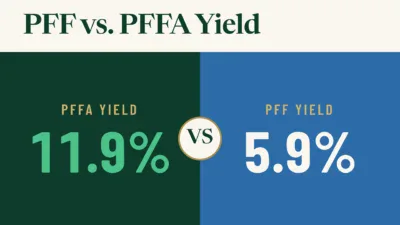
Income-focused retirees who want preferred stock usually end up with the iShares Preferred and Income Securities ETF (NASDAQ:PFF). A smaller fund, the Virtus InfraCap U.S. Preferred Stock ETF (NYSEARCA:PFFA), has the same kind of securities in a different way. At November 23 prices, its trailing distributions came to about 11.9%, compared with about 5.9% for PFF.
Preferred Stock in Plain Language
Preferred stock sits between a stock and a bond. It usually pays a fixed dividend and gets paid before common shareholders. Its price tends to move with long-term interest rates, much like a bond.
Three Differences That Set PFFA Apart
A Manager Picks the Holdings
PFF aims to track the ICE Exchange-Listed Preferred & Hybrid Securities Index, according to its prospectus. PFFA has no index to follow. FactSet describes it as actively managed. Its manager judges each company on its fundamentals and generally stays away from callable securities. Virtus says the fund’s main goal is current income, with capital appreciation second (per the fund page).
Borrowed Money Expands the Portfolio
FactSet says PFFA uses margin, meaning it borrows against its holdings to buy more securities, and that the fund caps leverage at a set share of its assets. The fund’s Form N-PORT shows how this plays out. As of July 31, 2026, its preferred securities were 125.64% of net assets. Total assets were $3.16 billion[1] against net assets of $2.45 billion, and liabilities came to about 22% of total assets.
A Fixed Monthly Payment
PFFA paid a distribution every month from December 22, 2025 through November 20, 2026. The amount was $0.17 in December and $0.1725 every month since, for a trailing total of $2.0675. The next payment is due November 27. PFF also pays monthly, but its checks moved around more over the past year: from $0.031167 in March 2026 to $0.177226 in February. If a 30-day income schedule is the point, there are other ways to build one; we rounded up seven monthly payers in a free report.
Holdings Reach Well Beyond Bank Preferreds
On July 31, 2026, PFFA’s largest position was preferred stock from Strategy Inc. (NASDAQ:MSTR | MSTR Price Prediction), at 2.63%[1] of net assets. Next came Flagstar Bank (NYSE:FLG) at 2.56%[1] and KKR (NYSE:KKR) at 2.54%. Beyond those, the fund holds banks, mortgage REITs, utilities, pipelines, telecom, and preferreds issued by large tech companies. It also has some common stock and corporate debt. PFF’s index covers exchange-listed preferred and hybrid securities.
Costs, Yield, and Returns Side by Side
| Metric | PFFA | PFF |
|---|---|---|
| Trailing 12-month distributions | $2.0675 | $1.637361 |
| Year-to-date adjusted price change | -11.59% | -6.23% |
| One-year adjusted price change | -9.17% | -3.97% |
| Five-year adjusted price change | 13.18% | -3.28% |
All periods end November 23, 2026. PFF’s net expense ratio is 0.45%. PFFA pays interest on the money it borrows, so check the fee table in its current prospectus for the full cost. Leverage helped PFFA over five years and hurt it over the past month, when it fell 7.4% while PFF fell 3.01%.
Risks Retirees Should Weigh
- While leverage increases income, it can also amplify losses.
- Borrowing costs climb when short-term rates rise.
- Preferred prices fall when long-term rates rise.
- Issuers can call (buy back) many preferreds, often when rates have fallen.
- Preferreds tend to be concentrated in financial companies.
- Some preferred income may not qualify for the lower tax rate on qualified dividends. Virtus has estimated in its Section 19(a) notices that part of some distributions was a return of capital. iShares prospectuses say distributions may be taxed as ordinary income or capital gains unless the shares are held in an IRA or 401(k).
Why PFFA Gets Overlooked
PFF dates back to March 2007. PFFA’s trading history starts in May 2018. On November 23, PFF traded 8,470,289 shares, compared with 1,741,476 for PFFA, about 4.9 times as many. Many income screens filter out funds that are actively managed or use leverage, so PFFA often never shows up.
Who Each Fund Fits
PFFA could suit retirees who want a fixed monthly amount, can live with deeper losses, and can hold it in an IRA. PFF matches investors who want index rules, no borrowing, a lower stated fee, and greater trading. Over the coming months, keep an eye on short-term rates, which drive PFFA’s borrowing costs, and on the fund’s next holdings report.
Contact [email protected] for any questions or corrections.
Ryne Mauck is an investment writer covering exchange-traded funds, retirement planning, and portfolio strategy. Through his work at 24/7 Wall St. and other investment platforms, including Seeking Alpha, he aims to provide clear, research-driven insights that help investors make more informed decisions while maintaining a long-term approach to investing.
Ryne holds a B.Sc. in Finance and an M.A. in Political Science. He is a formerly registered Municipal Advisor Representative and has passed the Series 50, Series 63, and Series 65 exams. His articles are not intended to be, nor should they be interpreted as, financial advice.