My 401(k) Dwarfs My Brokerage Account: With 7 Years Until Retirement, How Should I Invest Now?
Small businesses account for 43.5% of U.S. GDP and 61% of net new jobs since 1995. For a business-owning couple in their 40s wondering whether to keep maxing out their 401(k)s before selling the company and retiring near 50, the…

This post may contain links from our sponsors and affiliates, and Flywheel Publishing may receive compensation for actions taken through them.

Entrepreneurs and small business owners sit at the heart of a healthy, capitalism-driven economy. Small businesses represent 43.5% of U.S. GDP, and from January 1995 through December 2024, they accounted for 61% of net new job creation since 1995, according to the SBA’s February 2026 FAQ. The same SBA data counts 36.2 million small businesses currently operating in the United States, which is 99.9% of all businesses in the country.
Because tax law has long been shaped to encourage entrepreneurship, small business owners have retirement-planning tools available to them that traditional salaried employees at larger corporations simply cannot access. Understanding the full scope of those tools is critical for owners thinking about an early exit, especially when pre-tax retirement accounts have grown far larger than post-tax holdings.
A Business Owner’s 401(k) and Non-Retirement Investment Imbalance
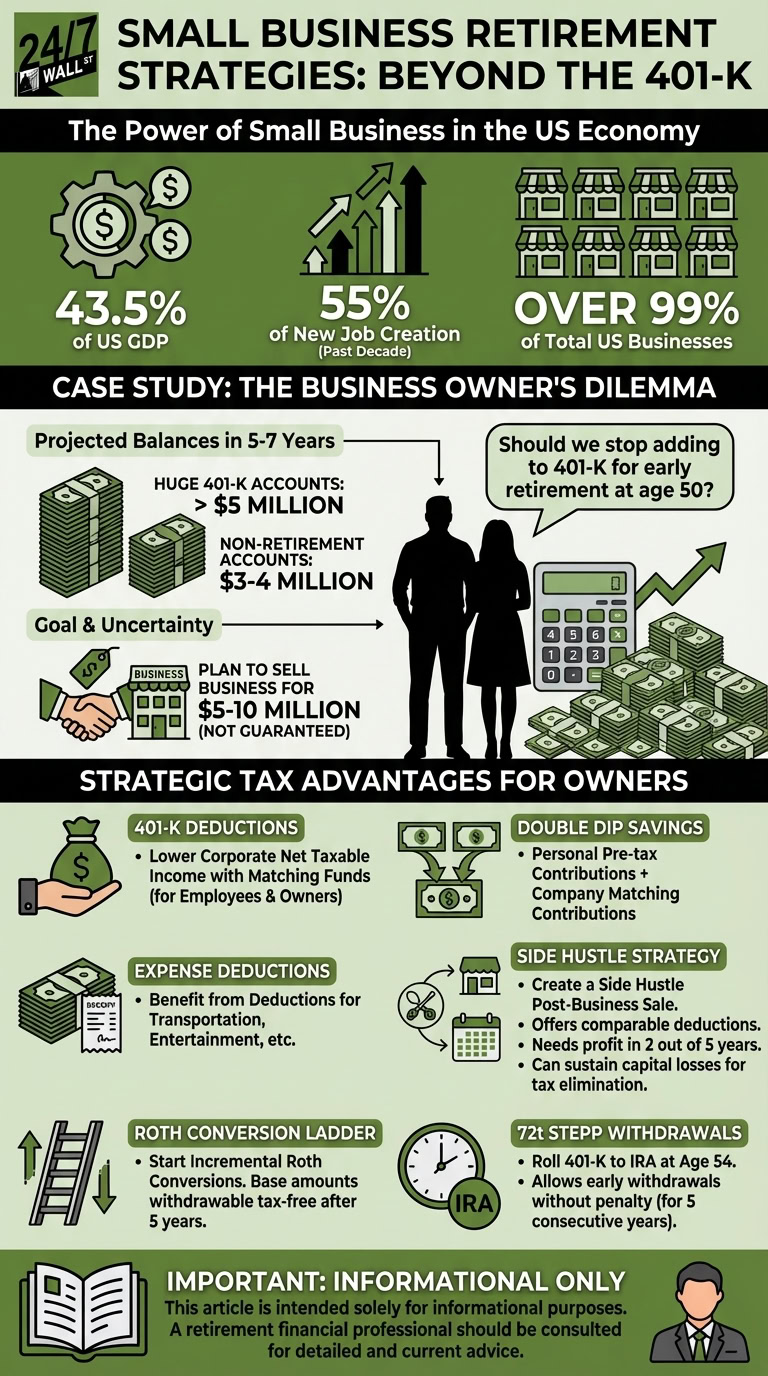
A Reddit poster in his 40s turned to the fatFIRE community for advice on a genuinely complex situation. His scenario broke down like this:
- Both he and his wife held large 401(k) balances relative to their taxable brokerage accounts.
- Within five to seven years, he expected their combined 401(k)s to surpass $5 million.
- Over that same period, he projected their non-retirement brokerage accounts would reach $3 to $4 million.
- The couple owns a business they plan to sell for $5 to $10 million in five to seven years, though that outcome is not guaranteed.
- His core question: given plans to retire near age 50, does it still make sense to keep maxing out their 401(k)s when the pre-tax accounts already so heavily outweigh their post-tax holdings?
The question has added weight in 2026, because the IRS raised the employee 401(k) deferral limit to $24,500 (up from $23,500 in 2025), with a combined employee-plus-employer ceiling of $72,000. At those figures, a high-earning business-owner couple can still shelter a very substantial amount each year, which makes the decision to slow or stop contributions one worth examining carefully rather than reflexively.
Small Business Retirement Account Strategies
The framing of the poster’s question suggests he is thinking about his 401(k) strictly as an employee benefit, rather than as one piece of a broader business-owner tax toolkit. Several angles are worth examining before deciding whether to slow or stop contributions.
First, consider the corporate deduction angle. The IRS allows small business owners to deduct 401(k) matching contributions from gross business revenues, which directly lowers the company’s net taxable income. That deduction covers matching funds for any employees, and for the owners themselves. Because the poster and his wife presumably draw the largest salaries in their company, they enjoy an annual “double dip”: personal pre-tax salary deferrals plus employer matching contributions, both flowing into their retirement accounts before any tax is applied.
Small business owners can also offset taxable income through a range of standard operating deductions, including transportation, business meals, home-office expenses, and equipment costs. These deductions continue to reduce the couple’s overall tax burden for as long as the business operates as a going concern, making the environment for continued 401(k) contributions more favorable than it might appear on the surface.
Second, a post-sale “side hustle” structured as a small business can extend many of those same tax advantages into retirement. If the couple establishes a venture built around a hobby or skill before selling their main company, it can generate deductible business expenses under the same IRS rules. The lower personal income bracket that follows early retirement would also make pre-tax 401(k) withdrawals less costly over time. Under IRS rules, a business generally needs to show a profit in at least two out of five consecutive years to be treated as a legitimate for-profit enterprise rather than a hobby, so the setup requires advance planning but is achievable.
Third, a Roth conversion ladder is worth starting sooner rather than later. The couple can begin converting portions of their pre-tax 401(k) or traditional IRA balances to Roth each year while still running the business. Each converted amount can then be withdrawn tax-free after a five-year seasoning period measured from the date of that specific conversion. Because multiple conversions can be staggered year by year, the ladder can supply tax-free income on a rolling basis once retirement begins. One additional wrinkle worth tracking: the SECURE 2.0 Act raised the age for required minimum distributions to 73 (and to 75 starting in 2033), which gives the couple more runway to let the pre-tax balances compound before they are forced to draw them down. That extra time makes a well-timed Roth ladder even more valuable as a planning tool.
Finally, there is the 72(t) Substantially Equal Periodic Payments (SEPP) option. The rule allows penalty-free early withdrawals from a retirement account when distributions follow a schedule of Substantially Equal Periodic Payments. Those payments must continue for at least five years or until the account holder reaches age 59½, whichever period is longer, and must follow precise IRS rules to remain free of the 10% early-withdrawal penalty. There is no minimum starting age, which makes SEPP available to someone retiring at 50.
IRS Notice 2022-6 recognizes exactly three calculation methods for a SEPP plan: the required minimum distribution (RMD) method, the fixed amortization method, and the fixed annuitization method. The RMD method recalculates the payment each year based on account balance and life expectancy, producing a variable and generally smaller distribution. The two fixed methods set a single level payment that repeats annually and is typically larger. Under the same notice, the interest rate for the fixed methods is capped at the greater of 5% or 120% of the federal mid-term rate, meaning a 5% floor now applies. Regular income taxes still apply to each withdrawal because the SEPP strategy eliminates the 10% penalty but does not create a tax-free distribution. Because the rules are complex and locking in a payment schedule is effectively irreversible, professional tax guidance is strongly recommended before committing to any SEPP plan.
Taken together, these strategies suggest that abandoning 401(k) contributions is not automatically the right move. The corporate deduction benefit, the Roth conversion ladder, and the SEPP option all become more valuable as the pre-tax balance grows, provided the couple plans carefully for how and when they will draw those funds down. The goal is not to minimize contributions but to ensure every dollar going into a tax-deferred account has a clear exit plan attached to it.
This article is intended solely for informational purposes. A retirement financial professional should be consulted for more detailed and current advice.
Editor’s note: This pass adds the current 2026 IRS 401(k) contribution limits ($24,500 employee deferral, $72,000 combined), notes the SECURE 2.0 Act’s increase of the required minimum distribution age to 73 (rising to 75 in 2033), and expands the 72(t) SEPP section to identify the three IRS-recognized calculation methods under Notice 2022-6 and the 5% interest rate floor now in effect for fixed-payment plans.
Contact [email protected] for any questions or corrections.
After 15 years on Wall Street with 7 of them as Director of Corporate and Municipal Bond Trading for a NYSE member firm, I started my own project and corporate finance consultancy. Much of the work involves writing business plans, presentations, white papers and marketing materials for companies seeking budgetary allocations for spinoffs and new initiatives or for raising capital for expansion or startup companies and entrepreneurs. On financial topics, I have been published under my own byline at The Motley Fool, 247wallst.com, DealFlow Events’ Healthcare Services Investment Newsletter and The Microcap Newsletter, among others. Additionally, I have done freelance ghostwriting writing and editing for several financial websites, such as Seeking Alpha and Shmoop Financial. I have also written and been published on a variety of other topics from music, audiophile sound and film to musical instrument history, martial arts, and current events. Publications include Copper Magazine, Fidelity (Germany), Blasting News, Inside Kung-Fu, and other periodicals.