Experts Warn Musk’s Million-Satellite Plan Could Set Off A Debris Cascade That Closes Off Space, As SpaceX Warns Other Operators Are Raising Collision Risks
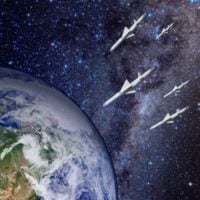
SpaceX wants FCC approval for up to one million satellites while a new physics paper argues that constellations above a certain size generate their own runaway debris problem, and regulators may be asking entirely the wrong questions.


Rival satellite operators are raising collision risks, according to SpaceX (NASDAQ:SPCX | SPCX Price Prediction). SpaceX said Starlink came close to about 650 different third-party satellites that were maneuvering in 2026, and only about half of them shared trajectory information. At the same time, 3DTested reports SpaceX has asked the FCC to approve up to one million satellites.
A New Paper Explains Challenges Of “Satellite Constellations”
On 31 July 2026, Hugh G. Lewis, a space sustainability expert and professor of astronautics, posted “Critical Sizes of Satellite Constellations” to arXiv. Weeks earlier, Lewis told Space.com that SpaceX was doing an excellent job managing orbital traffic.
Lewis also warned: “I think we’re heading towards a situation where there will be a collision involving an operational satellite… It will be in spite of all those maneuvers.”
Lewis finds that several constellations, whether planned, partly deployed or fully deployed, are above their critical size. Above that size, the debris population becomes unstable or runs away. Lewis writes that this happens for small and large constellations alike, even with mitigation that goes beyond accepted good practices, and even in a pristine, debris-free environment. A constellation above its critical size can create its own debris problem.
Lewis argues that regulators judge risk from single satellites and ignore the combined risk of a whole constellation. Lewis calls for “more stringent approaches to regulation.” The paper names no constellations, so it does not say which systems are over their critical size. Critical size is specific to each constellation, so there is no single threshold to hold SpaceX’s plan against. Finally, the paper is a preprint, and we could not confirm that it has been peer reviewed.
What SpaceX Is Proposing
3DTested reports the filing covers altitudes of 500 km to 2,000 km, in shells up to 50 km thick. 3DTested also quotes the filing calling the project “a first step towards becoming a Kardashev II-level civilization.” Reporting says the filing describes no specific debris-mitigation measures. Elon Musk promoted the plan as needed for AI power demands. KeepTrack counts 11,137 Starlink satellites still in orbit.
How a Debris Cascade Works
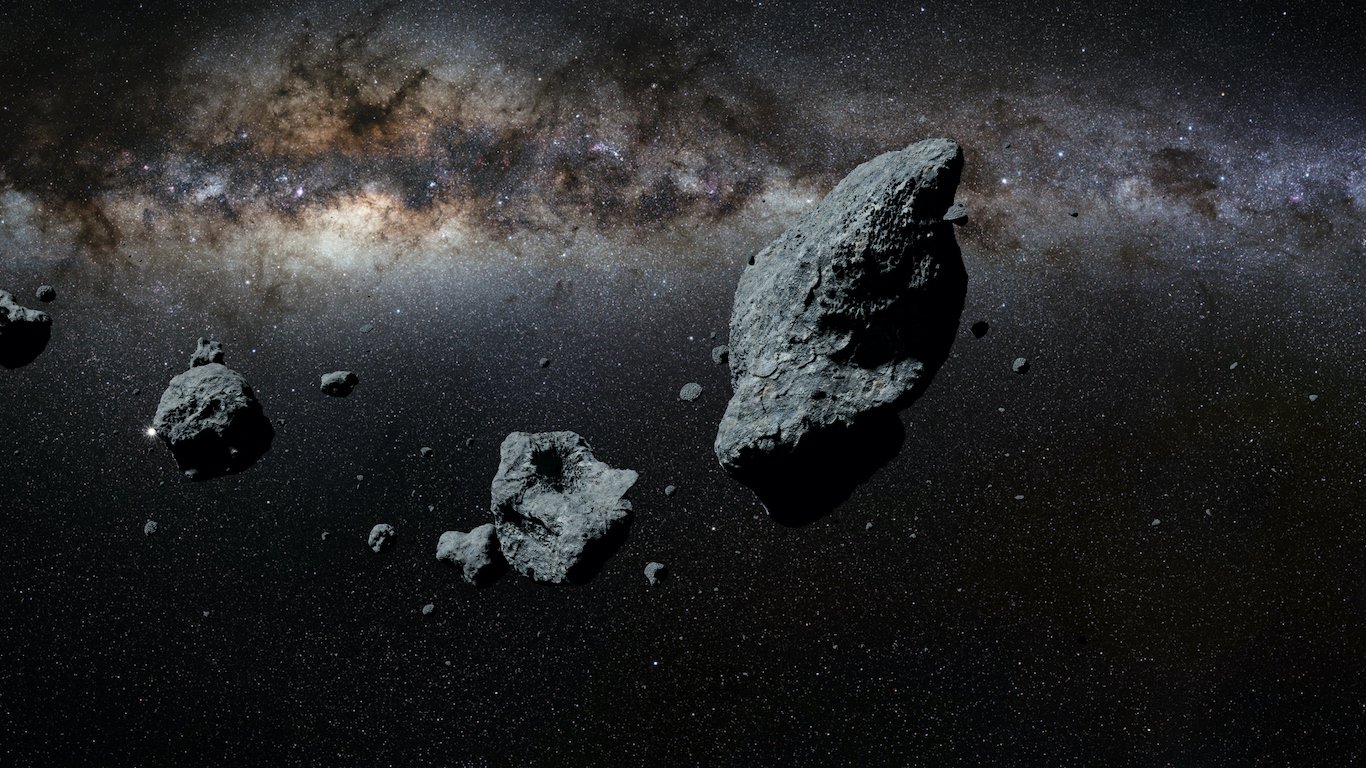
The Register notes that NASA scientists, including Donald Kessler, proposed the cascade scenario in 1978. Crowding makes collisions more likely, and the debris from each collision causes more collisions. Some orbits could become unusable for decades. The European Space Agency describes the February 2009 collision between Kosmos 2251, a defunct Russian satellite, and Iridium 33, an active satellite in the network run by Iridium Communications (NASDAQ:IRDM). The European Space Agency, via CNN, says that crash created thousands of pieces of debris. It showed how the mechanism works, but no cascade has happened. CNN reported in January 2025 that tens of thousands of trackable pieces of space junk orbit Earth.
Critics Warn of Compounding Risk
In a March Scientific American column, Phil Plait warned that multiplying satellite numbers by a factor of thousands could make the threat “apocalyptically worse.” In May, Plait told readers to watch out for of tech bros who treat the Kardashev scale as the “be-all and end-all,” calling that view “profoundly limited and limiting.” Plait, who says he supports space exploration, credits Musk with having “truly revolutionized rocketry.” He adds that Musk’s predictions tend to be “several years off the mark.”
SpaceX Points to Unshared Trajectories
Teslarati reports that over six months, Starlink recorded about 164,000 close approaches in which the closest point came within four hours of another satellite’s unannounced maneuver. Aerospace Global News reports that in August, a Starlink satellite came within 134 meters of another spacecraft and had to turn its solar arrays edge-on. Aerospace Global News also reports that in October 2025, another spacecraft briefly put itself on a course within 57 meters of a Starlink satellite. SpaceX says many of the satellites that did not share data were run by Chinese organizations, though it says the problem goes beyond China and Russia. Our sources do not verify that claim. SpaceX calls keeping maneuver plans private counterproductive and offers a free data-sharing platform.
On a separate measure, Space.com reports that Starlink satellites made over 355,000 collision-avoidance maneuvers from June 1, 2025 to May 31, 2026.
Musk’s Remarks Over Time
In December 2021, when Starlink was far smaller, Musk said “a couple of thousand satellites is nothing.” In November 2024, Musk replied “Exactly” to a post saying 10 times as many spacecraft would not be a challenge. In March 2026, Musk argued that space is so vast the satellites would be spread far apart. No source shows him speaking directly about a cascade.
Crowding also has other sources. IBTimes reports China has a separate plan for a 200,000-strong fleet, and AST SpaceMobile (NASDAQ:ASTS) is building its own constellation.
Single-Satellite Rules Face a Constellation Test
The FCC review tests Lewis’s argument that rules built around single satellites fail to judge a whole constellation. The company asking the industry to share data is also planning to add the most satellites.
Contact [email protected] for any questions or corrections.
AJ spent 10 years writing about financial markets at The Motley Fool. His coverage centers on technology stocks and the broader macroeconomic trends, from interest rates to geopolitics, that shape where markets are headed next. AJ is drawn to the stories where big-picture economics and individual companies collide.