I Discovered My Husband Had $150,000 in Gambling Debt After We Got Married and Had a Baby
Discovering $150,000 in hidden gambling debt after marriage and a new baby ranks among the most devastating financial betrayals a spouse can face. This is about broken trust, deception during vulnerable life transitions, and the sudden realization that your financial…

This post may contain links from our sponsors and affiliates, and Flywheel Publishing may receive compensation for actions taken through them.

Discovering $150,000 in hidden gambling debt after marriage and a new baby ranks among the most devastating financial betrayals a spouse can face. The damage extends well beyond the dollar figures: it represents broken trust, deception during the most vulnerable life transitions, and the sudden realization that an addiction has quietly hijacked the family’s financial future.
Stories like this one are far from rare. According to recent data compiled across more than 150 sources, up to 20 million Americans have gambling problems or are at risk, and 2.5 million U.S. adults experience severe gambling problems. Research also shows that about 6% of all adults were harmed by someone else’s gambling in the past year, most often a partner, most often emotionally and financially. The harm doesn’t stop with the person placing the bets; it moves through the household first and outward from there.
The Core Financial Reality
| Category | Amount |
|---|---|
| Gambling debt (judgments, payday loans, emptied 401k) | $150,000 |
| Current household income (single earner) | $68,000 |
| Husband’s potential income (when recovered) | $95,000-$110,000 |
| Additional secured debt (house, vehicles) | $142,000 |
| Total debt burden | $292,000 |
The income gap is the defining problem here. On Heather’s $68,000 salary alone, the household carries a gambling debt-to-income ratio above 3:1 before even counting the mortgage and vehicles. The two court judgments of $53,000 and $19,000 likely carry interest rates in the 8% to 12% range, while payday loans typically run 15% to 30% APR. Every month without a plan costs hundreds more in compounding interest charges.
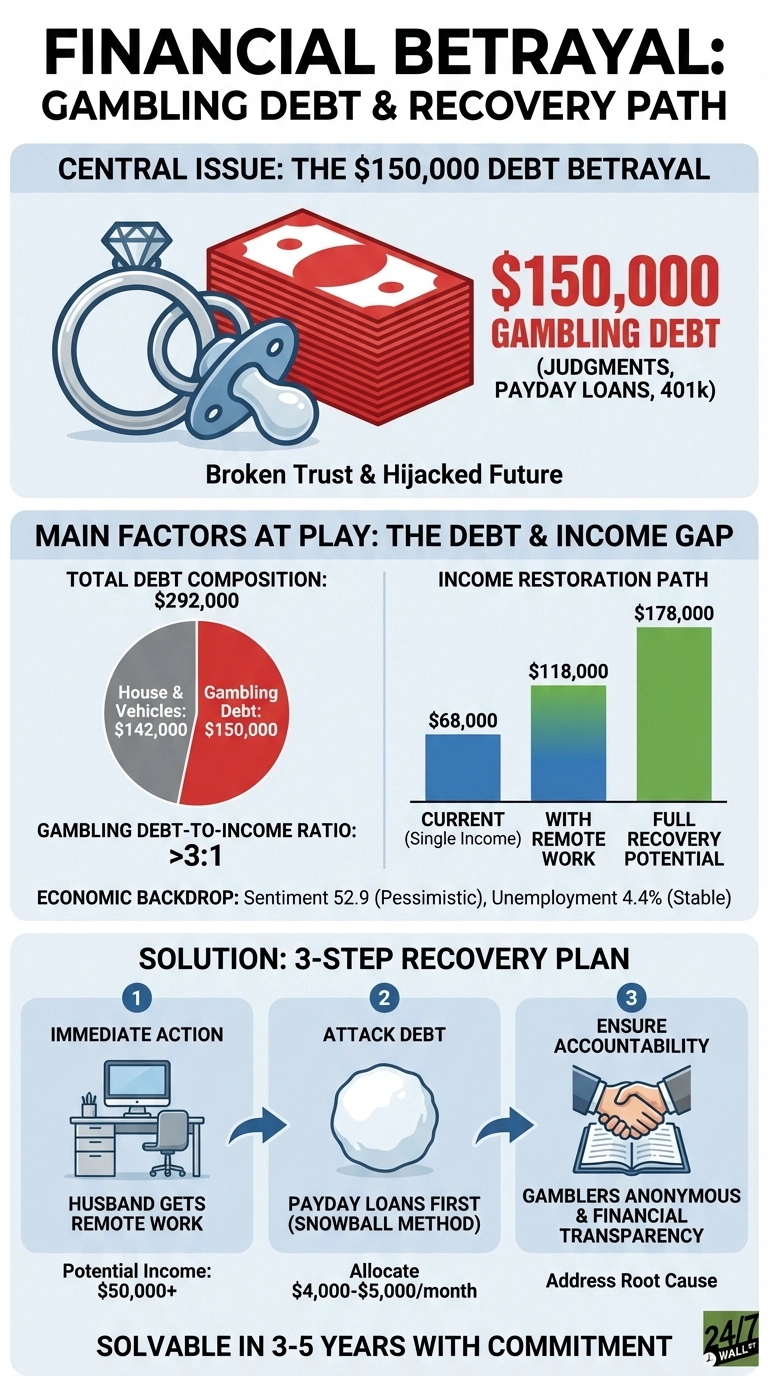
The broader economic backdrop adds further pressure. The University of Michigan Consumer Sentiment Index came in at 49.5 in June 2026, well below the 52.9 reading when this story was first published in January. That June figure rose from a record low of 44.8 in May, but sentiment remained the second lowest in data going back to the 1970s. On the jobs side, the U.S. unemployment rate dropped to 4.2% in June 2026, down from 4.3% in May, though nonfarm payrolls grew by just 57,000 in June, well below consensus expectations. Job opportunities exist, particularly in professional and business services, but competition for well-paying remote roles has stiffened in a cooling labor market.
The Path Forward Requires Immediate Action
Bankruptcy may seem like a quick exit, but with an earning capacity of $95,000 to $110,000, her husband would very likely fail the Chapter 7 means test. The more durable path runs through aggressive income restoration paired with a disciplined debt-elimination plan.
First priority: Her husband must pursue remote work immediately. A torn Achilles does not prevent computer-based work, and even a $50,000 remote role would nearly double household income. At $160,000 or more combined, the family could realistically eliminate all gambling debt within three years by routing $4,000 to $5,000 per month directly toward payoff.
Second priority: Attack the payday loans first. These carry the highest rates and the most predatory terms. Using the debt snowball method, starting with the smallest balances, builds psychological momentum that keeps the repayment plan on track over the long haul.
Third priority: Protect the marriage through accountability. Her husband needs Gamblers Anonymous, full financial transparency (shared access to every account), and potentially professional addiction counseling. Gambling addiction responds to treatment, and recovery is the usual outcome rather than the exception. Without addressing the behavioral root cause, any amount of debt payoff remains temporary.
What Matters Most Right Now
The math on this situation is genuinely solvable in three to five years, provided her husband returns to full earning capacity and commits to gambling sobriety. The harder question is whether the marriage can withstand years of recovery, resentment, and constant temptation while the family slowly digs out.
Evaluating his commitment to transparency and recovery has to come first. Genuine remorse and willingness to submit to complete financial accountability make the path forward real. Minimizing, deflecting, or resisting oversight signals a deeper problem that no debt repayment schedule can fix.
Editor’s note: This article was updated to reflect the June 2026 University of Michigan Consumer Sentiment Index reading of 49.5, down from the 52.9 cited at original publication, and the current U.S. unemployment rate of 4.2% per the Bureau of Labor Statistics June 2026 Employment Situation report. Context on the prevalence of gambling-related financial harm was added using 2024 and 2025 research data.
Contact [email protected] for any questions or corrections.
Austin Smith is a financial publisher with over two decades of experience as an investor, analyst, and advisor. He covers stocks, ETFs, Artificial intelligence and personal finance for 24/7 Wall St. Previously, he spent over a decade at The Motley Fool as a senior editor for Fool.com, portfolio advisor for Millionacres, and launched The Ascent to help reader take control of their personal finances.
His work has been featured on Fool.com, NPR, CNBC, USA Today, Yahoo Finance, MSN, AOL, Marketwatch, and many other publications. He is as an advisor to private companies, and co-hosts The AI Investor Podcast with Eric Bleeker.
When not looking for investment opportunities, he can be found skiing, running, or playing soccer with his children. Learn more about Austin's investment approach here.