How a Roth IRA Helps Your Social Security Benefits Go Further
Social Security benefits last a lifetime, and periodic Cost of Living Adjustments help your purchasing power keep pace with inflation. Here is why investing in a Roth IRA throughout your career is one of the smartest ways to protect those…

This post may contain links from our sponsors and affiliates, and Flywheel Publishing may receive compensation for actions taken through them.

Social Security benefits last a lifetime, and periodic Cost of Living Adjustments in most years help your purchasing power keep pace with inflation. Those qualities make the program extraordinarily valuable, which is why it pays to think carefully about how to protect as much of each check as possible. One of the most effective tools for doing that is a Roth IRA, and the sooner you start contributing during your working years, the greater the payoff in retirement.
Here is why putting money into a Roth can help ensure your Social Security benefits go further.
Why a Roth IRA is an ideal account to stretch your Social Security checks
Investing in a Roth IRA is one of the most effective ways to make sure your Social Security checks go further, because choosing a Roth over a traditional account can allow you to keep more of your benefits rather than sending extra money to the IRS. The reason comes down to how the federal government taxes Social Security income.
Social Security benefits become taxable once your income reaches a certain level, and the thresholds have not been adjusted for inflation since they were set decades ago. As a single tax filer, you could owe tax on up to 50% of your benefits once your provisional income falls between $25,000 and $34,000. Above $34,000, up to 85% of your benefits become taxable. Married filers hit the 50% tier at $32,000 and the 85% tier at $44,000 in provisional income.
The definition of income for these thresholds is narrower than the standard definition. The Social Security Administration uses “provisional income,” calculated as your adjusted gross income plus tax-exempt interest (such as municipal bond interest) plus half of your annual Social Security benefits. Because those thresholds are frozen, a modest COLA increase to your benefit check can nudge a growing number of retirees over the line and trigger a tax bill they did not expect.
Roth IRA distributions, however, are not counted as taxable income and do not factor into the provisional income calculation at all. That means you can withdraw as much as you need from a Roth each year without pushing your Social Security benefits into taxable territory, as long as your other income stays below the applicable thresholds. The practical effect is that each dollar you pull from a Roth is a dollar that does not expose more of your Social Security check to the IRS.
Consider the big picture when you’re making a retirement investing plan
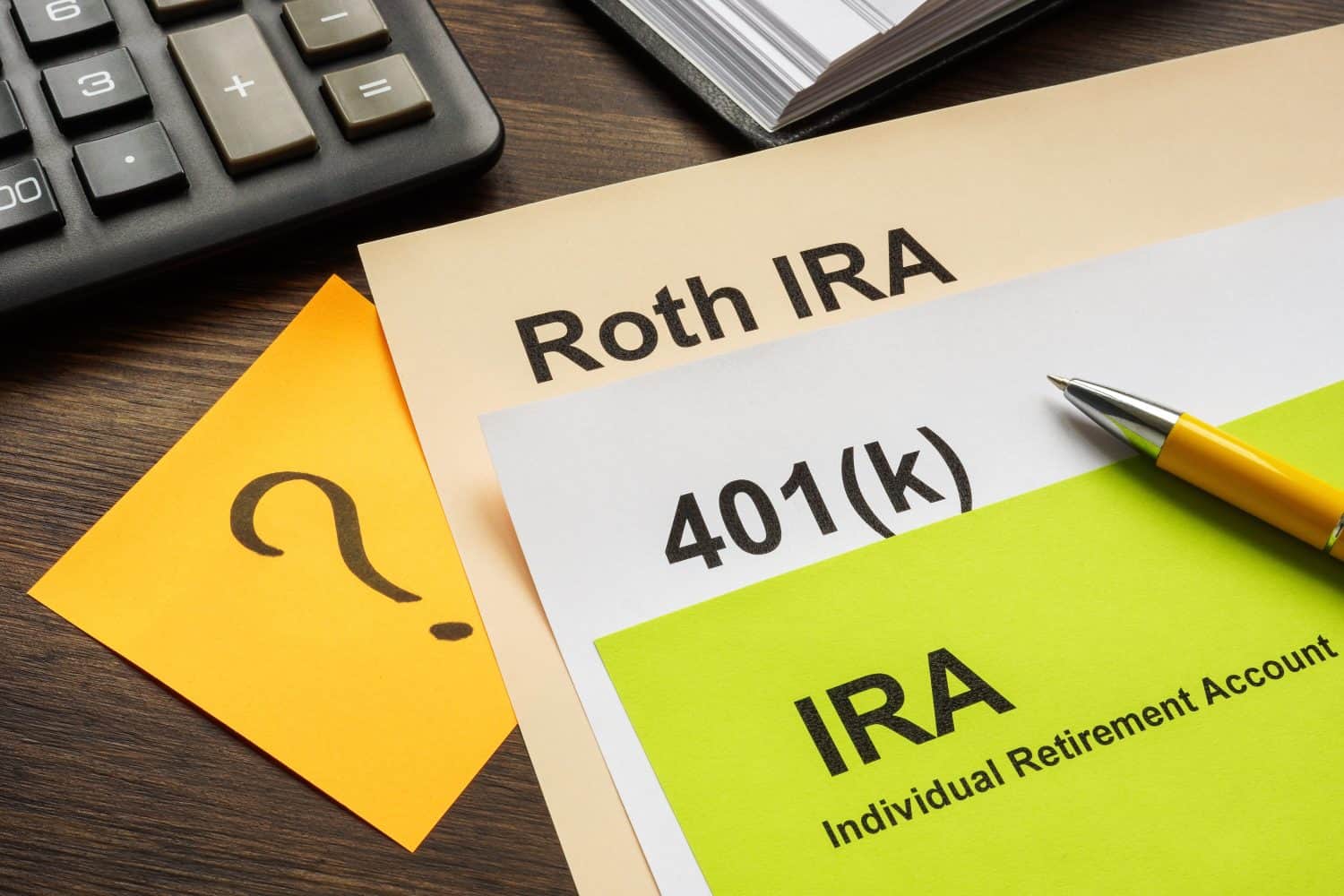
Several factors determine whether a Roth is right for you. Your current tax bracket, your preference for an upfront deduction versus tax-free withdrawals later, and your expected income in retirement all play a role. For 2026, you can contribute up to $7,500 to a Roth IRA (up from $7,000 in 2025), or $8,600 if you are age 50 or older, as long as your modified adjusted gross income falls under $153,000 for single filers or $242,000 for joint filers.
The case for a Roth has also been reinforced by recent legislation. The One Big Beautiful Bill Act, signed into law on July 4, 2025, extended the lower tax rates from the Tax Cuts and Jobs Act and added a new temporary “senior deduction” of up to $6,000 per person age 65 or older for tax years 2025 through 2028. Married couples where both spouses qualify can claim up to $12,000 combined, stacked on top of the standard deduction. The deduction phases out above $75,000 in modified AGI for single filers and $150,000 for joint filers. That said, it is important to understand that the OBBBA did not change the provisional income rules. The Social Security taxation thresholds remain frozen, and benefits can still be taxed at the 50% or 85% inclusion rates. The senior deduction reduces overall taxable income and can offset some of the tax owed, but it does not remove Social Security from the taxation framework.
Because those thresholds are not indexed to inflation, more retirees drift into taxable territory every year as COLAs lift benefit amounts and other income sources grow. A Roth strategy addresses this at the root by keeping distributions out of the provisional income calculation entirely, a structural advantage that the senior deduction does not replicate.
Ultimately, the wisest move is to speak with a financial advisor about your current income, projected retirement spending, and likely tax situation in your later years. A tax-efficient plan for most retirees will include a Roth component, both for its tax-free withdrawal benefits and for the protection it provides to the Social Security income that so many people depend on for their essential expenses.
Editor’s note: This article was updated to reflect the 2026 Roth IRA contribution limits ($7,500, or $8,600 for those 50 and older) and to incorporate post-publication context on the One Big Beautiful Bill Act’s new senior deduction of up to $6,000 per person age 65 and older for tax years 2025 through 2028, including a clarification that this law did not change the provisional income thresholds that determine how much of Social Security is subject to federal tax.
Contact [email protected] for any questions or corrections.
Christy Bieber has been a personal finance and legal writer since 2008. She has a JD from UCLA School of Law and a BA in English, Media and Communications with a certification in business from the University of Rochester.
Christy has been published by a wide variety of sites, including WSJ Buy Side, Forbes, Kiplinger, Fox Business, Credit Karma, Insurify, and Annuity.org. In addition to writing for the web, she has also ghostwritten textbooks on business and law and served as a subject matter expert for course design.