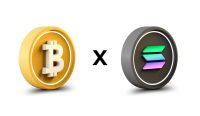
Solana Confirms a Transaction in 200 Milliseconds and Bitcoin Takes 10 Minutes. Does Speed Make a Coin Worth More?
Solana just became 3,000 times faster than Bitcoin at producing blocks, yet its coin lost nearly 8% of its value the same week. The relationship between blockchain speed and price turns out to be far more complicated than it looks.

This post may contain links from our sponsors and affiliates, and Flywheel Publishing may receive compensation for actions taken through them.

Solana (CRYPTO:SOL) has recently improved its performance by creating a new block every 200 milliseconds, compared to Bitcoin (CRYPTO:BTC), which produces a block approximately every 10 minutes. On paper, this means Solana’s block speed is about 3,000 times faster than Bitcoin’s. Bitcoin users generally wait for six confirmations, making the total wait time roughly an hour before they consider a payment secure.
Solana’s network made the switch to 200-millisecond block times on October 9, 2026. However, despite this enhancement, Solana’s price stands at around $110 as of October 10—a 7.9% decrease over the past week, making it the worst-performing major coin during that period. This raises the question: does speed truly make a coin more valuable?
Solana’s 200 Milliseconds Measures Block Speed, Not Finality

A blockchain is a shared digital ledger that groups transactions into blocks, which are added one at a time. Block time refers to how frequently new blocks are added to the chain. Solana reduced its block time step by step: from 400 milliseconds to 350 milliseconds on August 21, then to 300, 250, and finally 200 milliseconds on October 9.
However, merchants and exchanges care more than speed about finality—the point at which a payment can no longer be reversed. A block might be produced quickly, but it could still be reversible for some time. In Bitcoin’s case, each confirmation adds another block onto the one containing a transaction, making a reversal increasingly difficult with every confirmation.
Ethereum (CRYPTO:ETH) produces a block roughly every 12 seconds and reaches finality in about 13 minutes. Meanwhile, the XRP Ledger, which supports XRP (CRYPTO:XRP), completes payments in 3 to 5 seconds. Solana’s next planned update, Alpenglow, aims for finality of around 150 milliseconds, but this feature isn’t live yet.
| Network | New Block / Slot | Finality / Settlement |
|---|---|---|
| Solana | 200 milliseconds | Alpenglow target of about 150 milliseconds (not yet live) |
| Bitcoin | About 10 minutes | Six confirmations in roughly an hour |
| Ethereum | 12-second slot | About 13 minutes |
| XRP Ledger | N/A | 3 to 5 seconds |
These numbers don’t tell the whole story. Each network balances speed against costs and the number of computers required to verify each block. Satoshi Nakamoto, Bitcoin’s creator, deliberately set its 10-minute pace to give computers around the world ample time to receive and agree on each block. This slower pace reflects different priorities rather than a flaw in the system.
Solana Got Faster, but Its Price Fell 7.9% in a Week

Solana’s network officially went live with its fastest update on October 9, yet the coin’s price fell 7.9% over the past week, more than any other major coin. As the final speed upgrade date approached, holders appeared to sell off their assets.
However, looking at longer time frames is more favorable for Solana holders. The coin has appreciated by 8.7% over the past 30 days, 43% over 60 days, and 42% over 90 days. These gains include the first speed enhancement from August 21 and Solana’s September rally, which supporters may cite as evidence of the upgrade’s benefits.
On the flip side, Bitcoin has seen a 29% increase over the same 90-day span, despite not changing its block time. This suggests a broader market rally, indicating that Solana’s larger percentage gains may reflect the typical swings seen in smaller, more volatile coins during market uptrends, rather than solely its faster block production.
Currently, Solana trades about 63% below its all-time high of $293, reached in January 2025, and needs a 167% increase to regain that peak. Although the network is operating at its fastest, the coin’s price remains far below its peak.
Does Speed Make Solana More Valuable Than Bitcoin?
In conclusion, speed alone does not necessarily increase a coin’s value. Solana’s recent upgrades haven’t translated into a price increase, showing that technology improvements must attract real users and fees to boost demand.
Faster transaction speeds are an impressive technical feat and can create a competitive edge, but they don’t, by themselves, guarantee a price rise. Until Solana’s Alpenglow update is fully operational and the network attracts more users, the impact of its speed enhancements on SOL’s value remains uncertain.
The true test will be whether Solana’s fees and transaction activity increase significantly from their pre-October 9 levels once Alpenglow is live. If they do, we could see the demand for SOL reflect positively in its price.
Contact [email protected] for any questions or corrections.
Sam Daodu is a crypto analyst who's spent nearly a decade making blockchain understandable—no easy task when most whitepapers read like fever dreams. He writes for 24/7 Wall St., covering Bitcoin, altcoins, and crypto market analysis for investors. Before crypto, he was a tech writer (back when explaining "the cloud" was peak innovation). Since 2018, he's written for CoinTelegraph, Yahoo Finance, The Block, Cryptonews, Zypto, Rain, and more—basically anywhere people want crypto news without the headache. Sam runs MacLabs Marketing, a content agency for crypto brands tired of sounding like AI wrote their website. He also publishes free crypto education on his site for Web3 enthusiasts who think "gas fees" is a typo. When he's not writing or staring at charts, Sam's either: - Watching anime (currently convinced One Piece has better tokenomics than most altcoins) - At the gym sculpting himself into a Greek god - Listening to the music your mum warned you only bad boys listen to Connect: LinkedIn | Email | MacLabs Marketing