Gen X Started Saving Late: Here’s Why You Shouldn’t Beat Yourself Up About It
On a recent Catching Up to FI podcast crossover with How To Money, the hosts laid out a sobering line about Gen X savers: “40% of our population lives off of just Social Security and retirement. There’s something wrong with…

This post may contain links from our sponsors and affiliates, and Flywheel Publishing may receive compensation for actions taken through them.

On a recent Catching Up to FI podcast crossover with How To Money, the hosts laid out a sobering line about Gen X savers: “40% of our population lives off of just Social Security and retirement. There’s something wrong with that.” Their framing of Gen X as a “Rip Van Winkle generation” that slept through the pension-to-401(k) handoff is a structural diagnosis. And if you are reading this in your late 40s or 50s with a balance that embarrasses you, the diagnosis matters because it changes what you should do next.
The stakes are concrete. If you internalize shame, you freeze. If you internalize the structural story, you act. The math below shows why acting at 50 still works, and why beating yourself up costs you actual dollars.
The verdict: the hosts are right, and the numbers prove it
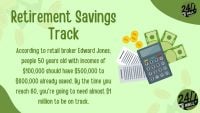
The advice to stop self-flagellating is correct because the runway for a 50-year-old is longer than shame lets you see. Fidelity’s Q3 2025 data shows the average Gen X 401(k) balance is $217,500, with an average IRA balance of $103,952. That is below the $1.57 million Gen X says they need, and 54% of Gen X doesn’t think they’ll be financially prepared for retirement. Those gaps are real. They are also closable.
Catch-up contributions under SECURE 2.0 are the mechanic. In 2026, the standard 401(k) employee cap is $24,500. Workers 50 to 59 and 64-plus can add $8,000 in catch-up contributions, for a total of $32,500. Workers ages 60 to 63 get a “super” catch-up of $11,250, bringing the total to $35,750.
Vanguard ran the comparison: Tom saves $24,500 a year starting at 50. Mike saves $32,500 a year including catch-ups. At retirement at 65, Mike has $186,208 more than Tom, assuming a 6% average annual return. That is roughly the cost of a year of long-term care, funded by the catch-up provision alone.
Now layer Social Security. Claiming at 62 cuts your benefit by up to 30% versus full retirement age. Delaying past full retirement age raises it by about 8% per year up to age 70. For a Gen X late starter, working to 67 instead of 62 and delaying Social Security can lift the monthly check by close to 70%. That increase compounds for the rest of your life.
The variable that flips the math: whether you have a Roth option at work
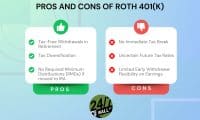
Starting this year, the catch-up rules changed for high earners. Employees 50 and older who earned more than $150,000 in 2025 must make catch-up contributions to a Roth 401(k) instead of the traditional pretax bucket. That means no upfront tax deduction on that extra $8,000 or $11,250.
The two scenarios diverge sharply. A 55-year-old in the 24% bracket making the max $8,000 catch-up used to cut their federal tax bill by about $1,900. Under the new rules, that $1,900 disappears. For a 62-year-old making the $11,250 super catch-up, the lost deduction is about $2,700. If your plan doesn’t even offer a Roth option, you cannot make catch-up contributions at all as a high earner, though roughly 96% of plans offered Roth accounts in 2024.
If you earn under the threshold, you keep the pretax deduction and the choice. The variable is binary: above $150,000 of W-2 wages, your catch-up dollars are after-tax and grow tax-free forever. Below it, you choose.
What to do this week
- Pull your W-2 Box 3 from 2025. That number determines whether your 2026 catch-up contributions must go Roth.
- Raise your contribution rate to capture catch-ups. If you are 50 or older, target $32,500. If you are 60 to 63, target $35,750. Even partial increases close the gap.
- Run your Social Security claiming scenarios at SSA.gov. Compare benefits at 62, full retirement age, and 70. The 8% per year delay credit is the highest-return move most Gen Xers ignore.
- Max your HSA if you have a high-deductible plan. Triple tax-advantaged dollars are the cleanest way to pre-fund the medical costs that eat retirement portfolios.
- Stop comparing your balance to a peer’s. Compare it to where it can be in 15 years of catch-up contributions and delayed claiming.
The hosts’ core point holds. Shame keeps you from contributing. Structure, catch-ups, and claiming strategy are what actually close the gap.
Contact [email protected] for any questions or corrections.
Don Lair writes about options income, dividend strategy, and the kind of boring-but-durable investing that actually funds retirement. He's the founder of FITools.com, an independent contributor to 24/7 Wall St., and a former writer for The Motley Fool.