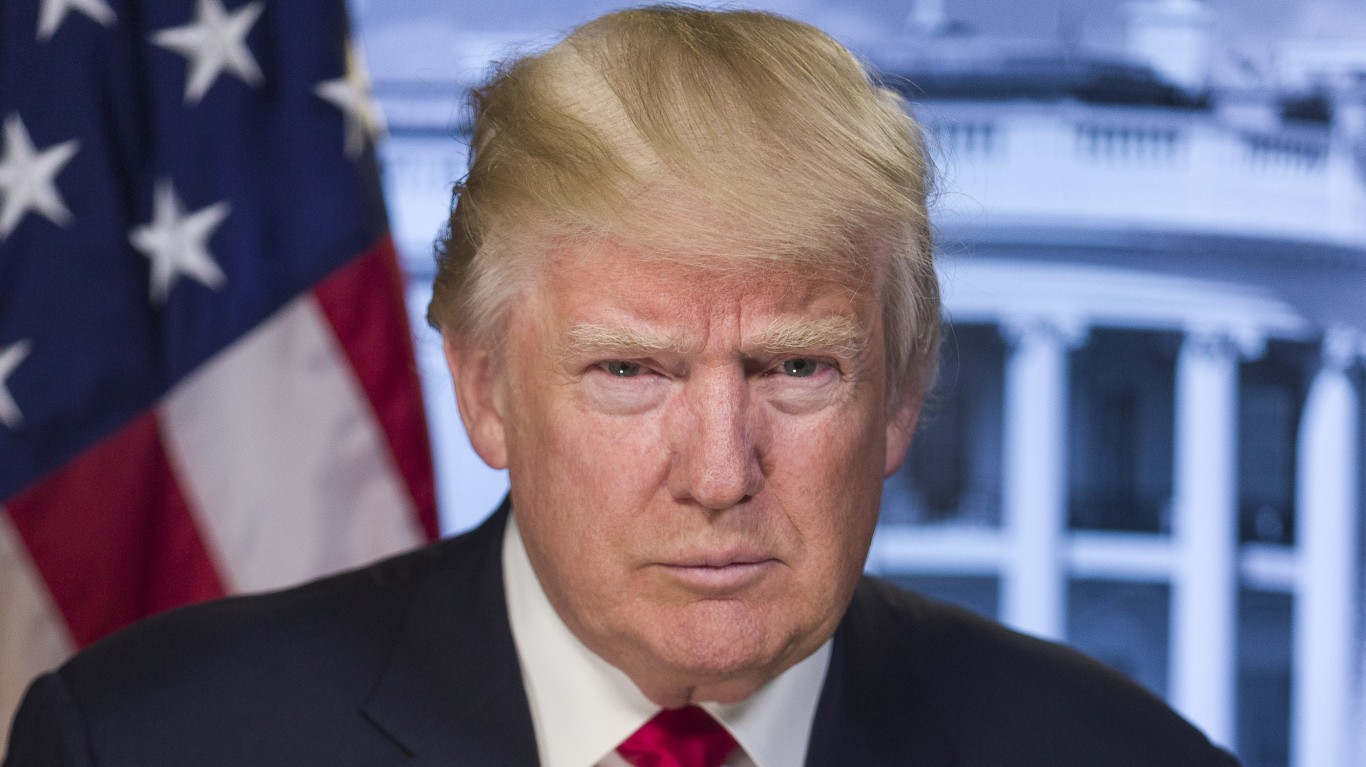
Trump Promised Not to Cut Social Security and Then Quietly Did It Anyway
In the course of his presidential campaign, Donald Trump had a lot to say about Social Security. And that makes sense, since it’s a big issue for current and future retirees alike. One thing Trump specifically pledged to do was…

This post may contain links from our sponsors and affiliates, and Flywheel Publishing may receive compensation for actions taken through them.

In the course of his presidential campaign, Donald Trump had a lot to say about Social Security. And that makes sense, since it’s a big issue for current and future retirees alike.
One thing Trump specifically pledged to do was not make cuts to Social Security. He also said he did not want current retirees paying taxes on their Social Security benefits.
Technically, Trump fell down on both promises, though. While he didn’t directly make cuts to Social Security, a key tax change on his part may have brought the program closer to insolvency. And while he tried to do away with taxes on benefits, he didn’t quite succeed there, either.
Trump’s attempt to get rid of taxes on Social Security benefits may have backfired
Many retirees feel that having their Social Security benefits taxes is unfair. And that makes sense.
The way to primarily earn Social Security is to work and pay taxes on wages. To then pay taxes on benefits feels like the IRS is double dipping.
To combat that, Trump introduced a new $6,000 senior tax deduction as part of the One Big Beautiful Bill Act that was signed into law last year. That deduction doesn’t get rid of taxes on Social Security benefits. But what it does is reduce most recipients’ income to the point where they’re exempt from paying taxes on their benefits.
But in an effort to let seniors off the hook from having their Social Security taxes, Trump may have created another big problem.
Social Security is facing solvency issues as the program’s financial obligations exceed its incoming revenue. Last year, the Social Security Trustees projected that the program’s Old-Age and Survivors Insurance (OASI) Trust Fund would only be able to pay benefits in full until 2033, at which point it was expected to run dry.
But earlier this year, the Congressional Budget Office moved up the depletion date of the OASI Trust Fund to 2032. The reason? Trump’s $6,000 senior tax deduction.
Although Social Security gets the majority of its revenue from payroll taxes, it also gets revenue as seniors pay taxes on their benefits. Now that most seniors are exempt from paying those taxes, Social Security’s revenue stream is shrinking once again. That could lead the program closer to broad benefit cuts if lawmakers don’t come up with a solution to prevent them.
Trump only solved one problem temporarily
Another issue with Trump’s approach to Social Security is that while most seniors are exempt from paying taxes on their benefits now, that’s likely to shift in a few years unless lawmakers make a major change.
Trump did not do away with taxes on Social Security benefits, and higher earners still have to pay them today. And his $6,000 senior tax deduction also expires in 2028. This means that come 2029, many more seniors are likely to find themselves being taxed on their benefits.
In other words, the $6,000 tax deduction is only a temporary reprieve. But that may be a good thing seeing as how it’s also causing more financial trouble for Social Security.
All told, it’s good to see that Trump attempted to help seniors keep more of their Social Security and that he did not directly attempt to cut benefits. But it’s going to take a huge effort on the part of lawmakers to stave off broad benefit cuts and create a system that actually gives retirees the financial support they need in the long run.
Contact [email protected] for any questions or corrections.
Maurie Backman has more than a decade of experience writing about financial topics, including retirement, investing, Social Security, and real estate. Her work has appeared on sites that include The Motley Fool, USA Today, U.S. News & World Report, The Washington Post, and Kiplinger.
Prior to becoming a full-time financial writer, Maurie worked in the financial industry trading distressed debt. She then changed course and spent a few years designing electronic toys. After a stint in content marketing and UX, she shifted back into writing and has since covered everything from the housing market to estate planning to Medicare.
When she's not busy writing, Maurie can be found hiking, walking her dogs, driving her kids to their various sports practices and games, and curling up with a good book. She cooks on occasion and bakes way too often.