73-Year-Old With $1.8M Faces $80,000 RMD That Pushes Him Into the Top Tax Bracket
A $1.8 million IRA sounds like a retirement success story until the IRS forces an $80,000 withdrawal that collides with a pension and Social Security, triggering tax consequences most retirees never see coming until it is too late to stop…

This post may contain links from our sponsors and affiliates, and Flywheel Publishing may receive compensation for actions taken through them.

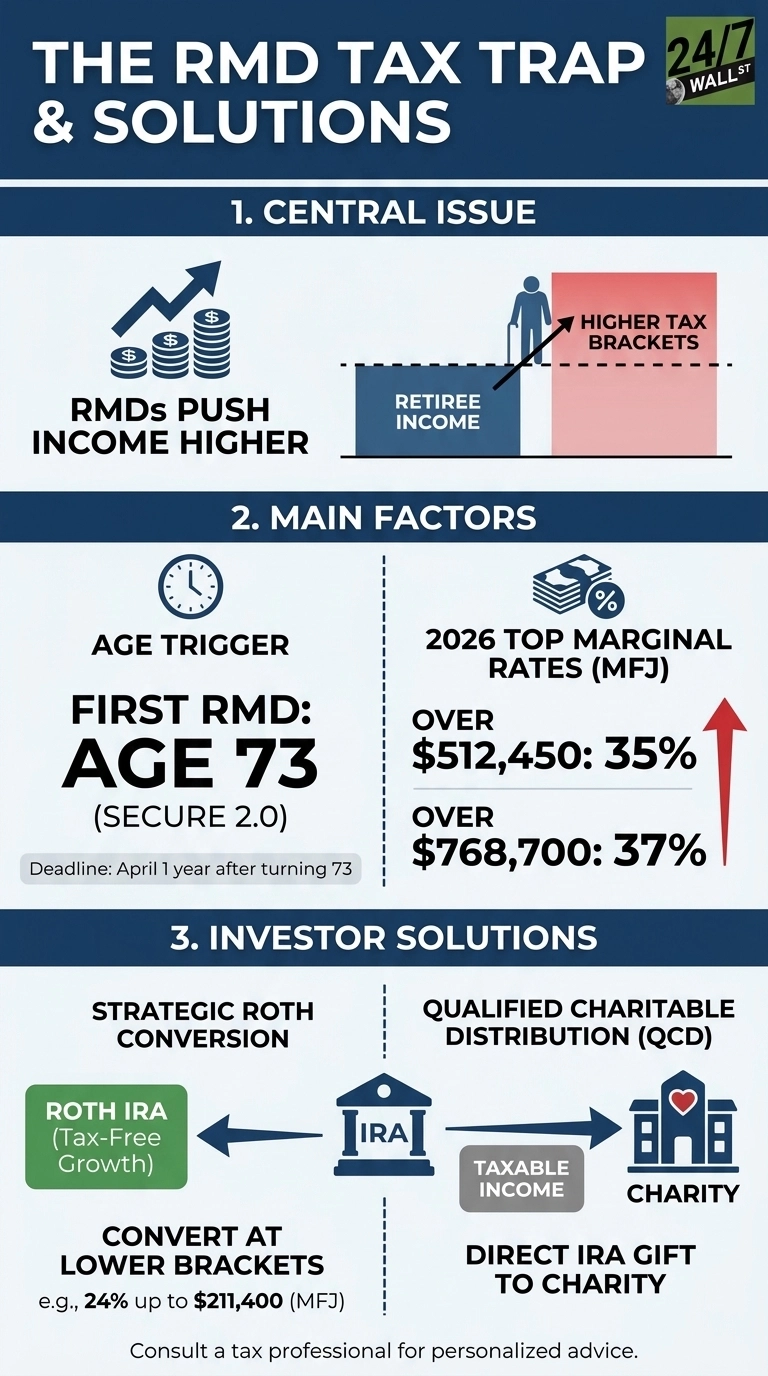
Many retirees face Required Minimum Distributions that arrive with large tax bills attached. Under SECURE 2.0, the first RMD is due by April 1 of the year after turning 73 for those born between 1951 and 1959. The statute shifts the starting age to 75 beginning January 1, 2033, for individuals born in 1960 or later.
The IRS uses the Uniform Lifetime Table to size an RMD. At age 73, the divisor is 26.5, applied to the prior year-end IRA balance. Consider a retiree with $1.8 million in retirement assets: a traditional IRA, a pension covering fixed expenses, and Social Security rounding out the income stack. His IRA closed the prior year near $2.1 million after a strong market run, producing a first RMD of roughly $80,000 when divided by that 26.5 factor.
Stack that $80,000 on top of existing income. A pension in the mid five figures plus a Social Security benefit (boosted by the 2.8% COLA for 2026) already lifts him well above the standard deduction of $32,200 for married filing jointly. The RMD lands on the last dollars earned, fills the middle brackets, and pushes the top slice into the 35% band. For a high-income household, that top layer faces the maximum federal rate, plus IRMAA surcharges on Medicare Part B and D.
Decades of tax deferral compress into non-optional income at exactly the moment he has the least flexibility to manage it. Every year he takes no action, the problem compounds.
The Roth Conversion Window He Already Missed (Partly)
The most effective lever is bracket-filled Roth conversions in the years between retirement and the first RMD. Between 63 and 72, most retirees sit in the 22% or 24% band. Converting enough IRA money each year to fill the 24% bracket, which tops out at $211,400 for married filing jointly in 2026, moves those dollars into a Roth where they grow tax-free and never trigger an RMD. Five or six years of disciplined conversions can shrink the IRA base by hundreds of thousands, dropping future RMDs enough to keep the household in the 24% bracket for good.
At age 73, that window is narrower but not closed. He can still convert IRA dollars above the RMD each year. The RMD itself cannot be rolled into a Roth, but any additional withdrawal or conversion taxed at 24% or 32% is far cheaper than letting the account compound into future distributions taxed at 35% or 37%. If future withdrawals will face a higher rate than today’s conversion rate, the Roth wins. That gap, 24% now versus 35% or 37% later, is the entire case for acting promptly.
One wrinkle worth knowing: the One Big Beautiful Bill Act, signed in 2025, created a temporary $6,000 above-the-line senior deduction for taxpayers 65 and older, available for tax years 2025 through 2028. For retirees with adjusted gross income below the phaseout threshold, that deduction can create a small amount of additional bracket room for Roth conversions each year.
Qualified Charitable Distributions
If he already gives to charity or is considering it, the Qualified Charitable Distribution is one of the most powerful tools available. A QCD sends IRA money directly to a qualifying 501(c)(3) charity, counts toward the RMD, and never enters adjusted gross income. The 2026 annual limit is $111,000 per person, up from $108,000 in 2025, because SECURE 2.0 indexes the cap to inflation. Redirecting $30,000 or $40,000 of the $80,000 RMD through QCDs shaves that same amount from taxable income, dollars that would otherwise have been taxed at 35%.
The contrast with ordinary charitable giving is stark. The standard deduction of $32,200 means most retirees no longer itemize, so a personal check written to charity produces zero federal tax benefit. A QCD delivers the full deduction economics without itemizing, and it also lowers MAGI, which directly determines Medicare IRMAA surcharges the following year. That second-order savings on premiums adds to the case for routing charitable dollars through the IRA rather than from a bank account.
What to Do First
- Model the next 10 years of RMDs, not just this one. The divisor shrinks every year, and the account balance may keep growing. A projection built on reasonable return assumptions shows the trajectory clearly. If year-10 RMDs push deeper into the 37% bracket, aggressive conversions starting now are almost certainly worth the cost.
- Set a QCD target before December. The distribution must flow directly from the IRA custodian to the charity. A check received by the account holder and then donated does not qualify, and a QCD made after December 31 cannot be credited to the current tax year.
- Avoid taking the RMD as a January lump sum with no withholding plan. Under-withholding on an $80,000 distribution can trigger safe-harbor penalties. Either withhold at the marginal rate at the source or cover the liability with quarterly estimated payments.
A fee-only advisor is worth the cost here because the sequencing of Roth conversions, QCDs, and IRMAA thresholds is a multi-year optimization requiring a view of the full income picture, not a single-year tax return fix.
Editor’s note: This article was updated to reflect the 2026 QCD annual limit of $111,000 per person (up from $108,000 in 2025, per IRS Rev. Proc. 2025-32) and to add context about the new $6,000 above-the-line senior deduction created by the One Big Beautiful Bill Act for taxpayers 65 and older in tax years 2025 through 2028.
Contact [email protected] for any questions or corrections.
Carl Sullivan has been a Flywheel Publishing contributor since 2020, focusing mostly on personal finance, investing and technology. He started his journalism career covering mutual funds, banking and financial regulation in Washington.Carl is a contributing editor at Financial Advisor Magazine and previously served as managing editor at Financial Planning Magazine. He is a long-time manager of editorial teams covering a variety of topics including news, business and politics. He’s currently the North America Managing Editor for Flipboard and worked previously for Microsoft News and Newsweek.Carl loves exploring the world and lived in India for several years. Today, he resides in New York City’s Queens borough, where you can hear hundreds of different languages just by riding the subway.