Medicare Hospice Paid for the Nurse, the Drugs, and the Hospital Bed. It Paid $0 Toward the $10,000-a-Month Nursing Home Room She Was Lying In
Families hear that hospice is covered and sign the election form with relief, then the nursing home bill arrives and nothing about the situation is what they thought it was.

This post may contain links from our sponsors and affiliates, and Flywheel Publishing may receive compensation for actions taken through them.
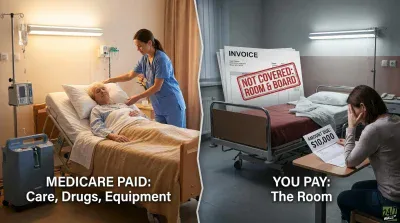
The hospice nurse came three times a week. Medicare paid. The morphine, the anti-nausea patches, the oxygen concentrator, the hospital bed rolled into the room: Medicare paid. The aide who bathed her, the chaplain who sat with the family, the social worker who explained what dying looks like: Medicare paid. Then the nursing home sent its monthly invoice for the room she was lying in, roughly $10,000, and Medicare paid nothing.
That gap is the entire story, and it blindsides families who hear “hospice is covered” and reasonably assume the bed is part of the package. It isn’t. The Medicare hospice benefit pays for care. Routine room and board in a nursing facility is housing, and Medicare treats housing as a living expense. (Our earlier piece laid out that gap in general terms. This one picks up where it stopped: what happens when the family cannot write the room check, and how Medicaid becomes the payer.)
What Medicare Hospice Actually Pays For
Electing the Medicare hospice benefit means a doctor has certified a terminal prognosis of six months or less if the illness runs its normal course, and the patient has signed a hospice election form waiving curative treatment for the terminal condition. Unrelated conditions still get regular Medicare coverage. This is not a do-not-treat order.
In exchange, Medicare covers an interdisciplinary team: physician oversight, skilled nursing visits, home health aide visits, medical social work, chaplaincy, and bereavement support for the family. It covers medications tied to the terminal diagnosis, durable medical equipment (hospital bed, wheelchair, oxygen), and medical supplies. It also covers two short-term, clinically triggered levels of care: general inpatient care for symptoms that cannot be controlled at the current setting, and respite care of up to five days at a time to give a home caregiver a break. Both are temporary. Neither is a housing solution.
Why the Room Isn’t Covered
Under Medicare, hospice is a medical benefit called “routine home care” when delivered in whatever the patient calls home. If home is a nursing facility, hospice comes to that room, but the room itself remains a residential charge. The facility keeps billing its private daily rate. Only during a general inpatient or respite stay does hospice pick up the facility charge, and those stays are short and clinical, not a way to keep a long-term resident housed.
Where Medicaid Steps In, and What the Family Has to Do
For a resident who qualifies for Medicaid long-term care, the state pays room and board while Medicare continues paying for hospice. In practice, the state’s daily room-and-board rate is usually routed through the hospice provider, which passes it to the nursing facility. A resident receiving both benefits is described as “dual eligible.”
Qualifying is never automatic on admission. The family (or an elder law attorney) files a Medicaid long-term care application with the state. The applicant must meet the state’s medical/functional criteria for nursing facility level of care, an asset test (in most states a countable-asset limit of $2,000 for a single applicant, higher for a married couple with a community spouse), and an income test that varies by state. The primary residence, one vehicle, and certain other assets are typically non-countable, though the home has its own equity cap and estate-recovery exposure.
Once eligible, almost all of the resident’s monthly income (Social Security, pension) goes to the facility as the “patient pay amount,” minus a small personal needs allowance the state sets, often between $50 and $130 a month, and an allowance for a spouse still living at home. Rules and rates are state specific: the daily Medicaid room-and-board rate a facility receives, the income cap, and the treatment of the house all vary. Confirm the numbers with the state Medicaid agency before signing anything.
Questions to Ask Before Electing Hospice in a Facility
- Who bills the room, and what is the private daily rate?
- Is a Medicaid long-term care application already pending, or does one need to be filed today?
- Who pays the room during the pending period, and will the facility accept private pay retroactively converted to Medicaid?
- What happens if Medicaid denies the application, and is there an appeal plan?
- If Medicaid approves, will room and board flow through the hospice provider, and will the family see a single statement or two?
Before signing the hospice election form in a facility, separate the two questions on paper: who pays for the care, and who pays for the bed. The first answer is usually Medicare. The second is the family’s problem until Medicaid says otherwise. (The room-and-board gap is one of several Medicare surprises we mapped in a free guide to Medicare’s hidden bills, from IRMAA surcharges to the coverage holes families only find at the worst possible moment.)
Contact [email protected] for any questions or corrections.
Jake has been been working in financial media for almost 15 years. He focuses on all things personal finance for 24/7 Wall St. with high hopes to educate and entertain. Most recently, Jake spent 12 years working various roles at The Motley Fool. He started copy editing fool.com content, worked on premium and marketing campaigns, and helped launch The Ascent, a personal finance brand.
His work has been featured on platforms like MSN, Yahoo Finance, USA Today, and more. He's written about credit cards, social security, ETFs, savings accounts, and just about anything else you can imagine when thinking about money. Jake love to cook, play golf, and tell people he's never had a cavity. (It's true!)