How to Build $9,150 a Month in Dividend Income Without Selling a Single Share
The yield you choose determines whether you need $900,000 or over $3 million to hit the same income target, and picking the wrong tier can leave your purchasing power shrinking every year even while the checks keep arriving.


Building $9,150 a month in dividend income means earning $109,800 a year while leaving every share in place. For a married couple filing jointly, that much taxable income falls in the 22% federal bracket, which starts at $100,800 for 2026. How much capital it takes depends on the yield you accept, and each yield level comes with its own risks. Divide the income target by the yield to find the capital needed.
Paying for Safety With Over $3 Million
A conservative portfolio yields about 3% to 4%, which is typical for dividend growth funds and broad high-dividend baskets. At 3.5%, $109,800 divided by 0.035 equals roughly $3,137,000. At 4%, the figure falls to $2,745,000. At 3%, it grows to $3,660,000.
One strong holding at this level is the iShares Core High Dividend ETF (NYSEARCA:HDV), which charges a 0.08% expense ratio and is up about 150% over 10 years. Its quarterly payouts vary, so check the current yield before planning around it. This level requires the most capital but carries the lowest risk of income loss.
Cutting the Capital Bill Nearly in Half at 5% to 7%
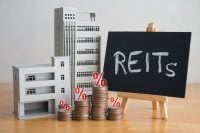
REITs, preferred shares, covered call funds, and high-dividend equity funds usually yield 5% to 7%. At 6%, $109,800 divided by 0.06 equals $1,830,000. For example, W. P. Carey (NYSE:WPC) pays a forward dividend of $3.80 on a stock near $66, a yield of about 5.7%. At that rate, you would need roughly $1,910,000. Since late 2023, the quarterly payout has grown from $0.86 to $0.95. Occupancy is 99%, and 48% of base rent is linked to CPI increases.
That history includes a cut. Quarterly payments ranged from $1.055 to $1.065 in 2022 before the reset. REIT dividends are mostly taxed as ordinary income.
Reaching Six-Figure Income on Under $1 Million
At 12%, $109,800 divided by 0.12 equals $915,000. Business development companies, mortgage REITs, and leveraged covered call funds sit in the 8% to 14% range.
Hercules Capital (NYSE:HTGC) pays $1.88 a year on a price near $17, about 11.1% yield, requiring roughly $989,000 in capital. Net investment income covered 125% of the base distribution last quarter. Non-accrual loans rose from 1 to 2, and the stock trades about 40% above its $12.15 net asset value. The payout has held at $0.47 for seven straight quarters.
Why the Smaller Yield Can Overtake the Bigger One
Say the $3,137,000 portfolio yielding 3.5% raises its dividends 8% a year. By year 10, it pays about $219,500, while a $915,000 portfolio yielding 12% with no dividend growth still pays $109,800, and inflation reduces what that money buys every year.
The lower-yield investor needs more capital upfront but gets income that roughly doubles over time, plus principal growth. That is the whole case for a dividend ladder built to never touch the shares, which we walked through step by step in a free guide here.
A Six-Fund Blend That Mixes All Three Tiers
One model breaks $1,830,000 this way:
- 20% in HDV and 20% in JPMorgan Nasdaq Equity Premium Income ETF (NASDAQ:JEPQ), about $366,000 each. HDV adds dividend growth, and JEPQ earns option premium by selling calls on Nasdaq stocks.
- 15% each in WPC and HTGC, about $274,500 apiece. WPC provides rent that is linked to inflation, and HTGC provides floating-rate venture debt income.
- 15% in Global X S&P 500 Covered Call ETF (NYSEARCA:XYLD), which trades away most of its upside for monthly premium income.
- 15% in Janus Henderson AAA CLO ETF (NYSEARCA:JAAA), which holds AAA-rated floating-rate loan securities and steadies the rest of the mix.
The blended yield shifts as each fund’s distribution rate changes. Check current rates before sizing positions.
Three Moves Before You Commit Capital
- Start with what you actually spend after taxes. Most REIT and BDC income is taxed at ordinary rates, while qualified dividends from funds like HDV are taxed at lower rates. Joint filers also get a $32,200 standard deduction for 2026.
- Before buying HTGC or any BDC, look up its net investment income coverage, non-accrual loans, and premium to net asset value in the latest quarterly report.
- Put the 10-year total returns of a 3.5% dividend growth fund and an 11% BDC side by side, including reinvested payouts and price changes. That shows how much principal each level kept.
Contact [email protected] for any questions or corrections.
David Beren has been a Flywheel Publishing contributor since 2022. Writing for 24/7 Wall St. since 2023, David loves to write about topics of all shapes and sizes. As a technology expert, David focuses heavily on consumer electronics brands, automobiles, and general technology. He has previously written for LifeWire, formerly About.com. As a part-time freelance writer, David’s “day job” has been working on and leading social media for multiple Fortune 100 brands. David loves the flexibility of this field and its ability to reach customers exactly where they like to spend their time. Additionally, David previously published his own blog, TmoNews.com, which reached 3 million readers in its first year. In addition to freelance and social media work, David loves to spend time with his family and children and relive the glory days of video game consoles by playing any retro game console he can get his hands on.