They’ll Lend Their Son $100,000 for the Down Payment at No Interest. Everyone Says the IRS Requires It. Because He Has No Investments of His Own, the IRS Won’t Tax Them on a Dollar, and the House Will Be His

This post may contain links from our sponsors and affiliates, and Flywheel Publishing may receive compensation for actions taken through them.
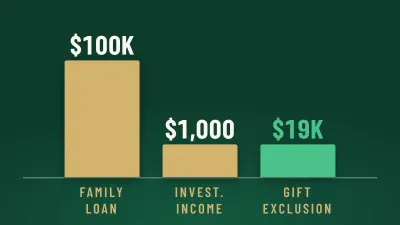
A son finds a house he wants to buy, and his parents decide to lend him $100,000[1] toward the down payment without charging interest. Then a friend tells them the IRS requires family loans to carry interest at the applicable federal rate, and a simple wish to help starts to look like a tax mess.
Anyone who has been told they have to charge their kids interest on a family loan may have heard only half the rule. The tax code has an exception for gift loans of $100,000 or less, and a borrower with almost no investment income meets it.
How a Zero-Interest Family Loan Can Leave No Taxable Interest
When a loan charges less than the applicable federal rate (AFR), the IRS normally treats the lender as if it collected the missing interest anyway. That amount is called forgone interest. The IRS treats it as passing from parent to child and then back to the parent as interest, and the parent reports it as income.
For a gift loan made directly between individuals, though, the amount treated as paid back to the lender each year can’t exceed the borrower’s net investment income for that year. If the borrower’s net investment income is $1,000[1] or less, it’s treated as zero. A son with no investments has no net investment income, so the parents have no imputed interest to report for income tax.
Where the Rule Sits in the Tax Code
The general rule is 26 U.S.C. § 7872(a)[1]. It treats forgone interest as transferred to the borrower and paid back as interest on the last day of each calendar year. The exception is § 7872(d)(1)(A)[1], which caps that amount at the borrower’s net investment income, and § 7872(d)(1)(E)(ii) sets the de minimis threshold. IRS Publication 550 lays out the default treatment, noting that “The lender must report that amount as interest income.”
Who Qualifies and Who Gets Left Out
The limit covers gift loans between individuals, meaning loans where skipping the interest is essentially a gift. It applies only on days when the total outstanding balance of loans between borrower and lender is $100,000[1] or less.
If a second loan, even a small one, pushes the total past the cap, the protection is lost for every day the balance stays above it. The limit also doesn’t apply if avoiding federal tax is one of the main purposes of the interest agreement. The test runs year by year. If a son later builds a brokerage account earning more than $1,000, the imputed interest would be brought back up to the amount of that income.
Setting Up the Loan So It Holds Up
- Keep all loans between the parents and the son at or below $100,000[1] combined at all times.
- Sign a promissory note with a repayment schedule so the money is recorded as a loan.
- Check the son’s net investment income each year, since the threshold resets every year.
- If the parents charge some interest and want the son to deduct it, record the note as a mortgage on the house. IRS Publication 936 allows the deduction only on a secured debt that is recorded or otherwise perfected under state or local law.
- Look up the current AFR, which the IRS releases monthly. For context, Treasury yields on November 17, 2026 ran from 4.09% at one month to 5.46% at 30 years.
Gift Tax Still Counts the Interest Nobody Charged
The § 7872(d)(1)[1] limit applies only to income tax. For gift tax, the forgone interest still counts as a gift from the parents to their son. On a demand loan, the gift is measured each year. On a term loan with a fixed payoff date, § 7872(d)(2)[1] treats the gap between the loan amount and the present value of the scheduled payments as a gift on the day the loan is made. That upfront gift can be much larger than one year of interest.
For 2026, the annual gift tax exclusion is $19,000 per recipient from each donor, and the lifetime basic exclusion is $15,000,000. Giving more than the annual exclusion to one person in a year means filing a gift tax return, and the excess counts against the lifetime amount.
Ultimately, the son owns the house and owes his parents the loan. As long as the note is signed, the son’s investment income stays at or below $1,000[1], and the balance never tops $100,000, the parents owe no income tax on interest they never charged. The gift tax side still needs tracking.
Contact [email protected] for any questions or corrections.
David Beren has been a Flywheel Publishing contributor since 2022. Writing for 24/7 Wall St. since 2023, David loves to write about topics of all shapes and sizes. As a technology expert, David focuses heavily on consumer electronics brands, automobiles, and general technology. He has previously written for LifeWire, formerly About.com. As a part-time freelance writer, David’s “day job” has been working on and leading social media for multiple Fortune 100 brands. David loves the flexibility of this field and its ability to reach customers exactly where they like to spend their time. Additionally, David previously published his own blog, TmoNews.com, which reached 3 million readers in its first year. In addition to freelance and social media work, David loves to spend time with his family and children and relive the glory days of video game consoles by playing any retro game console he can get his hands on.