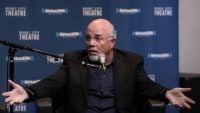
Rachel Cruze Says Debt Adds a Risk You Can’t Put Into a Spreadsheet

This post may contain links from our sponsors and affiliates, and Flywheel Publishing may receive compensation for actions taken through them.

Rachel Cruze made a point about loans. On the Nov. 19, 2026 episode of The Ramsey Show, titled Debt Turns Your Life Into a House of Cards, co-host she argued that every loan carries a cost the loan calculator leaves out:
“When you do take on debt, you add on a level of risk that cannot be calculated. You can talk interest rates all day long, but you can’t put that into an Excel form.”
Nobody can predict a job loss, an illness, or a family emergency, and debt payments keep coming when one hits. That matters most for people at or near retirement, because they no longer have a paycheck to absorb a surprise.
More people are carrying debt into retirement. Households headed by someone 70 or older held 11%[1] of all U.S. household liabilities in the second quarter of 2026. That figure comes from Federal Reserve distributional data. In 1989, that share was 3%[1].
Cruze Gets the Conclusion Right and Undersells the Spreadsheet
For retirees, her conclusion is correct. She goes too far when she says the risk can’t be modeled, but a stress test shows what happens when an emergency hits, and that test supports her case.
Consider a hypothetical couple, age 66, with $4,500 a month in fixed income from Social Security and a pension. They have a car loan and a credit card balance that together cost $900 a month. That means 20% of their income is spoken for before they pay for food, insurance, or prescription drugs.
Now suppose a roof repair costs them $8,000, and they have no cash set aside. The bill goes on a card. In August 2026, the average credit card APR was 21%[2], a record for that measure.
If they pay $200 a month, the balance takes 70 months to clear and costs $6,000 in interest. A single repair becomes a six-year bill.
Next, add a market drop. Suppose the couple covers those debt payments from savings, which takes $10,800 a year. After a 20% decline, raising that money means selling shares that were worth $13,500 before the crash. That’s $2,700 of pre-crash value they’ll never get back. A debt-free couple could stop withdrawals until prices recover, while a couple with debt pays on the lender’s schedule.
People do fall behind. In the second quarter of 2026, 3%[3] of credit card balances at commercial banks were at least 30 days past due.
Your Interest Rate Decides What to Pay Off First
The usual pushback is that low-rate debt can cost less than selling investments to pay it off. That math holds up. A $10,000 balance on a 3.5% mortgage costs $350 a year in interest. The same balance at the average card rate costs $2,119.
Selling taxable investments to pay off a cheap mortgage can also trigger capital gains tax, and you give up whatever those investments would have earned. So attack the higher-rate debt first. Even so, a 3.5% mortgage payment is due every month, including months when the market is down. With low-rate debt, manage risk by keeping a cash reserve. Early payoff is optional.
Four Ways to Lower Your Debt Risk Before Your Last Paycheck
- Run your own stress test. Add up every fixed debt payment and divide the total by the income you’re guaranteed in retirement. Then test two bad events: a surprise bill of several thousand dollars and a 20% market decline. If either one forces you onto a credit card or into selling investments at a loss, you’ve found the risk Cruze is describing.
- Pay off debt in order of interest rate. Write down what you owe, from highest APR to lowest. A balance near the 21%[2] average card rate goes first, because no conservative investment reliably earns that much.
- Build a cash reserve that matches your debt payments. For the couple above, six months of payments comes to $5,400. Hold that money in cash, separate from the investments you plan to draw on, so a bad market never forces you to sell to pay a lender.
- Avoid new loans in the years right before retirement. A five-year car loan signed at 63 keeps charging you after your last paycheck. If possible, buy the car with cash while you’re still working.
What you can control is deciding ahead of time how many fixed payments an emergency will run into.
Contact [email protected] for any questions or corrections.
Chris Lange is a financial and geopolitical writer with more than a decade of experience covering a myriad of topics. He has published thousands of articles for 24/7 Wall St., with past coverage focused heavily on stocks, IPOs, healthcare, defense, global affairs, and technology.
His work has been quoted, or referenced by a number of outlets including Business Insider, USA Today, Yahoo Finance, MSN, The Motley Fool, and many other publications. A graduate of Southwestern University, he studied business with a focus on investments and has previous experience in banking and startups.
When not reading or writing the news, he is following his passion for Lacrosse, playing chess, or building solar projects with his dad.