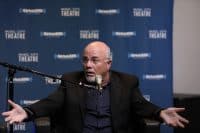
John Delony Says You Need an Enemy to Get Out of Debt. Here’s What He Means

This post may contain links from our sponsors and affiliates, and Flywheel Publishing may receive compensation for actions taken through them.

A $15,000 credit card balance at the latest average card rate costs about $265 in interest every month, and that comes due before a dime of principal goes away. That number is exactly what John Delony wants people to get angry about. On The Ramsey Show on November 20, 2026, a listener asked how to stop dipping into savings and stick to a debt payoff plan. His answer was blunt: “You have to have an enemy to fight… get out of debt, and go live your life.”
The stakes are highest for anyone near retirement. If you carry a balance into a fixed income, the interest bill keeps coming after the paychecks stop.
Why Delony’s Anger Strategy Holds Up Under the Math
Delony is right, and the reason is mechanical. When debt feels like a background bill, you pay the minimum. When it feels like an opponent, it gets every extra dollar. The size of that payment determines how much you lose to interest.
The Federal Reserve’s G.19 data put the average credit card APR at 21%[1] in August 2026. That places card rates in record territory for the period since 2023.
Here is a simple example. Take a $15,000 balance at that rate and pay $350 a month. It takes about 81 months to clear it, and total interest comes to roughly $13,269. That is almost as much as the original balance.
Now pick a fight. Cut spending and send that cash to the card until the payment reaches $850 a month. The balance is gone in about 21 months. Total interest falls to roughly $3,133. In this example, getting angry saves about $10,137.
Interest Rates Decide Which Debt to Attack First
Once you’ve chosen to fight, you need a plan. Two methods dominate. The snowball method pays off the smallest balance first, so you get quick wins. The avalanche method pays off the highest interest rate first, which keeps total cost as low as possible.
What determines which works best is how far apart your rates are. Say you owe a $2,500 medical bill at 0% and $9,000 on a card at 21%[1] (simple figures).
The snowball method tells you to clear the medical bill first. While you do, the card keeps adding about $159 a month in interest.
If all your debts carry similar rates, the snowball’s motivation boost costs almost nothing. If the rates are far apart, the avalanche saves real money. Delony’s point about emotion still matters here. A plan you quit in month four loses to a plan you finish, so choose the one you will stick with and know what it costs.
Debt Payments Hit Harder on a Fixed Income
Older families carry more debt than they did in the past. Fed Distributional Financial Accounts data show Americans 70 and older held about $2.3 trillion[2] in liabilities in 2026 Q2. That was 11%[2] of all families’ debt.
In 1989[2], the same age group held just 3%. Families aged 55 to 69 added roughly $5 trillion[2] more, which means a lot of people are heading into retirement with balances still open.
In retirement, withdrawals have to cover every debt payment. Under the common 4% withdrawal rule, a $350 monthly card payment takes about $105,000 in savings to keep up. That money pays off old balances when it could be paying for groceries, healthcare, or travel.
A Four-Step Framework for Fighting Back
- List every debt. Write down the balance, interest rate, and minimum payment for each card, loan, and medical bill. Once everything is in one place, a vague worry becomes a specific opponent with a known size.
- Choose your method based on rate spread. If your rates are within a few points of each other, the snowball’s quick wins can keep you going. If one balance is near the 21%[1] card average while others are far lower, the avalanche goes after the debt that costs you the most.
- Cut spending to free up cash. In the example above, an extra $500 a month turned an 81-month slog into a 21-month sprint. Go line by line through three months of bank statements and cut every recurring charge you can.
- Stop adding new debt. Put card spending on hold while you pay balances down. Keep a small cash cushion so a surprise bill doesn’t go straight back on the card, since that loop is what keeps people stuck.
Debt you ignore keeps compounding at 21%[1], and the move that works is to make a bigger payment and keep it up until the balance hits zero.
Contact [email protected] for any questions or corrections.
Chris Lange is a financial and geopolitical writer with more than a decade of experience covering a myriad of topics. He has published thousands of articles for 24/7 Wall St., with past coverage focused heavily on stocks, IPOs, healthcare, defense, global affairs, and technology.
His work has been quoted, or referenced by a number of outlets including Business Insider, USA Today, Yahoo Finance, MSN, The Motley Fool, and many other publications. A graduate of Southwestern University, he studied business with a focus on investments and has previous experience in banking and startups.
When not reading or writing the news, he is following his passion for Lacrosse, playing chess, or building solar projects with his dad.